Species · Reptiles
Diamond-backed Watersnake Nerodia rhombifer
The scientific name of the Diamond-backed Watersnake is Nerodia rhombifer. It is a species of reptile in the family Colubridae (colubrid), order Squamata. The name dates from 1852.
- Scientific name
- Nerodia rhombifer (Hallowell, 1852)
- Common name
- Diamond-backed Watersnake
- Genus
- Nerodia
- Family
- Colubridae (Colubrid)
- Order
- Squamata
- Class
- Reptilia
- Red List category
- LC Least Concern
- Environment
- freshwater
- Recorded in
- 3 countries
- Name status
- accepted in the Catalogue of Life

Overview
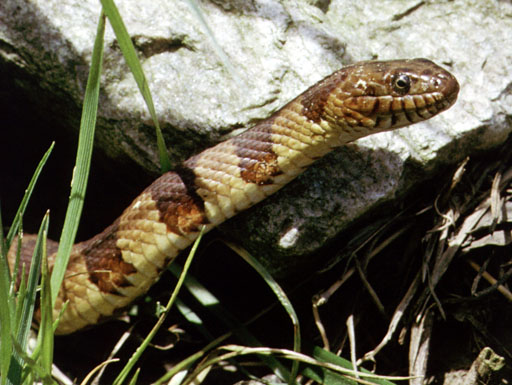
The native range includes the central United States and northern Mexico. It typically has a brown, dark brown, or dark olive-green body with a black net-like dorsal pattern of vaguely diamond-shaped spots.
Written 26 November 2026 from the sources listed below. Each statement was checked against the passage it cites; statements that could not be supported were removed.
Appearance
The body is typically brown, dark brown, or dark olive-green, with a black net-like dorsal pattern composed of vaguely diamond-shaped spots. The underside is generally yellow or light brown and often has black blotches.[1][2]
The dorsal scales are strongly keeled, giving the snake a rough texture. It usually has 25 or 27 dorsal scale rows at midbody.[3][4]
Adult males possess multiple papillae on the underside of the chin. Newborn individuals are often lighter in color than adults, making their patterns more conspicuous.[5][6]
The species also has a light grayish-brown body with a dark chain-like pattern extending along its length. Its belly is yellowish and marked with dark half-moons.[7][8]
The dorsal pattern consists of central dark blotches connected to alternating lateral blotches by short diagonal lines.[9]
Habitat
The Diamond-backed Watersnake is commonly found near slow-moving streams, rivers, ponds, and swamps. Across other parts of its range, it occupies a wide variety of freshwater habitats.[10][11]
The species prefers aquatic habitats with overhanging vegetation.[12]
Diet
The Diamond-backed Watersnake primarily consumes fish, with fish accounting for up to 98.5% of ingested food volume in the cited dietary study. It also feeds on frogs and eats almost exclusively freshwater fishes and frogs.[13][14]
The species captures prey with its jaws, subdues it, and swallows it without constriction.[15]
Behaviour
When foraging, individuals may hang from branches over water and dip their heads beneath the surface while searching for prey. They also frequently bask on branches over water.[16][17]
When approached, individuals typically escape by dropping into the water, diving, and swimming away.[17][18]
When threatened, individuals may hiss and flatten their heads and bodies to appear larger. They may bite when grabbed or pinned and release foul-smelling musk from glands near the tail.[19][20]
Biting is primarily a defensive response to intentional disturbance or handling. The species is typically nocturnal but may become more active during daylight in spring and autumn.[21][22]
The species is not considered venomous.[23]
Reproduction and life cycle
The Diamond-backed Watersnake is ovoviviparous. Adults breed during spring, and females give birth in late summer or early autumn.[24][25]
Newborn individuals measure approximately 20–25 cm in length. Females in other parts of the species' range typically give birth to 8–62 young between August and September.[26][27]
Interbreeding with other water snake species whose ranges overlap is not known.[28]
Conservation
The species is not classified as endangered or threatened in the first document. Human persecution resulting from mistaken identification as venomous snakes is identified as its main threat.[29][30]
Similar species
The Diamond-backed Watersnake is frequently mistaken for the venomous cottonmouth because of its defensive behaviour and overlapping habitat. It may also be mistaken for rattlesnakes because of its brown or tan coloration and diamond-shaped pattern.[31][32]
Uses
The species is frequently kept in captivity in states where keeping native reptiles is legal, although its pet-trade market value is low. Captive individuals may become docile with regular handling.[33][34]
Classification of the Diamond-backed Watersnake
| Kingdom | Animalia |
|---|---|
| Phylum | Chordata |
| Subphylum | Vertebrata |
| Infraphylum | Gnathostomata |
| Parvphylum | Osteichthyes |
| Megaclass | Tetrapoda |
| Class | Reptilia (Reptile) |
| Order | Squamata (Snakes) |
| Suborder | Serpentes (Snakes) |
| Infraorder | Alethinophidia |
| Family | Colubridae (Colubrid) |
| Subfamily | Natricinae |
| Genus | Nerodia (Water Snakes) |
| Species | Nerodia rhombifer (Hallowell, 1852) |
Where the Diamond-backed Watersnake is found
Checklists and occurrence records place Nerodia rhombifer in 3 countries across North America. GBIF holds 20,916 georeferenced records of it.
Countries
Regions and cities with the most records
- Texas, United States 8,386
- Arkansas, United States 3,429
- Oklahoma, United States 1,100
- Louisiana, United States 996
- Cabot, United States 823
- Frisco, United States 504
- San Antonio, United States 473
- Grapevine, United States 469
- Highland Village, United States 458
- Addison, United States 455
- Kansas, United States 448
- Jacksonville, United States 435
- Sugar Land, United States 434
- Lewisville, United States 423
- Pecan Grove, United States 423
- Farmers Branch, United States 421
- The Colony, United States 406
- New Territory, United States 401
- Corinth, United States 394
- Little Elm, United States 393
- Carrollton, United States 391
- The Trails of Frisco, United States 366
- Flower Mound, United States 363
- Coppell, United States 361
- Plano, United States 361
- Austin, United States 346
- Southlake, United States 332
- Allen, United States 321
- Stafford, United States 319
- Mississippi, United States 314
- Missouri City, United States 310
- Mission Bend, United States 302
- Murphy, United States 302
- Converse, United States 292
- Round Rock, United States 291
- Haltom City, United States 289
Range as the checklists state it
USA (Texas, Oklahoma, Kansas, Louisiana, Arkansas, Missouri, Illinois, Iowa, SW Indiana, W Tennessee, Mississippi, Alabama, Nebraska),
A number beside a place is its count of GBIF occurrence records. A place without a number comes from a checklist alone. Records show where a species has been observed or collected, which can include escapes and vagrants.
Common names
English
- Diamond-backed Watersnake
- Diamondback Water Snake
Names in 6 other languages
- Chinese
- 菱斑水蛇
- Danish
- Nordamerikansk Rudesnog
- German
- Diamant Wassernatter, Rauten-Schwimmnatter
- Portuguese
- Cobra-d'água-diamante
- Russian
- Американский ромбический уж
- Spanish
- Culebra De Agua De Diamantes, Culebra de Agua de Diamantada, Culebra de agua de espalda de diamantes, Culebra-de agua de diamantes
Synonyms
6 other scientific names have been used for this species and are now treated as synonyms of Nerodia rhombifer.
- Natrix rhombifer (Hallowell, 1852)
- Natrix rhombifera Cope, 1889
- Natrix rhombifera blanchardi Clay, 1938
- Natrix rhombifera werleri Conant, 1953
- Nerodia holbrookii Baird & Girard, 1853
- Tropidonotus rhombifera Hallowell, 1852
Subspecies and varieties
- Nerodia rhombifer blanchardi subspecies
- Nerodia rhombifer rhombifer (Diamondback Water Snake) subspecies
- Nerodia rhombifer werleri subspecies
Related species
-
 Common WatersnakeNerodia sipedon
-
 Banded Water SnakeNerodia fasciata
-
 Plain-bellied Water SnakeNerodia erythrogaster
-
 Green Water SnakeNerodia cyclopion
-
 Salt Marsh SnakeNerodia clarkii
-
 Brown Water SnakeNerodia taxispilota
-
 Florida Green Water SnakeNerodia floridana
- Concho Water SnakeNerodia paucimaculata
Compare
Questions and answers
What is the scientific name of the Diamond-backed Watersnake?
The scientific name of the Diamond-backed Watersnake is Nerodia rhombifer. Written with its author, the full name is Nerodia rhombifer (Hallowell, 1852).
Which family does the Diamond-backed Watersnake belong to?
Nerodia rhombifer belongs to the family Colubridae, in the order Squamata and the class Reptilia.
Where is the Diamond-backed Watersnake found?
Checklists and occurrence records place Nerodia rhombifer in 3 countries: United States, Mexico and Canada.
What is the conservation status of the Diamond-backed Watersnake?
The IUCN Red List category recorded for Nerodia rhombifer is Least Concern (LC).
What other names does the Diamond-backed Watersnake have?
Nerodia rhombifer is also known in English as Diamondback Water Snake.
How poisonous is a diamondback water snake?
The Diamond-backed Watersnake is not considered venomous.[23]
How big is a diamond-backed watersnake?
Adult individuals typically measure 76–122 cm in total length. The maximum recorded total length is 180 cm.[35][36]
Is a diamondback a water moccasin?
The Diamond-backed Watersnake is frequently mistaken for the venomous cottonmouth, also called a water moccasin. The Diamond-backed Watersnake is not considered venomous.[23][31]
Is there a such thing as a diamondback water snake?
Yes. Nerodia rhombifer is a recognized species first described under the name Tropidonotus rhombifer in 1852.[37]
What do diamondback water snakes eat?
They primarily eat fish and also feed on frogs. Fish can account for up to 98.5% of ingested food volume in the cited dietary study.[13][14]
What is the diet of a water snake?
The Diamond-backed Watersnake feeds almost exclusively on freshwater fishes and frogs. It captures prey with its jaws, subdues it, and swallows it without constriction.[14][15]
What is the habitat of a water snake?
The Diamond-backed Watersnake commonly inhabits areas near slow-moving streams, rivers, ponds, and swamps. It prefers aquatic habitats with overhanging vegetation.[10][12]
Where do diamondback water snakes live?
The native range includes the central United States and northern Mexico. In the United States, the species occurs in Texas, Oklahoma, Kansas, Iowa, Louisiana, Arkansas, Missouri, Illinois, Indiana, Tennessee, Mississippi, Georgia, and Alabama. In Mexico, it occurs in Coahuila, Nuevo León, Tamaulipas, and Veracruz.[38][39][40]
Sources
Passages the profile rests on
- The species typically has a brown, dark brown, or dark olive-green body with a black net-like dorsal pattern composed of vaguely diamond-shaped spots. Source passage: “predominantly brown, dark brown, or dark olive green in color, with a black net-like pattern along the back, with each spot being vaguely diamond-shaped.” — English Wikipedia
- The underside is generally yellow or light brown and often has black blotches. Source passage: “The underside is generally a yellow or lighter brown color, often with black blotching.” — English Wikipedia
- The dorsal scales are strongly keeled, giving the snake a rough texture. Source passage: “The dorsal scales are heavily keeled, giving the snake a rough texture.” — English Wikipedia
- The species usually has 25 or 27 dorsal scale rows at midbody. Source passage: “The dorsal scales are arranged in 25 or 27 rows at midbody.” — English Wikipedia
- Adult males possess multiple papillae on the underside of the chin. Source passage: “Adult males have multiple papillae (tubercles) on the under surface of the chin” — English Wikipedia
- Newborn individuals are often lighter in color than adults, making their patterns more conspicuous. Source passage: “Neonates are often lighter in color, making their patterns more pronounced, and they darken with age.” — English Wikipedia
- The species has a light grayish-brown body with a dark chain-like pattern extending along its length. Source passage: “These stout-bodied snakes are light grayish-brown with a dark chain-like pattern down the entire body.” — floridamuseum.ufl.edu
- The belly is yellowish and marked with dark half-moons. Source passage: “The belly is yellowish with dark half-moons.” — floridamuseum.ufl.edu
- The dorsal pattern consists of central dark blotches connected to alternating lateral blotches by short diagonal lines. Source passage: “dark blotches running down the middle of the back that are connected to the alternating rows of dark blotches running down the sides by short diagonal lines.” — floridamuseum.ufl.edu
- The species is commonly found near slow-moving streams, rivers, ponds, and swamps. Source passage: “It is found predominantly near slow-moving bodies of water such as streams, rivers, ponds, or swamps.” — English Wikipedia
- Across other parts of its range, the species occupies a wide variety of freshwater habitats. Source passage: “In other parts of their range, Diamond-backed Watersnakes can be found in a wide variety of freshwater habitats.” — floridamuseum.ufl.edu
- The species prefers aquatic habitats with overhanging vegetation. Source passage: “However, they prefer bodies of water with overhanging vegetation.” — floridamuseum.ufl.edu
- The species primarily consumes fish, with fish accounting for up to 98.5% of ingested food volume in the cited dietary study. Source passage: “fish constituting up to 98.5% of ingested volume.” — academia.edu
- The species feeds almost exclusively on freshwater fishes and frogs. Source passage: “Diamond-backed Watersnakes feed almost exclusively on freshwater fishes and frogs.” — floridamuseum.ufl.edu
- The species captures prey with its jaws, subdues it, and swallows it without constriction. Source passage: “These snakes are not constrictors and overpower their prey by grabbing it in their jaws, hauling it to shore, and swallowing it after it has been subdued.” — floridamuseum.ufl.edu
- When foraging, individuals may hang from branches over water and dip their heads beneath the surface while searching for prey. Source passage: “will hang on branches suspended over the water, dipping its head under the surface of the water” — English Wikipedia
- Individuals frequently bask on branches over water and escape by dropping into the water when approached. Source passage: “It is frequently found basking on branches over water, and when approached, it will quickly drop into the water and swim away.” — English Wikipedia
- When approached, individuals typically flee into the water, dive, and swim away. Source passage: “When approached, Diamond-backed Watersnakes will typically flee into the water, dive below the surface, and swim away.” — floridamuseum.ufl.edu
- When threatened, individuals may hiss and flatten their heads and bodies to appear larger. Source passage: “If cornered, it will often hiss, and flatten the head and body to appear larger.” — English Wikipedia
- Individuals may bite when grabbed or pinned and release foul-smelling musk from glands near the tail. Source passage: “If grabbed or pinned, they will typically bite the attacker and release a foul-smelling musk from a pair of glands in the base of the tail.” — floridamuseum.ufl.edu
- Biting is primarily a defensive response to intentional disturbance or handling. Source passage: “Virtually all bites occur when the snakes are intentionally bothered.” — floridamuseum.ufl.edu
- The species is typically nocturnal but may become more active during daylight in spring and autumn. Source passage: “Diamond-backed Watersnakes are typically nocturnal (active at night), but they may become more diurnal (active during the day) during the spring and fall.” — floridamuseum.ufl.edu
- The species is not considered venomous. Source passage: “This snake is not considered venomous” — English Wikipedia
- The species is ovoviviparous. Source passage: “the diamondback water snake is ovoviviparous.” — English Wikipedia
- Adults breed during spring, and females give birth in late summer or early autumn. Source passage: “Adults breed in the spring, and gravid females give birth in the late summer or early fall.” — English Wikipedia
- Newborn individuals measure approximately 20–25 cm in length. Source passage: “Neonates are around 8–10 in (20–25 cm) in length.” — English Wikipedia
- Females in other parts of the species' range typically give birth to 8–62 young between August and September. Source passage: “females typically give live birth to 8-62 young between August and September.” — floridamuseum.ufl.edu
- Interbreeding with other water snake species whose ranges overlap is not known. Source passage: “Though its range overlaps with several other species of water snakes, interbreeding is not known.” — English Wikipedia
- The species is not classified as endangered or threatened in the first document. Source passage: “While not endangered or threatened” — English Wikipedia
- Human persecution resulting from mistaken identification as venomous snakes is identified as the main threat to the species. Source passage: “the main threat to N. rhombifer is human ignorance.” — English Wikipedia
- The species is frequently mistaken for the venomous cottonmouth because of its defensive behaviour and overlapping habitat. Source passage: “This defensive behavior is frequently misinterpreted as aggression and often leads to its being mistaken for the venomous cottonmouth” — English Wikipedia
- The species may also be mistaken for rattlesnakes because of its brown or tan coloration and diamond-shaped pattern. Source passage: “The brown/tan coloration and diamond-shaped pattern also causes it to be mistaken for rattlesnakes” — English Wikipedia
- The species is frequently kept in captivity in states where keeping native reptiles is legal, although its pet-trade market value is low. Source passage: “the diamondback water snake is frequently found in captivity in states where it is legal to keep native reptiles in captivity, though there is little market value for it in the pet trade.” — English Wikipedia
- Captive individuals may become docile with regular handling. Source passage: “Captive specimens will often bite when captured but become fairly docile with regular handling.” — English Wikipedia
- Adult individuals typically measure 76–122 cm in total length. Source passage: “Nerodia rhombifer grows to an average total length (including tail) of 76–122 cm” — English Wikipedia
- The maximum recorded total length is 180 cm. Source passage: “The record total length is 180 cm (69 inches).” — English Wikipedia
- The species was first described under the name Tropidonotus rhombifer in 1852. Source passage: “The species was first described as Tropidonotus rhombifer by Edward Hallowell in 1852.” — English Wikipedia
- The native range includes the central United States and northern Mexico. Source passage: “endemic to the central United States and northern Mexico.” — English Wikipedia
- In the United States, the species occurs in Texas, Oklahoma, Kansas, Iowa, Louisiana, Arkansas, Missouri, Illinois, Indiana, Tennessee, Mississippi, Georgia, and Alabama. Source passage: “It ranges within the states of Texas, Oklahoma, Kansas, Iowa, Louisiana, Arkansas, Missouri, Illinois, Indiana, Tennessee, Mississippi, Georgia, and Alabama.” — English Wikipedia
- In Mexico, the species occurs in Coahuila, Nuevo León, Tamaulipas, and Veracruz. Source passage: “It is also found in northern Mexico, in the states of Coahuila, Nuevo León, Tamaulipas, and Veracruz.” — English Wikipedia
Data
- Catalogue of Life, 2026-10-16 XR cc by
- Global Biodiversity Information Facility CC BY 4.0
- Wikidata CC0
- GeoNames CC BY 4.0
- Wikimedia Commons per image; credit shown with each image
- Within the Catalogue of Life, this name comes from The Reptile Database cc by
References
- Hallowell, E. (1852). Descriptions of new species of reptiles inhabiting North America. Proc. Acad. Nat. Sci. Philadelphia 6: 177-182.
- Baird, S. F. and C. Girard. (1853). Catalogue of North American Reptiles in the Museum of the Smithsonian Institution. Part 1.-Serpents. Smithsonian Inst., Washington, Xvi + 172 Pp.
- Cope, E. D. (1900). The crocodilians, lizards and snakes of North America. Ann. Rep. U.S. Natl. Mus. 1898: 153-1270.
- Force, Edith R. (1928). A Preliminary Checklist of Amphibians and Reptiles of Tulsa County. Proceedings of the Oklahoma Academy of Science 8:
- Allen, Morrow J. (1932). A survey of the Amphibians and reptiles of Harrison County, Mississippi. American Museum Novitates (542): 1-20.
- Smith, Hobart M.;Leonard, Arthur B. (1934). Distributional records of reptiles and amphibians in Oklahoma. American Midland Naturalist 15: 190-196.
- Burt, Charles E. (1935). Further records of the ecology and distribution of amphibians and reptiles in the middle west. American Midland Naturalist 16 (3): 311-336.
- Grant, & Chapman. (1937). Herpetological notes from Central Kansas. American Midland Naturalist 18 (3): 370-372.
- Clay, William M. (1938). A synopsis of the North American Water Snakes of the genus Natrix. Copeia 1938 (4): 173-182.
- Clay, William M. (1938). A new water snake of the genus Natrix from Mexico. Annals of the Carnegie Museum 27: 251-255.
- Smith, Hobart M. (1939). An annotated list of the Mexican amphibians and reptiles in the Carnegie Museum. Annals of the Carnegie Museum 27: 311-320.
- Smith, C. C., & Acker, G. (1940). A Collection of Reptiles from Logan County, Oklahoma. Proceedings of the Oklahoma Academy of Science 20: 65.
- Smith, Hobart M. (1944). Snakes of the Hoogstraal Expeditions to northern Mexico. Zoological Series of Field Museum of Natural History 29 (8): 135-152.
- Shannon, Frederick A.;Smith, Hobart M. (1949). Herpetological results of the University of Illinois field expedition, Spring 1949. I. Introduction, Testudines, Serpentes. Transactions of the Kansas Academy of Science 52 (4): 494-509.
- Conant, & Roger. (1953). Three new water snakes of the genus Natrix from Mexico. Natural History Miscellanea (126): 1-9.
- Carpenter, Charles C. (1954). An unusually large diamond-backed water snake (Natrix rhombifera) from Buncombe Creek, Lake Texoma. Proceedings of the Oklahoma Academy of Science 35: 42.
- Cliburn, J. W. (1956). The taxonomic relations of the water snakes Natrix taxispilota and rhombifera. Herpetologica 12: 198-200.
- Conant, R. (1969). A review of the water snakes of the genus Natrix in México. Bull. Amer. Mus. Nat. Hist. 142: 1-140.
- Stovall, Randall H. and J. P. Kennedy. (1979). Pupillary Responses in Certain Snakes (Colubridae). The Southwestern Naturalist 24 (4): 701-703.
- McCALLISTER, C. T. (1985). Nerodia rhombifera (Hallowell). Catalogue of American Amphibians and Reptiles ( 376: 1-4.
- Mehrtens, J. M. (1987). Living snakes of the world in color. Sterling Publ. Co., Hic., New York, NY: 480 Pp.
- Lawson, R. (1987). Molecular studies of Thamnophiine snakes: 1. The phylogeny of the genus Nerodia. Journal of Herpetology 21 (2): 140-157.
- Ernst, C.H., & Barbour, R.W. (1989). Snakes of eastern North America. George Mason Univ. Press, Fairfax, VA 282 Pp.
- Conant, R., & Collins, J. T. (1991). A Field Guide to Reptiles and Amphibians of Eastern/Central North America, 3rd ed. Houghton Mifflin (Boston/New York), Xx + 450 P.
- George, Steven G.;Jensen, Steve L. (1993). Nerodia rhombifer (Diamondback water snake). USA: Louisiana. Herpetological Review 24 (4): 156.
This species in other databases
- Catalogue of Life 476BS
- Wikidata Q3024773
- iNaturalist 29310
- WoRMS urn:lsid:marinespecies.org:taxname:1425014
- ITIS 563904
Page built on 27 November 2026. See how the catalog is made and all sources and licences.
Cite this page
ScientificNames.org. (2026). Nerodia rhombifer (Diamond-backed Watersnake). Retrieved November 27, 2026, from https://scientificnames.org/species/nerodia-rhombifer
“Nerodia rhombifer (Diamond-backed Watersnake).” ScientificNames.org, 2026, scientificnames.org/species/nerodia-rhombifer. Accessed 27 Nov. 2026.
ScientificNames.org. “Nerodia rhombifer (Diamond-backed Watersnake).” Accessed November 27, 2026. https://scientificnames.org/species/nerodia-rhombifer.
@misc{scientificnames_nerodia_rhombifer_diamond_backed_watersnake,
  author = {{ScientificNames.org}},
  title = {Nerodia rhombifer (Diamond-backed Watersnake)},
  year = {2026},
  url = {https://scientificnames.org/species/nerodia-rhombifer},
  note = {Accessed 2026-11-27}
}