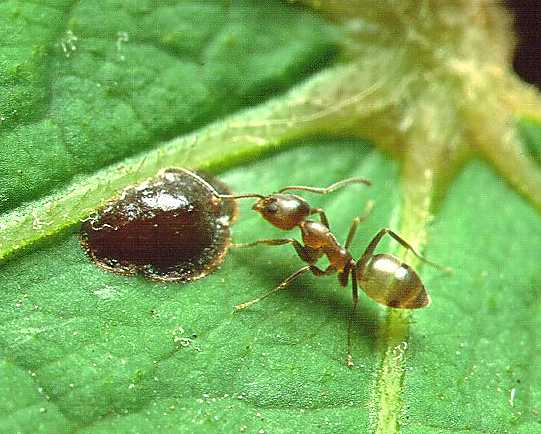
| Appearance | - Workers have nine-segmented antennae with a two-segmented club. English Wikipedia
- Workers have a trapezoidal promesonotum when viewed from above. English Wikipedia
- The propodeal spiracles are positioned on the edges of the propodeum. English Wikipedia
- The fourth abdominal sternite bears two rounded, recurved anterolateral extensions that curve upward onto its dorsal surface. English Wikipedia
- The petiolar node is comparatively high and narrow, contrasting with the broader, lower, rounded postpetiolar node. English Wikipedia
- The postpetiole joins the gaster at a low position, making it appear very low relative to the upper margin of the gaster in lateral view. English Wikipedia
- The fourth abdominal sternite has rounded, recurved extensions visible from above that delimit two rounded semicircular areas. English Wikipedia
| - Adult Argentine ants are uniformly dull brown, with males and queens generally darker than workers. animaldiversity.org
- Workers have yellowish mandibles and legs that are lighter brown than their bodies. animaldiversity.org
- Males retain their wings throughout adulthood, whereas reproductive females lose theirs after mating. animaldiversity.org
- Argentine ant eggs are pearly white and elliptical. animaldiversity.org
|
|---|
| Size | No checked fact yet | - Adult Argentine ants measure approximately 2.2–2.6 mm in body length. English Wikipedia
- Reproductive females measure approximately 4.5–5.0 mm in length. animaldiversity.org
- Male Argentine ants weigh approximately 1.0 mg. animaldiversity.org
- Argentine ant eggs average 0.3 mm in length and 0.2 mm in width. animaldiversity.org
- Newly hatched Argentine ant larvae are approximately 0.5 mm long and can grow to 1.7 mm, while male larvae can reach 2.5 mm. animaldiversity.org
|
|---|
| Habitat | - The species was collected from leaf-litter samples in three rainforest remnants in southern Bahia, Brazil. English Wikipedia
- The rainforest remnants occur in a landscape dominated by forested valleys within the coastal plateau. English Wikipedia
- Most vegetation in the sampled forest remnants was undergoing initial or intermediate regeneration. English Wikipedia
| - Argentine ants naturally inhabit riparian floodplain environments in the lowland Paraná River drainage. English Wikipedia
- Argentine ants establish nests in forests, agricultural fields, shrublands, and areas near rivers. animaldiversity.org
- Argentine ant nests are generally shallow, typically extending no more than 1–2 inches into the soil. animaldiversity.org
- Argentine ants also nest beneath wood, debris, and rocks, in sandy soil, and inside pavement cracks and buildings. animaldiversity.org
- Argentine ants can survive in temperatures ranging from -5 to 45 degrees Celsius. animaldiversity.org
- Argentine ants require access to water sources, including rivers and urban water runoff. animaldiversity.org
|
|---|
| Diet | No checked fact yet | |
|---|
| Behaviour | - The known workers were collected using the Winkler extraction method. English Wikipedia
| - Introduced Argentine ant colonies commonly form supercolonies because individuals from different nests generally do not attack one another. English Wikipedia
- Argentine ants from neighboring nests can mingle without aggression in most of their introduced range. English Wikipedia
- When their nests become flooded, Argentine ant workers collect the brood and relocate the colony to dry ground. English Wikipedia
- Argentine ant colonies readily occupy abandoned nests belonging to deeper-nesting ant species. English Wikipedia
- Argentine ants can incorporate dietary hydrocarbons into their cuticles, influencing recognition between colony members. English Wikipedia
|
|---|
| Reproduction | | - Argentine ant colonies are polygynous and may contain as many as one reproductive queen per 125 workers. English Wikipedia
- Argentine ant workers cannot lay reproductive eggs but can influence egg development in reproductive females. English Wikipedia
- Argentine ants generally mate inside their nests during late spring and summer. animaldiversity.org
- Argentine ant females are inseminated by a single male, although they may mate with several males. animaldiversity.org
- Male Argentine ants die shortly after mating, while queens generally delay egg-laying until the following spring. animaldiversity.org
- Argentine ant eggs generally hatch after approximately 28 days, although incubation can range from 12 to 55 days. animaldiversity.org
- Argentine ant larvae take an average of 31 days to develop. animaldiversity.org
- Argentine ant workers require an average of 20 days to complete pupation. animaldiversity.org
- Argentine ants require at least 33 days to develop from egg to adult, with approximately 74 days being the average. animaldiversity.org
|
|---|
| Distribution | - The species is known only from its type locality in Bahia, Brazil. English Wikipedia
- The known specimens were collected in the extreme southern part of Bahia, Brazil. English Wikipedia
| - Argentine ants are native to northern Argentina, Uruguay, Paraguay, and southern Brazil. English Wikipedia
- Argentine ants have established populations on every continent except Antarctica. English Wikipedia
- Argentine ants have spread into parts of Chile, Colombia, Ecuador, and Peru. English Wikipedia
- Argentine ants have spread globally since the late nineteenth century, largely through human commercial activities. animaldiversity.org
|
|---|
| Conservation | No checked fact yet | - Argentine ants are ranked among the world's 100 worst invasive animal species. English Wikipedia
|
|---|
| Similar species | - The genus has been considered potentially close to the ant genera Allomerus and Diplomorium. English Wikipedia
| No checked fact yet |
|---|
| Other | - The genus Diaphoromyrma contains only one described species, Diaphoromyrma sofiae. English Wikipedia
| - Higher environmental temperatures shorten the developmental time of Argentine ant brood. pmc.ncbi.nlm.nih.gov
- The maximum egg-to-adult brood survival rate recorded in the temperature study was 16% at 26 degrees Celsius. pmc.ncbi.nlm.nih.gov
- No Argentine ant eggs survived at 32 degrees Celsius under the experimental conditions. pmc.ncbi.nlm.nih.gov
- At 18 degrees Celsius, fewer than 2% of Argentine ant eggs hatched into larvae in the temperature study. pmc.ncbi.nlm.nih.gov
|
|---|