Species · Insects
Argentine Ant Linepithema humile
The scientific name of the Argentine Ant is Linepithema humile. It is a species of insect in the family Formicidae (ant), order Hymenoptera. The name dates from 1868.
- Scientific name
- Linepithema humile (Mayr, 1868)
- Common name
- Argentine Ant
- Genus
- Linepithema
- Family
- Formicidae (Ant)
- Order
- Hymenoptera
- Class
- Insecta
- Environment
- terrestrial
- Recorded in
- 24 countries
- Name status
- accepted in the Catalogue of Life
Overview
Linepithema humile naturally inhabits riparian floodplain environments in the lowland Paraná River drainage and establishes nests in forests, agricultural fields, shrublands, and areas near rivers. Introduced colonies commonly form supercolonies in which ants from different nests generally do not attack one another.
Written 24 November 2026 from the sources listed below. Each statement was checked against the passage it cites; statements that could not be supported were removed.
Appearance
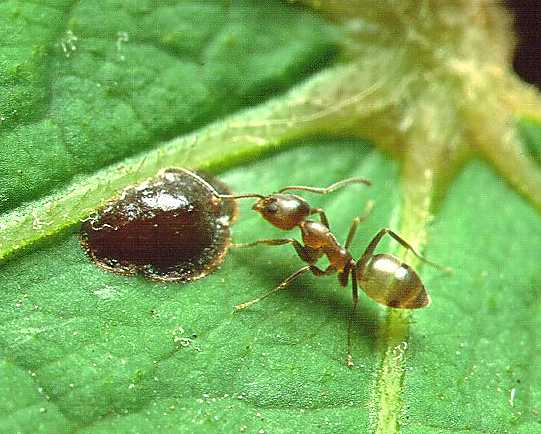
Adult Argentine ants are uniformly dull brown, with males and queens generally darker than workers. Workers have yellowish mandibles and legs that are lighter brown than their bodies.[1][2]
Males retain their wings throughout adulthood, whereas reproductive females lose theirs after mating. Argentine ant eggs are pearly white and elliptical.[3][4]
Adult Argentine ants measure approximately 2.2–2.6 mm in body length, while reproductive females measure approximately 4.5–5.0 mm. Male Argentine ants weigh approximately 1.0 mg.[5][6][7]
Argentine ant eggs average 0.3 mm in length and 0.2 mm in width. Newly hatched larvae are approximately 0.5 mm long and can grow to 1.7 mm, while male larvae can reach 2.5 mm.[8][9]
Habitat
Argentine ants naturally inhabit riparian floodplain environments in the lowland Paraná River drainage. They establish nests in forests, agricultural fields, shrublands, and areas near rivers.[10][11]
Their nests are generally shallow, typically extending no more than 1–2 inches into the soil. They also nest beneath wood, debris, and rocks, in sandy soil, and inside pavement cracks and buildings.[12][13]
Argentine ants can survive in temperatures ranging from -5 to 45 degrees Celsius. They require access to water sources, including rivers and urban water runoff.[14][15]
Behaviour
When nests become flooded, workers collect the brood and relocate the colony to dry ground. Argentine ant colonies also readily occupy abandoned nests belonging to deeper-nesting ant species.[16][17]
Argentine ants can incorporate dietary hydrocarbons into their cuticles, influencing recognition between colony members.[18]
Reproduction and life cycle
Argentine ant colonies are polygynous and may contain as many as one reproductive queen per 125 workers. Workers cannot lay reproductive eggs but can influence egg development in reproductive females.[19][20]
Argentine ants generally mate inside their nests during late spring and summer. Females are inseminated by a single male, although they may mate with several males.[21][22]
Males die shortly after mating, while queens generally delay egg-laying until the following spring.[23]
Eggs generally hatch after approximately 28 days, although incubation can range from 12 to 55 days. Larvae take an average of 31 days to develop, and workers require an average of 20 days to complete pupation.[24][25][26]
Argentine ants require at least 33 days to develop from egg to adult, with approximately 74 days being the average.[27]
Higher environmental temperatures shorten the developmental time of Argentine ant brood. The maximum egg-to-adult brood survival rate recorded in the temperature study was 16% at 26 degrees Celsius.[28][29]
At 18 degrees Celsius, fewer than 2% of Argentine ant eggs hatched into larvae in the temperature study. No eggs survived at 32 degrees Celsius under the experimental conditions.[30][31]
Conservation
Argentine ants are ranked among the world's 100 worst invasive animal species.[32]
They are native to northern Argentina, Uruguay, Paraguay, and southern Brazil. They have established populations on every continent except Antarctica and have spread into parts of Chile, Colombia, Ecuador, and Peru.[33][34][35]
Argentine ants have spread globally since the late nineteenth century, largely through human commercial activities.[36]
Classification of the Argentine Ant
| Kingdom | Animalia |
|---|---|
| Phylum | Arthropoda |
| Subphylum | Hexapoda |
| Class | Insecta (Insect) |
| Order | Hymenoptera (Ants) |
| Suborder | Apocrita (Ants) |
| Infraorder | Aculeata |
| Superfamily | Formicoidea |
| Family | Formicidae (Ant) |
| Subfamily | Dolichoderinae |
| Tribe | Leptomyrmecini |
| Genus | Linepithema |
| Species | Linepithema humile (Mayr, 1868) |
Where the Argentine Ant is found
Checklists and occurrence records place Linepithema humile in 24 countries. GBIF holds 21,817 georeferenced records of it.
Countries
- Argentina 318
- Australia 855
- Bahamas 3
- Belgium 95
- Bermuda 58
- Canada 10
- Chile 353
- Croatia 5
- France 319
- Germany 4
- Greece 32
- Guam 20
- Italy 203
- Malta 3
- Mexico 453
- New Zealand 467
- Norfolk Island 6
- Portugal 864
- South Africa 509
- Spain 1,248
- Switzerland 10
- The Netherlands 14
- United Kingdom 13
- United States 15,955
Regions and cities with the most records
- California, United States 12,217
- Poway, United States 1,349
- Los Angeles, United States 1,344
- Huntington Park, United States 1,223
- Glendale, United States 1,190
- Florence-Graham, United States 1,164
- Burbank, United States 1,155
- East Los Angeles, United States 1,153
- Inglewood, United States 1,139
- Encinitas, United States 1,093
- South Gate, United States 1,052
- Santa Clara, United States 1,044
- Hawthorne, United States 1,025
- Oakland, United States 1,012
- Lynwood, United States 1,007
- San Diego, United States 1,005
- La Mesa, United States 1,001
- Monterey Park, United States 1,001
- National City, United States 1,000
- San Jose, United States 998
- San Francisco, United States 978
- Alhambra, United States 973
- Alameda, United States 961
- Gardena, United States 956
- Compton, United States 944
- Pico Rivera, United States 939
- Cupertino, United States 935
- Montebello, United States 928
- Pasadena, United States 915
- Sunnyvale, United States 889
- Berkeley, United States 881
- Richmond, United States 847
- El Cajon, United States 845
- Santa Monica, United States 842
- Mountain View, United States 841
- Downey, United States 836
14 more countries have a few records outside this range
These countries hold a few records of Linepithema humile but lie outside the range the checklists give for it. Such records are often zoo or garden specimens, museum material or vagrants, so the species is not counted as occurring there.
A number beside a place is its count of GBIF occurrence records. A place without a number comes from a checklist alone. Records show where a species has been observed or collected, which can include escapes and vagrants.
Common names
English
- Argentine Ant
Names in 17 other languages
- Afrikaans
- Argentynse Mier
- Catalan
- Formiga argentina
- Czech
- mravenec argentinský
- Dutch
- Argentijnse mier, Argentijnse plaagmier
- French
- Fourmi d'Argentine
- Galician
- Formiga arxentina
- German
- Argentinische Ameise, Argentinische Heeresameise
- Italian
- Formica argentina
- Japanese
- アルゼンチンアリ
- Korean
- 아르헨티나개미
- Norwegian Bokmål
- argentinamaur
- Polish
- Mrówka argentyńska
- Portuguese
- Formiga-argentina
- Russian
- Аргентинский муравей
- Spanish
- Hormiga sudamericana
- Swedish
- Argentinamyra, invasionsmyra
- Turkish
- Arjantin Karıncası
Synonyms
8 other scientific names have been used for this species and are now treated as synonyms of Linepithema humile.
- Hypoclinea humilis Mayr, 1868
- Hypoclinea humilis Mayr, 1855
- Iridomyrmex humilis (Mayr, 1868)
- Iridomyrmex humilis arrogans Chopard, 1921
- Iridomyrmex humilis var. arrogans Chopard, 1921
- Iridomyrmex riograndensis Borgmeier, 1928
- Linepithema humile arrogans (Chopard, 1921)
- Linepithema riograndensis (Borgmeier, 1928)
Subspecies and varieties
- Linepithema humile humile subspecies
Questions and answers
What is the scientific name of the Argentine Ant?
The scientific name of the Argentine Ant is Linepithema humile. Written with its author, the full name is Linepithema humile (Mayr, 1868).
Which family does the Argentine Ant belong to?
Linepithema humile belongs to the family Formicidae, in the order Hymenoptera and the class Insecta.
Where is the Argentine Ant found?
Checklists and occurrence records place Linepithema humile in 24 countries, including United States, Spain, Portugal, Australia, South Africa and New Zealand.
Why are Argentine ants a problem?
Argentine ants are ranked among the world's 100 worst invasive animal species. Introduced colonies commonly form supercolonies in which ants from different nests generally do not attack one another.[32][37][38]
What is the diet of an ant?
Argentine ants have an omnivorous diet and feed on honeydew produced by aphids, mealybugs, and scale insects.[39][40]
Are there Argentine ants in the US?
The Argentine ant has established populations on every continent except Antarctica.[34]
Sources
Passages the profile rests on
- Adult Argentine ants are uniformly dull brown, with males and queens generally darker than workers. Source passage: “All ants of this species are dull brown, though males and queens are usually darker than workers.” — animaldiversity.org
- Workers have yellowish mandibles and legs that are lighter brown than their bodies. Source passage: “Workers have yellowish mandibles and their legs are a lighter shade of brown than their body.” — animaldiversity.org
- Males retain their wings throughout adulthood, whereas reproductive females lose theirs after mating. Source passage: “Males have wings throughout their adult lifespan, while sexual females lose their wings after mating.” — animaldiversity.org
- Argentine ant eggs are pearly white and elliptical. Source passage: “Their eggs are pearly white and elliptical in shape.” — animaldiversity.org
- Adult Argentine ants measure approximately 2.2–2.6 mm in body length. Source passage: “Linepithema humile is a small-bodied (2.2–2.6 mm) ant species” — English Wikipedia
- Reproductive females measure approximately 4.5–5.0 mm in length. Source passage: “sexual females (also known as queens) are significantly larger, measuring 4.5 to 5.0 mm in length” — animaldiversity.org
- Male Argentine ants weigh approximately 1.0 mg. Source passage: “Males are about the same size or a little larger than workers, weighing about 1.0 mg” — animaldiversity.org
- Argentine ant eggs average 0.3 mm in length and 0.2 mm in width. Source passage: “Their mean size is 0.3 mm long by 0.2 mm wide” — animaldiversity.org
- Newly hatched Argentine ant larvae are approximately 0.5 mm long and can grow to 1.7 mm, while male larvae can reach 2.5 mm. Source passage: “Newly hatched larvae are about 0.5 mm long and grow to about 1.7 mm, though male larvae can grow to 2.5 mm in length.” — animaldiversity.org
- Argentine ants naturally inhabit riparian floodplain environments in the lowland Paraná River drainage. Source passage: “The native range of Argentine ants is limited to riparian habitats in the lowland areas of the Paraná River drainage” — English Wikipedia
- Argentine ants establish nests in forests, agricultural fields, shrublands, and areas near rivers. Source passage: “Colonies nest in forests, agricultural fields, shrublands, fields, near rivers, and in other areas disturbed by human activity.” — animaldiversity.org
- Argentine ant nests are generally shallow, typically extending no more than 1–2 inches into the soil. Source passage: “Nests are shallow, typically no more than 1 to 2 inches into the soil.” — animaldiversity.org
- Argentine ants also nest beneath wood, debris, and rocks, in sandy soil, and inside pavement cracks and buildings. Source passage: “Argentine ants also nest under wood and debris, in sandy soil, under rocks, in cracks in pavement, and in buildings.” — animaldiversity.org
- Argentine ants can survive in temperatures ranging from -5 to 45 degrees Celsius. Source passage: “They are able to survive in temperatures from -5 to 45 degrees Celsius” — animaldiversity.org
- Argentine ants require access to water sources, including rivers and urban water runoff. Source passage: “Water sources are also key to these ants, including natural sources such as rivers and man-made sources such as urban water runoff.” — animaldiversity.org
- When their nests become flooded, Argentine ant workers collect the brood and relocate the colony to dry ground. Source passage: “if their nests become inundated with water, workers will collect the brood and the entire colony will move to dry ground.” — English Wikipedia
- Argentine ant colonies readily occupy abandoned nests belonging to deeper-nesting ant species. Source passage: “if a deeper nesting ant species abandons their nest, Argentine ant colonies will readily take over the space.” — English Wikipedia
- Argentine ants can incorporate dietary hydrocarbons into their cuticles, influencing recognition between colony members. Source passage: “The hydrocarbons from the diet were eventually incorporated into the cuticle of the subjects.” — English Wikipedia
- Argentine ant colonies are polygynous and may contain as many as one reproductive queen per 125 workers. Source passage: “Argentine ant colonies almost invariably have many reproductive queens, as many as one queen for every 125 workers.” — English Wikipedia
- Argentine ant workers cannot lay reproductive eggs but can influence egg development in reproductive females. Source passage: “Argentine ant workers are unable to lay reproductive eggs but can direct the development of eggs in reproductive females” — English Wikipedia
- Argentine ants generally mate inside their nests during late spring and summer. Source passage: “Argentine ants mate in the nest during late spring and summer.” — animaldiversity.org
- Argentine ant females are inseminated by a single male, although they may mate with several males. Source passage: “Females are only inseminated by one male, though they may mate with several males.” — animaldiversity.org
- Male Argentine ants die shortly after mating, while queens generally delay egg-laying until the following spring. Source passage: “Males die shortly after mating, while queens do not lay eggs until the following spring, if they survive until then.” — animaldiversity.org
- Argentine ant eggs generally hatch after approximately 28 days, although incubation can range from 12 to 55 days. Source passage: “Eggs are laid from early spring to late fall and hatch after about 28 days, though incubation can last from 12 to 55 days.” — animaldiversity.org
- Argentine ant larvae take an average of 31 days to develop. Source passage: “their development takes 11 to 61 days, with an average of 31 days.” — animaldiversity.org
- Argentine ant workers require an average of 20 days to complete pupation. Source passage: “Workers pupate for an average of 20 days” — animaldiversity.org
- Argentine ants require at least 33 days to develop from egg to adult, with approximately 74 days being the average. Source passage: “At least 33 days are needed to develop into an adult, though 74 days seems average.” — animaldiversity.org
- Higher environmental temperatures shorten the developmental time of Argentine ant brood. Source passage: “The higher the temperature, the shorter the development times.” — pmc.ncbi.nlm.nih.gov
- The maximum egg-to-adult brood survival rate recorded in the temperature study was 16% at 26 degrees Celsius. Source passage: “Brood survival from egg to adult was low, with the maximum survival rate being only 16% at 26° C.” — pmc.ncbi.nlm.nih.gov
- No Argentine ant eggs survived at 32 degrees Celsius under the experimental conditions. Source passage: “At 32° C no eggs survived” — pmc.ncbi.nlm.nih.gov
- At 18 degrees Celsius, fewer than 2% of Argentine ant eggs hatched into larvae in the temperature study. Source passage: “while at 18° C less than 2% of the eggs hatched into larva.” — pmc.ncbi.nlm.nih.gov
- Argentine ants are ranked among the world's 100 worst invasive animal species. Source passage: “The ants are ranked among the world's 100 worst invasive animal species.” — English Wikipedia
- Argentine ants are native to northern Argentina, Uruguay, Paraguay, and southern Brazil. Source passage: “The Argentine ant (Linepithema humile, formerly Iridomyrmex humilis) is an ant native to northern Argentina, Uruguay, Paraguay, Bolivia and southern Brazil.” — English Wikipedia
- Argentine ants have established populations on every continent except Antarctica. Source passage: “The species has become established to every continent except Antarctica” — English Wikipedia
- Argentine ants have spread into parts of Chile, Colombia, Ecuador, and Peru. Source passage: “Within South America, this species has spread into parts of Chile, Colombia, Ecuador, and Peru.” — English Wikipedia
- Argentine ants have spread globally since the late nineteenth century, largely through human commercial activities. Source passage: “Since the late 1800s, they have been spreading due to human commercial activities” — animaldiversity.org
- Introduced Argentine ant colonies commonly form supercolonies because individuals from different nests generally do not attack one another. Source passage: “different nests of the introduced Argentine ants seldom attack or compete with each other” — English Wikipedia
- Argentine ants from neighboring nests can mingle without aggression in most of their introduced range. Source passage: “individuals from one nest can mingle in a neighboring nest without being attacked.” — English Wikipedia
- Argentine ants feed on honeydew produced by aphids, mealybugs, and scale insects. Source passage: “In return for this protection, the ants benefit by feeding off honeydew.” — English Wikipedia
- Argentine ants have an omnivorous diet. Source passage: “Pest control usually requires exploiting their omnivorous dietary habits” — English Wikipedia
Data
- Catalogue of Life, 2026-10-16 XR cc by
- Global Biodiversity Information Facility CC BY 4.0
- Wikidata CC0
- GeoNames CC BY 4.0
- Wikimedia Commons per image; credit shown with each image
- Within the Catalogue of Life, this name comes from An Online Catalog of the Ants of the World cc by
References
- Mayr, G. (1868). Formicidae novae Americanae collectae a Prof. P. de Strobel. Annuario Della Società Dei Naturalisti E Matematici, Modena, 3, 161–178. https://antcat.org/documents/2148/4369.pdf Link where the name was published
This species in other databases
- Catalogue of Life 3V2M8
- Wikidata Q645538
- iNaturalist 68165
- WoRMS urn:lsid:marinespecies.org:taxname:1490363
- ITIS 575041
Page built on 24 November 2026. See how the catalog is made and all sources and licences.
Cite this page
ScientificNames.org. (2026). Linepithema humile (Argentine Ant). Retrieved November 24, 2026, from https://scientificnames.org/species/linepithema-humile
“Linepithema humile (Argentine Ant).” ScientificNames.org, 2026, scientificnames.org/species/linepithema-humile. Accessed 24 Nov. 2026.
ScientificNames.org. “Linepithema humile (Argentine Ant).” Accessed November 24, 2026. https://scientificnames.org/species/linepithema-humile.
@misc{scientificnames_linepithema_humile_argentine_ant,
  author = {{ScientificNames.org}},
  title = {Linepithema humile (Argentine Ant)},
  year = {2026},
  url = {https://scientificnames.org/species/linepithema-humile},
  note = {Accessed 2026-11-24}
}