Comparison
Distichlis stricta vs Saltgrass
Distichlis stricta (Distichlis stricta) and Saltgrass (Distichlis spicata) both belong to the genus Distichlis (saltgrass) and part ways below it. Both are recorded in 3 countries.
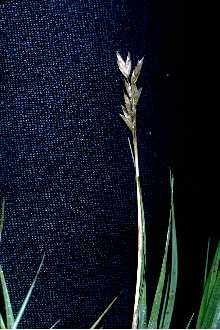
Saltgrass
Distichlis spicata
Robert H. Mohlenbrock. USDA NRCS. 1992. Western wetland flora: Field office guide to plant species. West Region, Sacramento. Courtesy of USDA NRCS Wetland Science Institute., Public domain, via Wikimedia Commons

Side by side
| Distichlis stricta | Saltgrass | |
|---|---|---|
| Scientific name | Distichlis stricta (Torr.) Rydb. | Distichlis spicata (L.) Greene |
| English name | Not recorded | Saltgrass |
| Group | Flowering plants | Flowering plants |
| Class | Liliopsida | Liliopsida |
| Order | Poales | Poales |
| Family | Poaceae Turf | Poaceae Turf |
| Genus | Distichlis Saltgrass | Distichlis Saltgrass |
| Red List category | Not recorded | Least Concern |
| Countries on record | 3 countries | 23 countries |
| GBIF occurrence records | 1,892 records | 18,409 records |
Rows where the two agree are shown in grey.
Where each is found
Both recorded in 3 countries
Only Saltgrass (20)
- Argentina
- Bahamas
- Belize
- Bolivia
- Cayman Islands
- Chile
- Colombia
- Cuba
- Dominican Republic
- Ecuador
- El Salvador
- French Polynesia
- Guatemala
- Haiti
- Jamaica
- Peru
- Saint Kitts and Nevis
- Turks and Caicos Islands
- Uruguay
- Venezuela
From Catalogue of Life checklists and GBIF occurrence records. A country missing from a list means no record is held, which is not proof of absence.
Checked facts
| Distichlis stricta | Saltgrass | |
|---|---|---|
| Appearance | No checked fact yet |
|
| Size | No checked fact yet |
|
| Habitat | No checked fact yet |
|
| Behaviour | No checked fact yet |
|
| Reproduction | No checked fact yet |
|
| Conservation | No checked fact yet |
|
| Uses | No checked fact yet |
|
In brief
Saltgrass
Distichlis spicata grows along coastlines, on salt flats, and in disturbed soils, as well as in forest, woodland, montane, and desert scrub habitats. It has rhizomes, sometimes stolons, and releases excess salts from its tissues through salt glands. Full profile
Compare something else
Page built on 27 November 2026 from the data on the two species pages, where every source is listed.
Cite this page
ScientificNames.org. (2026). Distichlis stricta vs Saltgrass. Retrieved November 27, 2026, from https://scientificnames.org/compare/distichlis-stricta-vs-saltgrass
“Distichlis stricta vs Saltgrass.” ScientificNames.org, 2026, scientificnames.org/compare/distichlis-stricta-vs-saltgrass. Accessed 27 Nov. 2026.
ScientificNames.org. “Distichlis stricta vs Saltgrass.” Accessed November 27, 2026. https://scientificnames.org/compare/distichlis-stricta-vs-saltgrass.
@misc{scientificnames_distichlis_stricta_vs_saltgrass,
  author = {{ScientificNames.org}},
  title = {Distichlis stricta vs Saltgrass},
  year = {2026},
  url = {https://scientificnames.org/compare/distichlis-stricta-vs-saltgrass},
  note = {Accessed 2026-11-27}
}