Species · Flowering plants
Saltgrass Distichlis spicata
The scientific name of the Saltgrass is Distichlis spicata. It is a species of flowering plant in the family Poaceae (turf), order Poales.
- Scientific name
- Distichlis spicata (L.) Greene
- Common name
- Saltgrass
- Genus
- Distichlis
- Family
- Poaceae (Turf)
- Order
- Poales
- Class
- Liliopsida
- Red List category
- LC Least Concern
- Recorded in
- 23 countries
- Name status
- accepted in the Catalogue of Life
Overview
Distichlis spicata grows along coastlines, on salt flats, and in disturbed soils, as well as in forest, woodland, montane, and desert scrub habitats. It has rhizomes, sometimes stolons, and releases excess salts from its tissues through salt glands.
Written 26 November 2026 from the sources listed below. Each statement was checked against the passage it cites; statements that could not be supported were removed.
Appearance
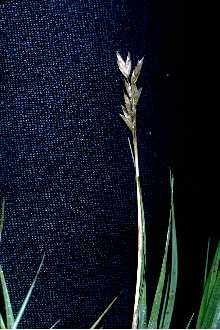
Saltgrass has solid, stiff stems and narrow leaves that can reach 10 centimeters in length. It occasionally grows to nearly half a meter tall.[1][2][3]
Its leaves may develop a salt crust in saline environments. The female inflorescence can reach 8 centimeters in length and bears green or purple-tinted spikelets.[4][5]
The flower parts of both sexes can be bright pinkish-purple.[6]
Habitat
Saltgrass grows readily in salty and alkaline soils. It can grow underwater and in mud.[7][8]
Behaviour
Saltgrass can form dense stands consisting of a single species and frequently grows in clonal colonies. Non-clonal populations tend to contain a majority of individuals of one sex.[9][10][11]
Saltgrass develops sod through its root system. Its rhizomes have sharp points that help them penetrate hard soils.[12][13]
Saltgrass releases excess salts from its tissues through salt glands.[14]
Reproduction and life cycle
Saltgrass is dioecious, with male and female flowers occurring on separate individuals. It reproduces vegetatively.[15][16]
Conservation
Saltgrass is listed as critically imperiled in Missouri.[17]
Uses
Salt collected from saltgrass was used by the Kawaiisu Indians to make salt blocks.[18]
Saltgrass provides fair to good forage because it can remain green during drought periods. It is resistant to grazing and trampling.[19][20]
Saltgrass is harvested for livestock feed in both green and dry conditions, with winter being its most common feeding season. Saltgrass growing along the Atlantic coast was an important hay source for early colonists.[21][22]
Classification of the Saltgrass
| Kingdom | Plantae |
|---|---|
| Subkingdom | Pteridobiotina |
| Phylum | Tracheophyta |
| Class | Liliopsida |
| Order | Poales |
| Family | Poaceae (Turf) |
| Genus | Distichlis (Saltgrass) |
| Species | Distichlis spicata (L.) Greene |
Where the Saltgrass is found
Checklists and occurrence records place Distichlis spicata in 23 countries across North America, Oceania and South America. GBIF holds 18,409 georeferenced records of it.
Countries where it is native or its origin is not stated
- Argentina 890
- Bahamas 37
- Belize 26
- Bolivia 73
- Canada 751
- Cayman Islands 3
- Chile 419
- Colombia 5
- Cuba 65
- Dominican Republic 11
- Ecuador 76
- El Salvador 2
- Guatemala 1
- Haiti 5
- Jamaica 3
- Mexico 1,430
- Peru 201
- Saint Kitts and Nevis 7
- Turks and Caicos Islands 8
- Uruguay 18
- Venezuela 4
Countries where it has been introduced
Regions and cities with the most records
- California, United States 5,537
- Nevada, United States 484
- San Diego, United States 393
- National City, United States 380
- Encinitas, United States 370
- Coronado, United States 358
- Texas, United States 329
- Costa Mesa, United States 311
- Newport Beach, United States 310
- British Columbia, Canada 302
- Chula Vista, United States 302
- Washington, United States 300
- Santa Ana, United States 298
- Baja California, Mexico 295
- Huntington Beach, United States 294
- Fountain Valley, United States 291
- Oregon, United States 280
- Richmond, United States 276
- San Pablo, United States 275
- Irvine, United States 262
- San Francisco, United States 262
- El Cerrito, United States 260
- San Marcos, United States 256
- Albany, United States 254
- Carlsbad, United States 252
- Garden Grove, United States 250
- San Rafael, United States 246
- Laguna Hills, United States 241
- Laguna Woods, United States 239
- Aliso Viejo, United States 237
- Westminster, United States 237
- Tustin, United States 235
- Imperial Beach, United States 233
- Marina, United States 233
- Laguna Beach, United States 231
- Lake Forest, United States 225
5 more countries have a few records outside this range
These countries hold a few records of Distichlis spicata but lie outside the range the checklists give for it. Such records are often zoo or garden specimens, museum material or vagrants, so the species is not counted as occurring there.
A number beside a place is its count of GBIF occurrence records. A place without a number comes from a checklist alone. Records show where a species has been observed or collected, which can include escapes and vagrants.
Common names
English
- Saltgrass
- Alkali Saltgrass
- Alkaline Grass
- Coastal Saltgrass
- Inland Saltgrass
- Seashore Saltgrass
Names in 1 other language
- French
- distichlis dressé
Synonyms
67 other scientific names have been used for this species and are now treated as synonyms of Distichlis spicata.
- Agropyron peruvianum (Lam.) Roem. & Schult.
- Brachypodium peruvianum (Lam.) Roem. & Schult. ex Kunth
- Briza spicata Burm.f.
- Brizopyrum americanum Link
- Brizopyrum boreale J.Presl
- Brizopyrum ovatum Nees ex Steud.
- Brizopyrum prostratum (Kunth) Benth. ex E.Fourn.
- Brizopyrum prostratum var. erectum E.Fourn.
- Brizopyrum prostratum var. humile E.Fourn.
- Brizopyrum spicatum (L.) Hook. & Arn.
- Brizopyrum spicatum var. spicatum
- Brizopyrum thalassicum (Kunth) Nees
- Distichlis araucana Phil.
- Distichlis deserticola Phil.
- Distichlis hirsuta Phil.
- Distichlis hirta Phil.
- Distichlis marginata Phil.
- Distichlis maritima Raf.
- Distichlis maritima var. laxa Holm
- Distichlis mendocina Phil.
- Distichlis nodosa Raf.
- Distichlis prostrata (Kunth) É.Desv.
- Distichlis spicata (L.) Kuntze
- Distichlis spicata f. hirta (Phil.) Kuntze
- Distichlis spicata subsp. spicata
- Distichlis spicata var. andina Beetle
- Distichlis spicata var. borealis (J.Presl) Beetle
- Distichlis spicata var. distichophylla (Michx.) Beetle
- Distichlis spicata var. divaricata Beetle
- Distichlis spicata var. marginata (Phil.) Kuntze
- Distichlis spicata var. mendocina (Phil.) Hack.
- Distichlis spicata var. mendozina (Phil.) Hack.
- Distichlis spicata var. mexicana Beetle
- Distichlis spicata var. nana Beetle
- Distichlis spicata var. spicata
- Distichlis spicata var. stolonifera Beetle
- Distichlis spicata var. thalassica (Kunth) Kuntze
- Distichlis stricta var. stricta
- Distichlis tenuifolia Phil.
- Distichlis thalassica É.Desv.
Showing 40 of 67.
Questions and answers
What is the scientific name of the Saltgrass?
The scientific name of the Saltgrass is Distichlis spicata. Written with its author, the full name is Distichlis spicata (L.) Greene.
Which family does the Saltgrass belong to?
Distichlis spicata belongs to the family Poaceae, in the order Poales and the class Liliopsida.
Where is the Saltgrass found?
Checklists and occurrence records place Distichlis spicata in 23 countries, including Mexico, Argentina, Canada, Chile, Peru and Ecuador.
What is the conservation status of the Saltgrass?
The IUCN Red List category recorded for Distichlis spicata is Least Concern (LC).
What other names does the Saltgrass have?
Distichlis spicata is also known in English as Alkali Saltgrass, Alkaline Grass, Coastal Saltgrass, Inland Saltgrass and Seashore Saltgrass.
Why is saltgrass called saltgrass?
Its leaves may develop a salt crust when growing in saline environments, and it releases excess salts from its tissues through salt glands.[4][14]
Sources
Passages the profile rests on
- Distichlis spicata is an erect, hardy perennial grass with solid, stiff stems, narrow leaves, and rhizomes. Source passage: “It is an erect grass which occasionally approaches half a meter in height but is generally shorter.” — English Wikipedia
- The leaves of Distichlis spicata can reach 10 centimeters in length. Source passage: “The solid, stiff stems have narrow leaves up to 10 centimeters in length” — English Wikipedia
- Distichlis spicata occasionally grows to nearly half a meter tall. Source passage: “occasionally approaches half a meter in height” — English Wikipedia
- The leaves of Distichlis spicata may develop a salt crust when growing in saline environments. Source passage: “which may be crusted with salt in saline environments.” — English Wikipedia
- The female inflorescence of Distichlis spicata can reach 8 centimeters in length and bears green or purple-tinted spikelets. Source passage: “The pistillate inflorescence may be up to 8 centimeters long, with green or purple-tinted spikelets.” — English Wikipedia
- The flower parts of both sexes can be bright pinkish-purple. Source passage: “The flower parts of both sex may be bright pinkish-purple.” — English Wikipedia
- Distichlis spicata can grow underwater and in mud. Source passage: “which allow it to grow underwater and in mud.” — English Wikipedia
- Distichlis spicata grows readily in salty and alkaline soils. Source passage: “This plant grows easily in salty and alkaline soils” — English Wikipedia
- Distichlis spicata can form dense stands consisting of a single species. Source passage: “It can form dense monotypic stands” — English Wikipedia
- Distichlis spicata frequently grows in clonal colonies. Source passage: “it often grows in clonal colonies.” — English Wikipedia
- Non-clonal populations of Distichlis spicata tend to contain a majority of individuals of one sex. Source passage: “Non-clonal populations tend to be skewed toward a majority of one sex or the other.” — English Wikipedia
- Distichlis spicata develops sod through its root system. Source passage: “The grass forms sod with its hearty root system.” — English Wikipedia
- The rhizomes of Distichlis spicata have sharp points that help them penetrate hard soils. Source passage: “Its rhizomes have sharp points which allow it to penetrate hard soils” — English Wikipedia
- Distichlis spicata releases excess salts from its tissues through salt glands. Source passage: “excreting salts from its tissues via salt glands.” — English Wikipedia
- Distichlis spicata is dioecious, with male and female flowers occurring on separate individuals. Source passage: “This species is dioecious, meaning the male flowers and female flowers grow on separate individuals.” — English Wikipedia
- Distichlis spicata reproduces vegetatively. Source passage: “Distichlis is characterized by papillae on subsidiary cells of lemma stomata, dioecy, vegetative reproduction.” — florida.plantatlas.usf.edu
- Distichlis spicata is listed as critically imperiled in Missouri. Source passage: “Saltgrass is listed as critically imperiled in Missouri” — fs.usda.gov
- Salt collected from Distichlis spicata was used by the Kawaiisu Indians to make salt blocks. Source passage: “the Kawaiisu Indians were able to make salt blocks by scraping off the salt.” — English Wikipedia
- Distichlis spicata provides fair to good forage because it can remain green during drought periods. Source passage: “it has a forage value of fair to good because it remains green when most other grasses are dry during the drought periods” — English Wikipedia
- Distichlis spicata is resistant to grazing and trampling. Source passage: “and it is resistant to grazing and trampling.” — English Wikipedia
- Distichlis spicata is harvested for livestock feed in both green and dry conditions, with winter being its most common feeding season. Source passage: “It is cropped both when green and in the dry state; however, it is most commonly used the winter for livestock feed.” — English Wikipedia
- Distichlis spicata growing along the Atlantic coast was an important hay source for early colonists. Source passage: “Saltgrass along the Atlantic coast was the primary source of hay for the early colonists.” — English Wikipedia
- Distichlis spicata can be used as pasture grass when soil and moisture conditions are favorable, including where saline irrigation water is used. Source passage: “studies have shown Saltgrass favorable for pastures irrigated with saline water.” — English Wikipedia
- Distichlis spicata grows along coastlines, on salt flats, and in disturbed soils. Source passage: “thrives along coastlines and on salt flats and disturbed soils” — English Wikipedia
- Distichlis spicata also occurs in forest, woodland, montane, and desert scrub habitats. Source passage: “as well as forest, woodland, montane, and desert scrub habitats.” — English Wikipedia
Data
- Catalogue of Life, 2026-10-16 XR cc by
- Global Biodiversity Information Facility CC BY 4.0
- Wikidata CC0
- GeoNames CC BY 4.0
- Wikimedia Commons per image; credit shown with each image
- Within the Catalogue of Life, this name comes from The World Checklist of Vascular Plants (WCVP) cc by
References
- Bull. Calif. Acad. Sci. 2: 415 (1887) where the name was published
This species in other databases
Page built on 26 November 2026. See how the catalog is made and all sources and licences.
Cite this page
ScientificNames.org. (2026). Distichlis spicata (Saltgrass). Retrieved November 26, 2026, from https://scientificnames.org/species/distichlis-spicata
“Distichlis spicata (Saltgrass).” ScientificNames.org, 2026, scientificnames.org/species/distichlis-spicata. Accessed 26 Nov. 2026.
ScientificNames.org. “Distichlis spicata (Saltgrass).” Accessed November 26, 2026. https://scientificnames.org/species/distichlis-spicata.
@misc{scientificnames_distichlis_spicata_saltgrass,
  author = {{ScientificNames.org}},
  title = {Distichlis spicata (Saltgrass)},
  year = {2026},
  url = {https://scientificnames.org/species/distichlis-spicata},
  note = {Accessed 2026-11-26}
}