Comparison
Humboldt Squid vs European Flying Squid
Humboldt Squid (Dosidicus gigas) and European Flying Squid (Todarodes sagittatus) both belong to the family Ommastrephidae (flying squids) and part ways below it.
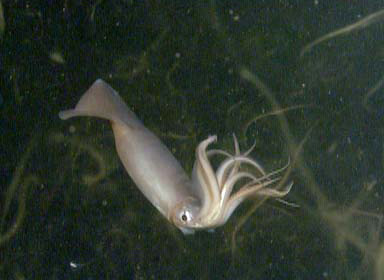
Humboldt Squid
Dosidicus gigas
Image courtesy of NOAA/MBARI 2006, Public domain, via Wikimedia Commons


European Flying Squid
Todarodes sagittatus
Comingio Merculiano in Jatta Giuseppe, Public domain, via Wikimedia Commons

Side by side
| Humboldt Squid | European Flying Squid | |
|---|---|---|
| Scientific name | Dosidicus gigas (A. d'Orbigny, 1835) | Todarodes sagittatus (Lamarck, 1798) |
| English name | Humboldt Squid | European Flying Squid |
| Group | Molluscs | Molluscs |
| Class | Cephalopoda Cephalopod | Cephalopoda Cephalopod |
| Order | Oegopsida | Oegopsida |
| Family | Ommastrephidae Flying Squids | Ommastrephidae Flying Squids |
| Genus | Dosidicus | Todarodes |
| Named in | 1835 | 1798 |
| Red List category | Data Deficient | Least Concern |
| Environment | marine | marine |
| Countries on record | 5 countries | 15 countries |
| GBIF occurrence records | 89,997 records | 3,566 records |
Rows where the two agree are shown in grey.
Where each is found
Only Humboldt Squid (5)
Only European Flying Squid (15)
- Belgium
- Croatia
- Denmark
- France
- Germany
- Greece
- Iceland
- Ireland
- Italy
- Norway
- Portugal
- Spain
- Sweden
- The Netherlands
- United Kingdom
From Catalogue of Life checklists and GBIF occurrence records. A country missing from a list means no record is held, which is not proof of absence.
Checked facts
| Humboldt Squid | European Flying Squid | |
|---|---|---|
| Appearance |
| No checked fact yet |
| Size |
| No checked fact yet |
| Habitat |
| No checked fact yet |
| Diet |
| No checked fact yet |
| Behaviour |
| No checked fact yet |
| Reproduction |
| No checked fact yet |
| Distribution |
| No checked fact yet |
| Conservation |
| No checked fact yet |
| Uses |
| No checked fact yet |
| Other |
| No checked fact yet |
In brief
Humboldt Squid
Dosidicus gigas occurs in the eastern Pacific Ocean from northern California to southern Chile and inhabits ocean depths ranging from approximately 200 to 700 metres. It is distinguished by its ability to rapidly change its body coloration and produce red-and-white flashes across its entire body. Full profile
Compare something else
Page built on 24 November 2026 from the data on the two species pages, where every source is listed.
Cite this page
ScientificNames.org. (2026). Humboldt Squid vs European Flying Squid. Retrieved November 24, 2026, from https://scientificnames.org/compare/humboldt-squid-vs-european-flying-squid
“Humboldt Squid vs European Flying Squid.” ScientificNames.org, 2026, scientificnames.org/compare/humboldt-squid-vs-european-flying-squid. Accessed 24 Nov. 2026.
ScientificNames.org. “Humboldt Squid vs European Flying Squid.” Accessed November 24, 2026. https://scientificnames.org/compare/humboldt-squid-vs-european-flying-squid.
@misc{scientificnames_humboldt_squid_vs_european_flying_squid,
  author = {{ScientificNames.org}},
  title = {Humboldt Squid vs European Flying Squid},
  year = {2026},
  url = {https://scientificnames.org/compare/humboldt-squid-vs-european-flying-squid},
  note = {Accessed 2026-11-24}
}