Species · Molluscs
Humboldt Squid Dosidicus gigas
The scientific name of the Humboldt Squid is Dosidicus gigas. It is a species of mollusc in the family Ommastrephidae (flying squids), order Oegopsida. The name dates from 1835.
- Scientific name
- Dosidicus gigas (A. d'Orbigny, 1835)
- Common name
- Humboldt Squid
- Genus
- Dosidicus
- Family
- Ommastrephidae (Flying Squids)
- Order
- Oegopsida
- Class
- Cephalopoda
- Red List category
- DD Data Deficient
- Environment
- marine
- Recorded in
- 5 countries
- Name status
- accepted in the Catalogue of Life
Overview
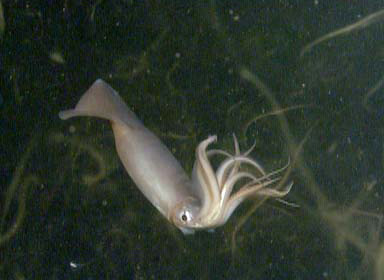
Dosidicus gigas occurs in the eastern Pacific Ocean from northern California to southern Chile and inhabits ocean depths ranging from approximately 200 to 700 metres. It is distinguished by its ability to rapidly change its body coloration and produce red-and-white flashes across its entire body.
Written 24 November 2026 from the sources listed below. Each statement was checked against the passage it cites; statements that could not be supported were removed.
Appearance
It can rapidly change its body coloration using chromatophores and produce rapid red-and-white flashes across its entire body.[1][2]
Individuals can reach 1.5 metres in mantle length and weigh as much as 50 kilograms. The mantle can reach 2 metres in length.[3][4][5]
Habitat
The Humboldt Squid inhabits ocean depths ranging from approximately 200 to 700 metres. It occupies depths exceeding 250 metres during the day and approaches the surface at night.[6][7]
It can tolerate low dissolved oxygen concentrations in deep water by reducing its oxygen consumption and can inhabit hypoxic and anoxic ocean waters.[8][9]
It occurs in the eastern Pacific Ocean from northern California to southern Chile and has been recorded as far north as Alaska. Its historical range extended from Chile to Baja California.[10][11][12]
A small-scale migration has been documented between the Baja California peninsula and Guaymas Basin.[13]
Diet
The Humboldt Squid feeds primarily on small fish, crustaceans, other cephalopods, and copepods.[14]
Juveniles consume copepods and pelagic shrimp before shifting toward fish and other cephalopods as they grow.[15]
Off Peru, it consumes very little anchovy despite the large biomass of this fish in the region. It sometimes consumes other individuals of its own species.[16][17]
Behaviour
The Humboldt Squid can travel in shoals containing as many as 1,200 individuals and swim at speeds of up to 24 kilometres per hour.[18][19]
It undertakes daily vertical migrations between deeper daytime waters and shallower nighttime waters. It can also travel horizontally for up to 100 kilometres over three to four days.[20][21]
The species has been observed participating in cooperative hunting and can use visual signals to interact with other individuals.[22][23]
Reproduction and life cycle
Females produce floating egg masses enclosed in a gelatinous protective layer. A single egg mass can contain approximately 5,000 to 4.1 million eggs.[24][25]
Large females can produce egg masses measuring three to four metres in diameter. Females may produce between three and twenty egg masses during their reproductive cycle.[26][27]
Embryonic development lasts approximately six to nine days before hatching. Spawning is believed to occur throughout the year, with peaks between October and January in the Southern Hemisphere.[28][29]
Conservation
The Gulf of California fishery collapse associated with warming waters in 2015 had not recovered at the time described.[30]
Uses
The Humboldt Squid is commercially harvested for markets in Europe, Russia, China, Japan, Southeast Asia, and the Americas. It is the most important squid worldwide in commercial fisheries.[31][32]
In Chile, it is consumed in dishes including chupes and paila marina. In Peru, it is used to prepare ceviche.[33][34]
Classification of the Humboldt Squid
| Kingdom | Animalia |
|---|---|
| Phylum | Mollusca |
| Class | Cephalopoda (Cephalopod) |
| Subclass | Coleoidea |
| Superorder | Decapodiformes |
| Order | Oegopsida |
| Superfamily | Cranchioidea |
| Family | Ommastrephidae (Flying Squids) |
| Subfamily | Ommastrephinae |
| Genus | Dosidicus |
| Species | Dosidicus gigas (A. d'Orbigny, 1835) |
Where the Humboldt Squid is found
Checklists and occurrence records place Dosidicus gigas in 5 countries. GBIF holds 89,997 georeferenced records of it.
Countries
Regions and cities with the most records
- Coquimbo, Chile 2,478
- San Antonio, Chile 2,423
- Valparaíso, Chile 600
- La Serena, Chile 562
- Viña del Mar, Chile 327
- Quilpué, Chile 115
- Talcahuano, Chile 90
- Hualpén, Chile 68
- San Pedro de la Paz, Chile 50
- Valparaiso, Chile 43
- Coquimbo Region, Chile 39
- Tomé, Chile 38
- Concepción, Chile 30
- Coronel, Chile 28
- Penco, Chile 28
- Villa Alemana, Chile 28
- Biobio, Chile 27
- Lota, Chile 17
- Araucania, Chile 16
- Atacama, Chile 15
- Iquique, Chile 12
- Los Ríos Region, Chile 9
- Ovalle, Chile 8
- Arica, Chile 7
- Chiguayante, Chile 7
- La Calera, Chile 7
- Los Lagos Region, Chile 7
- Maule Region, Chile 7
- Santiago Metropolitan, Chile 6
- Alto Hospicio, Chile 5
- Limache, Chile 5
- Quillota, Chile 5
- Vallenar, Chile 5
- Ucayali, Peru 3
- Ñuble, Chile 3
8 more countries have a few records outside this range
These countries hold a few records of Dosidicus gigas but lie outside the range the checklists give for it. Such records are often zoo or garden specimens, museum material or vagrants, so the species is not counted as occurring there.
A number beside a place is its count of GBIF occurrence records. A place without a number comes from a checklist alone. Records show where a species has been observed or collected, which can include escapes and vagrants.
Common names
English
- Humboldt Squid
- Red Devil
- Jumbo Flying Squid
- Jumbo Squid
Names in 13 other languages
- Catalan
- Canana gegant
- Chinese
- 美洲大赤魷
- Czech
- Kalmar peruánský
- Dutch
- reuzenpijlinktvis
- French
- Calmar de Humboldt, Diable des profondeurs, encornet géant
- German
- Humboldt Kalmar, Humboldt-Kalmar, Jumbokalmar, Riesen-Flugkalmar, Riesen-Pfeilkalmar, RiesenPfeilkalmar
- Italian
- Calamaro di Humboldt, Totano di Humboldt, Totano gigante del Pacifico
- Japanese
- アメリカオオアカイカ
- Polish
- kałamarnica Humboldta
- Portuguese
- Lula-de-humboldt
- Russian
- Перуанско-чилийский гигантский кальмар
- Slovak
- gordan kančukový
- Spanish
- Calamar de Humboldt, Jibia
Synonyms
7 other scientific names have been used for this species and are now treated as synonyms of Dosidicus gigas.
- Dosidicus eschrichtii Steenstrup, 1857
- Dosidicus steenstrupii Pfeffer, 1884
- Loligo gigas A. d'Orbigny, 1835
- Ommastrephes giganteus A. d'Orbigny, 1842
- Ommastrephes gigas (A. d'Orbigny, 1835)
- Sepia nigra Bosc, 1802
- Sepia tunicata Molina, 1782
Related species
-
 Japanese Flying SquidTodarodes pacificus
-
 Boreal SquidIllex illecebrosus
-
 European Flying SquidTodarodes sagittatus
-
 Neon Flying SquidOmmastrephes bartramii
-
 Argentine Shortfin SquidIllex argentinus
-
 Purpleback Flying SquidSthenoteuthis oualaniensis
-
 New Zealand Arrow SquidNototodarus sloanii
-
 Southern Shortfin SquidIllex coindetii
Compare
Questions and answers
What is the scientific name of the Humboldt Squid?
The scientific name of the Humboldt Squid is Dosidicus gigas. Written with its author, the full name is Dosidicus gigas (A. d'Orbigny, 1835).
Which family does the Humboldt Squid belong to?
Dosidicus gigas belongs to the family Ommastrephidae, in the order Oegopsida and the class Cephalopoda.
Where is the Humboldt Squid found?
Checklists and occurrence records place Dosidicus gigas in 5 countries: Chile, Peru, Ecuador, Argentina and Colombia.
What is the conservation status of the Humboldt Squid?
The IUCN Red List category recorded for Dosidicus gigas is Data Deficient (DD).
What other names does the Humboldt Squid have?
Dosidicus gigas is also known in English as Red Devil, Jumbo Flying Squid and Jumbo Squid.
Can you eat Humboldt squid?
Yes. It is commercially harvested for markets in Europe, Russia, China, Japan, Southeast Asia, and the Americas. It is consumed in Chile in dishes including chupes and paila marina and used to prepare ceviche in Peru.[31][33][34]
What is the habitat and diet of a squid?
The Humboldt Squid inhabits ocean depths ranging from approximately 200 to 700 metres, occupying depths exceeding 250 metres during the day and approaching the surface at night. Its diet includes small fish, crustaceans, other cephalopods, and copepods.[6][7][14]
Sources
Passages the profile rests on
- The species can rapidly change its body coloration using chromatophores. Source passage: “they possess chromatophores which enable them to quickly change body coloration” — English Wikipedia
- The species can produce rapid red-and-white flashes across its entire body. Source passage: “The entire body flashes between the colors red and white at 2–4 Hz” — English Wikipedia
- Individuals can reach 1.5 metres in mantle length. Source passage: “some individuals may grow to 1.5 m (5 ft) in mantle length” — English Wikipedia
- Individuals can weigh as much as 50 kilograms. Source passage: “weigh up to 50 kg (110 lb)” — English Wikipedia
- The mantle can reach 2 metres in length. Source passage: “These squid can weigh up to 50kg and have a mantle length of up to 2m.” — animaldiversity.org
- The species inhabits ocean depths ranging from approximately 200 to 700 metres. Source passage: “They are most commonly found at depths of 200 to 700 m (660 to 2,300 ft)” — English Wikipedia
- The species occupies depths exceeding 250 metres during the day and approaches the surface at night. Source passage: “Dosidicus gigas occupies vast habitat that ranges in depths from >250m during the day to near surface depths at night.” — animaldiversity.org
- The species can tolerate low dissolved oxygen concentrations in deep water by reducing its oxygen consumption. Source passage: “Dosidicus gigas can apparently tolerate the low dissolved oxygen levels by suppressing its rate of oxygen consumption.” — animaldiversity.org
- The species can inhabit hypoxic and anoxic ocean waters. Source passage: “its presence within anoxic or hypoxic waters was validated by tagging experiments” — pmc.ncbi.nlm.nih.gov
- The species occurs in the eastern Pacific Ocean from northern California to southern Chile. Source passage: “Dosidicus gigas , otherwise known as the Humboldt or jumbo squid, inhabits the Eastern Pacific Ocean from northern California to southern Chile.” — animaldiversity.org
- The species has been recorded as far north as Alaska. Source passage: “Humboldt squid have been spotted as far north as Alaska.” — animaldiversity.org
- The species has historically ranged from Chile to Baja California. Source passage: “Dosidicus gigas, also known as the jumbo flying squid or the Humboldt squid (from its prevalence in the Humboldt current), has a historical range from Chile to Baja California.” — sharkresearch.earth.miami.edu
- The species has a documented small-scale migration between the Baja California peninsula and Guaymas Basin. Source passage: “Small scale migration within the Gulf of California, from the Baja peninsula to Guaymas Basin has been documented.” — animaldiversity.org
- The species feeds primarily on small fish, crustaceans, other cephalopods, and copepods. Source passage: “The Humboldt squid's diet consists mainly of small fish (lanternfish, in particular), crustaceans, cephalopods (octopuses and other squid), and copepods.” — English Wikipedia
- Juveniles consume copepods and pelagic shrimp before shifting toward fish and other cephalopods as they grow. Source passage: “Juveniles eat copepods and pelagic shrimp, and as Dosidicus gigas grows, its diet shifts more towards fish and other cephalopods.” — animaldiversity.org
- The species consumes very little anchovy off Peru despite the large biomass of this fish in the region. Source passage: “D. gigas consumes very few anchovy Engraulis ringens in Peru, whereas a tremendous biomass of anchovy is potentially available.” — pmc.ncbi.nlm.nih.gov
- The species sometimes consumes other individuals of its own species. Source passage: “Their behavior while feeding often includes cannibalism” — English Wikipedia
- The species can travel in shoals containing as many as 1,200 individuals. Source passage: “move in shoals of up to 1,200 individuals.” — English Wikipedia
- The species can swim at speeds of up to 24 kilometres per hour. Source passage: “They swim at speeds up to 24 km/h (15 mph; 13 kn).” — English Wikipedia
- The species undertakes daily vertical migrations between deeper daytime waters and shallower nighttime waters. Source passage: “Jumbo squid are known to show diel vertical migration, swimming deep during the day and approaching the surface at night.” — animaldiversity.org
- The species can travel horizontally for up to 100 kilometres over three to four days. Source passage: “The squid can also migrate horizontally and travel up to 100 kilometers in a 3 to 4 day period” — animaldiversity.org
- The species has been observed participating in cooperative hunting. Source passage: “research conducted between 2007 and 2011 indicates this species does engage in cooperative hunting.” — English Wikipedia
- The species can use visual signals to interact with other individuals. Source passage: “they use visual cues to interact with one another.” — animaldiversity.org
- Females produce floating egg masses enclosed in a gelatinous protective layer. Source passage: “Females produce floating egg masses protected by a layer of jelly.” — animaldiversity.org
- A single egg mass can contain approximately 5,000 to 4.1 million eggs. Source passage: “the egg masses seem to contain anywhere from 5,000 to 4.1 million eggs” — English Wikipedia
- Large females can produce egg masses measuring three to four metres in diameter. Source passage: “large females can lay egg masses up to 3–4 m (10–13 ft) in diameter” — English Wikipedia
- Females may produce between three and twenty egg masses during their reproductive cycle. Source passage: “Examination of gravid females suggests that each female can produce 3-20 such masses.” — animaldiversity.org
- Embryonic development lasts approximately six to nine days before hatching. Source passage: “The embryo develops for 6-9 days then hatches into a paralarval stage” — animaldiversity.org
- Spawning is believed to occur throughout the year, with peaks between October and January in the Southern Hemisphere. Source passage: “spawning is believed to occurs throughout the year, with peaks from October through January in the Southern Hemisphere.” — animaldiversity.org
- The Gulf of California fishery collapse associated with warming waters in 2015 had not recovered at the time described in the source. Source passage: “a 2015 warming waters fishery collapse in the Gulf of California remains unrecovered.” — English Wikipedia
- The species is commercially harvested for markets in Europe, Russia, China, Japan, Southeast Asia, and the Americas. Source passage: “Commercially, this species has been caught to serve the European market (mainly Spain, Italy, France, and Ireland), Russia, China, Japan, Southeast Asia, and increasingly North and South American markets.” — English Wikipedia
- The species is the most important squid worldwide in commercial fisheries. Source passage: “This species is the most important squid worldwide for commercial fisheries” — English Wikipedia
- The species is consumed in Chile in dishes including chupes and paila marina. Source passage: “In Chile the squid is eaten in chupes and paila marina.” — English Wikipedia
- The species is used to prepare ceviche in Peru. Source passage: “the practice of making ceviche from cheap squid began in the poorer parts of Lima” — English Wikipedia
Data
- Catalogue of Life, 2026-10-16 XR cc by
- Global Biodiversity Information Facility CC BY 4.0
- Wikidata CC0
- GeoNames CC BY 4.0
- Wikimedia Commons per image; credit shown with each image
- Within the Catalogue of Life, this name comes from World Register of Marine Species cc by
This species in other databases
Page built on 24 November 2026. See how the catalog is made and all sources and licences.
Cite this page
ScientificNames.org. (2026). Dosidicus gigas (Humboldt Squid). Retrieved November 24, 2026, from https://scientificnames.org/species/dosidicus-gigas
“Dosidicus gigas (Humboldt Squid).” ScientificNames.org, 2026, scientificnames.org/species/dosidicus-gigas. Accessed 24 Nov. 2026.
ScientificNames.org. “Dosidicus gigas (Humboldt Squid).” Accessed November 24, 2026. https://scientificnames.org/species/dosidicus-gigas.
@misc{scientificnames_dosidicus_gigas_humboldt_squid,
  author = {{ScientificNames.org}},
  title = {Dosidicus gigas (Humboldt Squid)},
  year = {2026},
  url = {https://scientificnames.org/species/dosidicus-gigas},
  note = {Accessed 2026-11-24}
}