Comparison

Lesser Spotted Woodpecker vs Ladder-backed Woodpecker

Lesser Spotted Woodpecker (Dryobates minor) and Ladder-backed Woodpecker (Dryobates scalaris) both belong to the genus Dryobates (dryobates woodpeckers) and part ways below it.

Lesser Spotted Woodpecker

Lesser Spotted Woodpecker

Dryobates minor

Thermos, CC BY-SA 2.5, via Wikimedia Commons

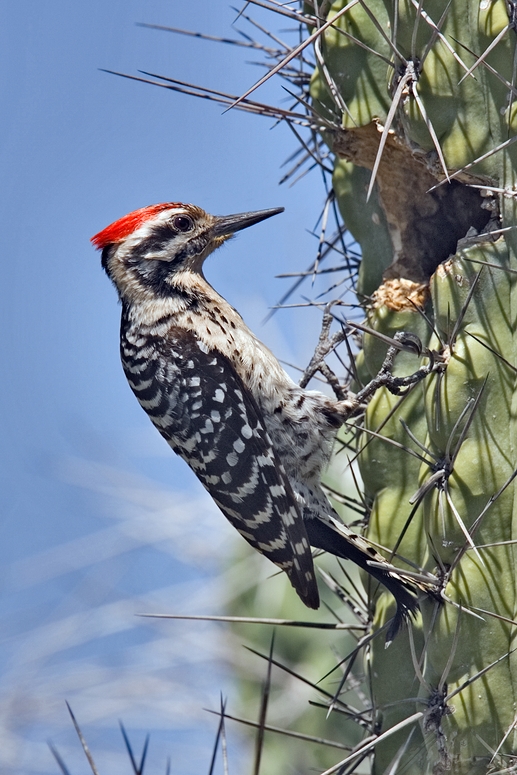
Ladder-backed Woodpecker

Ladder-backed Woodpecker

Dryobates scalaris

Alan D. Wilson, www.naturespicsonline.com, CC BY-SA 3.0, via Wikimedia Commons

Side by side

Lesser Spotted WoodpeckerLadder-backed Woodpecker
Scientific nameDryobates minor (Linnaeus, 1758)Dryobates scalaris (Wagler, 1829)
English nameLesser Spotted WoodpeckerLadder-backed Woodpecker
GroupBirdsBirds
ClassAves BirdAves Bird
OrderPiciformes WoodpeckersPiciformes Woodpeckers
FamilyPicidae WoodpeckerPicidae Woodpecker
GenusDryobates Dryobates WoodpeckersDryobates Dryobates Woodpeckers
Named in17581829
Red List categoryLeast ConcernLeast Concern
EnvironmentNot recordedterrestrial
Countries on record54 countries7 countries
GBIF occurrence records761,040 records1,030,776 records

Rows where the two agree are shown in grey.

Where each is found

Only Lesser Spotted Woodpecker (54)

Only Ladder-backed Woodpecker (7)

From Catalogue of Life checklists and GBIF occurrence records. A country missing from a list means no record is held, which is not proof of absence.

Checked facts

Lesser Spotted WoodpeckerLadder-backed Woodpecker
Appearance
  • The lesser spotted woodpecker is the smallest European woodpecker. English Wikipedia
  • Its wings have broad black-and-white bars, while its lower back has narrower bars. English Wikipedia
  • Adult males have a crimson crown, brown forehead, black superciliary stripe, and another black stripe extending from the bill base to the neck. English Wikipedia
  • The male has a black nape and upper back, with black-and-white barring on the lower back. English Wikipedia
  • The male has white underparts with streaking along the flanks. English Wikipedia
  • The bill and legs are slate-grey. English Wikipedia
  • Adult females have a white crown. English Wikipedia
  • Young birds of both sexes have varying amounts of crimson colouring on their heads. English Wikipedia
  • The species does not exhibit marked seasonal changes in appearance. English Wikipedia
  • The Ladder-backed Woodpecker has predominantly black-and-white plumage with barred markings on its back and wings. English Wikipedia
  • The species has a rump speckled with black and cream-colored breast and flank underparts that are also speckled with black. English Wikipedia
  • Southern populations have darker buff-colored breasts and smaller bills than other populations. English Wikipedia
  • Adult males have a red crown patch that is smaller in immature birds and absent in adult females. English Wikipedia
  • The Ladder-backed Woodpecker has less black on its head and upper back than Nuttall's Woodpecker. English Wikipedia
Size
  • Adults measure 14–16.5 cm in length, have a wingspan of 24–29 cm, and weigh 17–25 g. English Wikipedia
No checked fact yet
Habitat
  • The species spends much of its time in the upper parts of tall trees in woods and parks. English Wikipedia
  • It frequently searches for insect larvae on thin dead branches of living trees. English Wikipedia
  • Decaying wood is identified as a favoured nesting habitat. English Wikipedia
  • The Ladder-backed Woodpecker commonly inhabits dry brushy areas and thickets. English Wikipedia
  • The species uses large cacti as nesting sites in arid environments. English Wikipedia
Diet
  • The species feeds on insects, including wood-boring larvae. English Wikipedia
  • From autumn through spring, its diet consists mainly of insect larvae living in wood. English Wikipedia
  • During the breeding season, surface-dwelling insects found on tree foliage and bark become a larger part of its diet. English Wikipedia
  • Nestlings are fed mainly surface-dwelling insects, including aphids and insect larvae. English Wikipedia
  • The Ladder-backed Woodpecker hunts insects and their larvae by boring into tree trunks with its bill. English Wikipedia
  • The species also consumes fruit produced by cacti. English Wikipedia
  • Wood-boring insects are included in the species' diet. wilcotx.gov
Behaviour
  • The species has habits similar to those of the great spotted woodpecker. English Wikipedia
  • When moving between trees, it adopts a nearly triangular, compact appearance. English Wikipedia
  • Its call is a repeated, loud-for-its-size 'keek' note. English Wikipedia
  • Its vibrating rattle can be distinguished from the rattle of larger woodpecker species. English Wikipedia
  • Its rattling vocalisation can be heard throughout the year but is most frequent when courtship begins early in the year. English Wikipedia
  • When extracting wood-boring larvae, the bird chips away at rotten wood. English Wikipedia
  • The species roosts at night in old holes. English Wikipedia
  • The species does not always remove wood chips excavated during nesting-hole construction. English Wikipedia
  • Most populations are resident, although some individuals or populations exhibit a degree of nomadic movement. English Wikipedia
  • Ladder-backed Woodpeckers may visit feeding stations where mealworms are offered. allaboutbirds.org
Reproduction
  • Nesting holes are generally situated well above ground level and can reach heights of 10–20 m. English Wikipedia
  • The entrance diameter of a nesting burrow is approximately 2.5–5 cm. English Wikipedia
  • The nesting cavity is often located at least 30 cm below the entrance. English Wikipedia
  • Females lay five to eight highly polished white eggs on wood dust and chips during the second half of May. English Wikipedia
  • The species generally produces one brood per breeding season. English Wikipedia
  • Both parents participate in incubating the eggs. English Wikipedia
  • The species sometimes uses or enlarges existing natural hollows or old cavities for nesting. English Wikipedia
Distribution
  • The Ladder-backed Woodpecker occurs year-round in the southwestern United States, including extreme southern Nevada and extreme southeastern Colorado. English Wikipedia
  • The species occurs locally in Central America as far south as Nicaragua. English Wikipedia
Conservation
  • Annual fluctuations in population numbers are common in this species. English Wikipedia
  • Winter temperatures may directly affect winter survival through heat loss. English Wikipedia
  • Spring weather can indirectly influence breeding performance by affecting food availability. English Wikipedia
  • The UK population was reported to have declined by almost half between 2009 and 2017, reaching approximately 2,000 birds. English Wikipedia
  • The British Ornithology Trust attributed the UK population decline to the rapid removal of dead trees from parks and woodland. English Wikipedia
No checked fact yet
Similar speciesNo checked fact yet
  • The Ladder-backed Woodpecker is similar in appearance to Nuttall's Woodpecker. English Wikipedia
  • The ranges of the Ladder-backed Woodpecker and Nuttall's Woodpecker overlap minimally in southern California and northern Baja California. English Wikipedia
OtherNo checked fact yet
  • The Ladder-backed Woodpecker provides cavities for other organisms in desert ecosystems. wilcotx.gov

In brief

Lesser Spotted Woodpecker

Dryobates minor occurs across the Palearctic region. It is the smallest European woodpecker and has broad black-and-white wing bars. Full profile

Ladder-backed Woodpecker

Dryobates scalaris occurs year-round in the southwestern United States, including extreme southern Nevada and extreme southeastern Colorado, and locally in Central America as far south as Nicaragua. It has predominantly black-and-white plumage with barred markings on its back and wings, a speckled rump, and cream-colored underparts speckled with black. Full profile

Compare something else

Page built on 29 November 2026 from the data on the two species pages, where every source is listed.

Cite this page

ScientificNames.org. (2026). Lesser Spotted Woodpecker vs Ladder-backed Woodpecker. Retrieved November 29, 2026, from https://scientificnames.org/compare/lesser-spotted-woodpecker-vs-ladder-backed-woodpecker