Species · Birds
Ladder-backed Woodpecker Dryobates scalaris
The scientific name of the Ladder-backed Woodpecker is Dryobates scalaris. It is a species of bird in the family Picidae (woodpecker), order Piciformes. The name dates from 1829.
- Scientific name
- Dryobates scalaris (Wagler, 1829)
- Common name
- Ladder-backed Woodpecker
- Genus
- Dryobates
- Family
- Picidae (Woodpecker)
- Order
- Piciformes
- Class
- Aves
- Red List category
- LC Least Concern
- Environment
- terrestrial
- Recorded in
- 7 countries
- Name status
- accepted in the Catalogue of Life
Overview
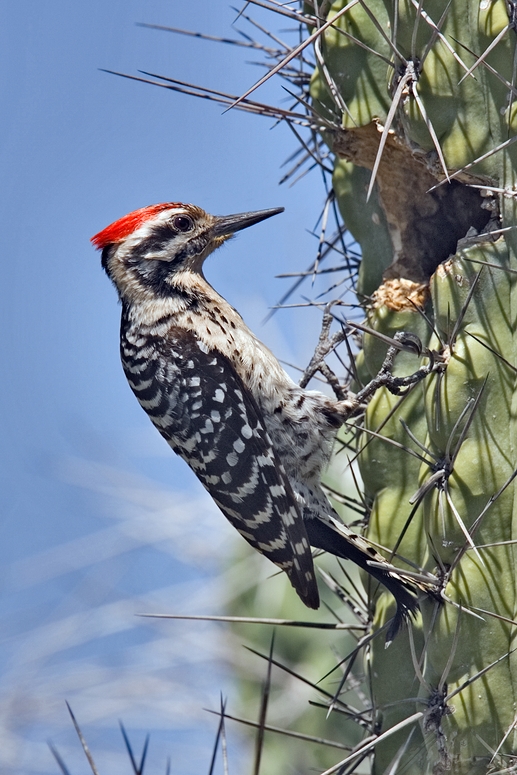
Dryobates scalaris occurs year-round in the southwestern United States, including extreme southern Nevada and extreme southeastern Colorado, and locally in Central America as far south as Nicaragua. It has predominantly black-and-white plumage with barred markings on its back and wings, a speckled rump, and cream-colored underparts speckled with black.
Written 26 November 2026 from the sources listed below. Each statement was checked against the passage it cites; statements that could not be supported were removed.
Appearance
The Ladder-backed Woodpecker has predominantly black-and-white plumage, with barred markings on its back and wings. Its rump is speckled, and its cream-colored breast and flank underparts are also speckled with black.[1][2]
Adult males have a red crown patch, which is smaller in immature birds and absent in adult females. Southern populations have darker buff-colored breasts and smaller bills than other populations.[3][4]
The Ladder-backed Woodpecker has less black on its head and upper back than Nuttall's Woodpecker.[5]
Habitat
The Ladder-backed Woodpecker commonly inhabits dry brushy areas and thickets. In arid environments, it uses large cacti as nesting sites.[6][7]
Diet
The Ladder-backed Woodpecker hunts insects and their larvae by boring into tree trunks with its bill. Its diet includes wood-boring insects and fruit produced by cacti.[8][9][10]
Behaviour
Ladder-backed Woodpeckers may visit feeding stations where mealworms are offered.[11]
Reproduction and life cycle
The species nests in cavities excavated from tree trunks. It also uses large cacti as nesting sites in arid environments.[7][12]
Females lay between two and seven eggs per clutch. The eggs are plain white, and both sexes incubate them.[13][14][15]
Uses
The Ladder-backed Woodpecker provides cavities for other organisms in desert ecosystems.[16]
Similar species
The Ladder-backed Woodpecker is similar in appearance to Nuttall's Woodpecker. Their ranges overlap minimally in southern California and northern Baja California.[17][18]
Classification of the Ladder-backed Woodpecker
| Kingdom | Animalia |
|---|---|
| Phylum | Chordata |
| Subphylum | Vertebrata |
| Infraphylum | Gnathostomata |
| Parvphylum | Osteichthyes |
| Megaclass | Tetrapoda |
| Class | Aves (Bird) |
| Order | Piciformes (Woodpeckers) |
| Family | Picidae (Woodpecker) |
| Subfamily | Picinae |
| Genus | Dryobates (Dryobates Woodpeckers) |
| Species | Dryobates scalaris (Wagler, 1829) |
Where the Ladder-backed Woodpecker is found
Checklists and occurrence records place Dryobates scalaris in 7 countries across North America. GBIF holds 1,030,776 georeferenced records of it.
Countries
- Belize 1,252
- El Salvador 22
- Guatemala 863
- Honduras 98
- Mexico 87,383
- Nicaragua 91
- United States 941,067
Regions and cities with the most records
- Texas, United States 411,999
- Arizona, United States 362,043
- New Mexico, United States 103,131
- Catalina Foothills, United States 79,798
- Casas Adobes, United States 73,855
- Flowing Wells, United States 71,432
- Tucson, United States 70,239
- Oro Valley, United States 67,778
- Drexel Heights, United States 45,986
- McAllen, United States 44,639
- Alamo, United States 44,347
- Donna, United States 43,506
- Tanque Verde, United States 41,026
- Reynosa, Mexico 40,953
- Rio Rico, United States 39,780
- Weslaco, United States 37,460
- California, United States 36,132
- Pharr, United States 35,744
- Albuquerque, United States 30,691
- Alton, United States 30,047
- San Juan, United States 29,790
- Mission, United States 28,326
- Rio Rancho, United States 27,439
- Sierra Vista, United States 26,072
- Cedar Park, United States 24,210
- Mercedes, United States 23,668
- South Valley, United States 23,607
- Austin, United States 22,798
- Green Valley, United States 22,095
- Brushy Creek, United States 18,221
- San Antonio, United States 18,096
- Live Oak, United States 17,388
- Nogales, United States 16,880
- Round Rock, United States 15,989
- Converse, United States 15,869
- Leander, United States 15,755
Range as the checklists state it
Middle America
North America
A number beside a place is its count of GBIF occurrence records. A place without a number comes from a checklist alone. Records show where a species has been observed or collected, which can include escapes and vagrants.
Common names
English
- Ladder-backed Woodpecker
- Cactus Woodpecker
Names in 27 other languages
- Catalan
- picot garser arlequí
- Chinese
- 梯背啄木, 紋背啄木鳥, 纹背啄木鸟
- Croatian
- pjegavoprsi djetlić
- Czech
- strakapoud proužkohřbetý
- Danish
- Hvidbåndet Flagspætte
- Dutch
- Ladderspecht
- Esperanto
- stridorsa pego
- Estonian
- kõnnu-kirjurähn
- Finnish
- meksikonkirjotikka
- French
- Pic arlequin
- German
- Texasspecht
- Italian
- Picchio scalare
- Japanese
- シマアカゲラ
- Latvian
- redeļu dzenis
- Lithuanian
- teksasinis genys
- Norwegian
- leiderspett
- Polish
- dzięcioł pasiasty
- Portuguese
- pica-pau-arlequim, pica-pau-galego-mexicano
- Russian
- Арлекиновый дятел, Техасский дятел
- Serbian
- Kaktusov detlić
- Slovak
- ďateľ harlekýn
- Spanish
- Carpintero mexicano, Pico mexicano
- Swedish
- bandryggig hackspett
- Turkish
- Meksika Alaca Ağaçkakanı
- Ukrainian
- дятел техаський
- Welsh
- cnocell y prysgdir
- nav
- Tsįįłkaałii noodǫ́zígíí
Synonyms
3 other scientific names have been used for this species and are now treated as synonyms of Dryobates scalaris.
- Dendrocopos scalaris (Wagler, 1829)
- Picoides scalaris (Wagler, 1829)
- Picus scalaris Wagler, JG, 1829
Subspecies and varieties
- Dryobates scalaris cactophilus (Texas Woodpecker) subspecies
- Dryobates scalaris eremicus (San Fernando Woodpecker) subspecies
- Dryobates scalaris graysoni subspecies
- Dryobates scalaris leucoptilurus subspecies
- Dryobates scalaris lucasanus (San Lucas Woodpecker) subspecies
- Dryobates scalaris parvus subspecies
- Dryobates scalaris scalaris subspecies
- Dryobates scalaris sinaloensis subspecies
- Dryobates scalaris soulei subspecies
Related species
-
 Downy WoodpeckerDryobates pubescens
-
 Lesser Spotted WoodpeckerDryobates minor
-
 Nuttall's WoodpeckerDryobates nuttallii
-
 Crimson-naped WoodpeckerDryobates cathpharius
- Northern FlickerColaptes auratus
-
 Pileated WoodpeckerDryocopus pileatus
-
 Ivory-billed WoodpeckerCampephilus principalis
-
 Red-bellied WoodpeckerMelanerpes carolinus
Compare
Questions and answers
What is the scientific name of the Ladder-backed Woodpecker?
The scientific name of the Ladder-backed Woodpecker is Dryobates scalaris. Written with its author, the full name is Dryobates scalaris (Wagler, 1829).
Which family does the Ladder-backed Woodpecker belong to?
Dryobates scalaris belongs to the family Picidae, in the order Piciformes and the class Aves.
Where is the Ladder-backed Woodpecker found?
Checklists and occurrence records place Dryobates scalaris in 7 countries, including United States, Mexico, Belize, Guatemala, Honduras and Nicaragua.
What is the conservation status of the Ladder-backed Woodpecker?
The IUCN Red List category recorded for Dryobates scalaris is Least Concern (LC).
What other names does the Ladder-backed Woodpecker have?
Dryobates scalaris is also known in English as Cactus Woodpecker.
What type of diet does a woodpecker have?
The Ladder-backed Woodpecker eats insects and their larvae, including wood-boring insects. It also consumes fruit produced by cacti.[8][9][10]
Sources
Passages the profile rests on
- The Ladder-backed Woodpecker has predominantly black-and-white plumage with barred markings on its back and wings. Source passage: “It is primarily colored black and white, with a barred pattern on its back and wings resembling the rungs of a ladder.” — English Wikipedia
- The species has a rump speckled with black and cream-colored breast and flank underparts that are also speckled with black. Source passage: “Its rump is speckled with black, as are its cream-colored underparts on the breast and flanks.” — English Wikipedia
- Southern populations have darker buff-colored breasts and smaller bills than other populations. Source passage: “Southern populations have duskier buff breasts and distinctly smaller bills.” — English Wikipedia
- Adult males have a red crown patch that is smaller in immature birds and absent in adult females. Source passage: “Adult males have a red crown patch that is smaller in immatures and lacking in adult females.” — English Wikipedia
- The Ladder-backed Woodpecker has less black on its head and upper back than Nuttall's Woodpecker. Source passage: “The ladder-backed woodpecker is very similar in appearance to Nuttall's woodpecker, but has much less black on its head and upper back” — English Wikipedia
- The Ladder-backed Woodpecker commonly inhabits dry brushy areas and thickets. Source passage: “The ladder-backed woodpecker is fairly common in dry brushy areas and thickets” — English Wikipedia
- The species uses large cacti as nesting sites in arid environments. Source passage: “or in more arid environments a large cactus will do.” — English Wikipedia
- The Ladder-backed Woodpecker hunts insects and their larvae by boring into tree trunks with its bill. Source passage: “Like most other woodpeckers the ladder-backed woodpecker bores into tree-trunks with its chisel-like bill to hunt for insects and their larva” — English Wikipedia
- The species also consumes fruit produced by cacti. Source passage: “but it also feeds on fruit produced by cacti.” — English Wikipedia
- Wood-boring insects are included in the species' diet. Source passage: “Diet: Wood-boring insects,” — wilcotx.gov
- Ladder-backed Woodpeckers may visit feeding stations where mealworms are offered. Source passage: “Ladder-backed Woodpeckers may come for mealworms offered at feeding” — allaboutbirds.org
- The species nests in cavities excavated from tree trunks. Source passage: “Ladder-backed woodpeckers nest in cavities excavated from tree trunks” — English Wikipedia
- Female Ladder-backed Woodpeckers lay between two and seven eggs per clutch. Source passage: “The female lays between 2 and 7 eggs, which are plain white.” — English Wikipedia
- The eggs of the Ladder-backed Woodpecker are plain white. Source passage: “The female lays between 2 and 7 eggs, which are plain white.” — English Wikipedia
- Both sexes incubate the eggs. Source passage: “The eggs are incubated by both sexes” — English Wikipedia
- The Ladder-backed Woodpecker provides cavities for other organisms in desert ecosystems. Source passage: “They are cavity providers in desert ecosystems.” — wilcotx.gov
- The Ladder-backed Woodpecker is similar in appearance to Nuttall's Woodpecker. Source passage: “The ladder-backed woodpecker is very similar in appearance to Nuttall's woodpecker” — English Wikipedia
- The ranges of the Ladder-backed Woodpecker and Nuttall's Woodpecker overlap minimally in southern California and northern Baja California. Source passage: “the range of the two species only intersects a minimal amount in southern California and northern Baja California.” — English Wikipedia
- The Ladder-backed Woodpecker occurs year-round in the southwestern United States, including extreme southern Nevada and extreme southeastern Colorado. Source passage: “The species can be found year-round over the southwestern United States (north to extreme southern Nevada and extreme southeastern Colorado)” — English Wikipedia
- The species occurs locally in Central America as far south as Nicaragua. Source passage: “locally in Central America as far south as Nicaragua.” — English Wikipedia
Data
- Catalogue of Life, 2026-10-16 XR cc by
- Global Biodiversity Information Facility CC BY 4.0
- Wikidata CC0
- GeoNames CC BY 4.0
- Wikimedia Commons per image; credit shown with each image
- Within the Catalogue of Life, this name comes from The Integrated Taxonomic Information System cc0
This species in other databases
Page built on 28 November 2026. See how the catalog is made and all sources and licences.
Cite this page
ScientificNames.org. (2026). Dryobates scalaris (Ladder-backed Woodpecker). Retrieved November 28, 2026, from https://scientificnames.org/species/dryobates-scalaris
“Dryobates scalaris (Ladder-backed Woodpecker).” ScientificNames.org, 2026, scientificnames.org/species/dryobates-scalaris. Accessed 28 Nov. 2026.
ScientificNames.org. “Dryobates scalaris (Ladder-backed Woodpecker).” Accessed November 28, 2026. https://scientificnames.org/species/dryobates-scalaris.
@misc{scientificnames_dryobates_scalaris_ladder_backed_woodpecker,
  author = {{ScientificNames.org}},
  title = {Dryobates scalaris (Ladder-backed Woodpecker)},
  year = {2026},
  url = {https://scientificnames.org/species/dryobates-scalaris},
  note = {Accessed 2026-11-28}
}