Comparison
Eastern Brown Snake vs Indian Cobra
Eastern Brown Snake (Pseudonaja textilis) and Indian Cobra (Naja naja) both belong to the family Elapidae (cobras) and part ways below it.

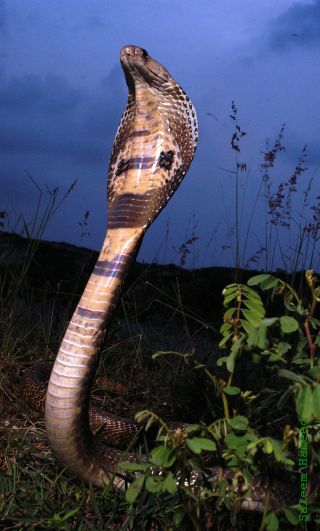


How they differ
The Eastern brown snake has a slender to moderate build and body colours ranging from near-black and light tan to chestnut and burnt-orange, whereas the Indian cobra is moderately sized, heavy-bodied and has a relatively large hood. The Eastern brown snake may raise its body and flatten its neck when threatened, whereas the Indian cobra expands its hood when threatened. The Eastern brown snake occurs in eastern Australia, parts of Papua New Guinea and the Indonesian region of New Guinea, whereas the Indian cobra is native to the Indian subcontinent, with documented distribution in India, Pakistan, Sri Lanka, Bangladesh and southern Nepal.
| Eastern Brown Snake | Indian Cobra | |
|---|---|---|
| Build and head | The Eastern brown snake has a slender to moderate build and a head barely distinct from its neck. | The Indian cobra is moderately sized and heavy-bodied, with an elliptical, depressed head that is only slightly distinct from its neck. |
| Appearance | The Eastern brown snake has body colours ranging from near-black and light tan to chestnut and burnt-orange, with a cream, yellow or orange ventral surface. | The Indian cobra has a relatively large hood, and many individuals have a hood marking consisting of two circular eye-like patterns connected by a curved line. |
| Pupils and scales | The Eastern brown snake has a round pupil, smooth and slightly glossy body scales, and 17 rows of midbody scales. | The Indian cobra has round pupils and smooth, strongly oblique dorsal scales. |
| Defensive behaviour | The Eastern brown snake may raise its body and flatten its neck in a defensive display when threatened. | The Indian cobra expands its hood when threatened. |
| Activity and feeding behaviour | The Eastern brown snake is primarily active during daylight and may delay foraging until late afternoon or early evening during very hot weather. | The Indian cobra bites its prey quickly and subsequently waits for its venom to paralyse or kill it before swallowing the prey whole. |
| Diet | The Eastern brown snake consumes frogs, reptiles, reptile eggs, birds and mammals, including introduced rats and mice. | The Indian cobra feeds on rodents, plovers, grebes, lizards and frogs. |
| Distribution | The Eastern brown snake occurs along eastern Australia's coast from northern Queensland through New South Wales and Victoria to South Australia's Yorke Peninsula, with disjunct populations in the Barkly Tableland and MacDonnell Ranges of the Northern Territory. | The Indian cobra is native to the Indian subcontinent, with documented distribution in India, Pakistan, Sri Lanka, Bangladesh and southern Nepal. |
| Habitat | The Eastern brown snake inhabits dry sclerophyll forests, coastal heathlands, savannah woodlands, grasslands, arid scrublands and farmland, and is particularly common in open agricultural and suburban areas. | The Indian cobra inhabits dense and open forests, plains, agricultural lands, rocky terrain and wetlands, and also occurs in populated villages and city outskirts. |
Written from the checked facts listed further down. Statements that the sources did not support were removed.
Side by side
| Eastern Brown Snake | Indian Cobra | |
|---|---|---|
| Scientific name | Pseudonaja textilis (Duméril, Bibron & Duméril, 1854) | Naja naja (Linnaeus, 1758) |
| English name | Eastern Brown Snake | Indian Cobra |
| Group | Reptiles | Reptiles |
| Class | Reptilia Reptile | Reptilia Reptile |
| Order | Squamata Snakes | Squamata Snakes |
| Family | Elapidae Cobras | Elapidae Cobras |
| Genus | Pseudonaja Australian Brown Snakes | Naja Cobras |
| Named in | 1854 | 1758 |
| Red List category | Least Concern | Least Concern |
| Environment | Not recorded | terrestrial |
| Countries on record | 2 countries | 15 countries |
| GBIF occurrence records | 23,519 records | 2,471 records |
Rows where the two agree are shown in grey.
Where each is found
Only Eastern Brown Snake (2)
Only Indian Cobra (15)
- Bangladesh
- Bhutan
- China
- India
- Indonesia
- Malaysia
- Myanmar
- Nepal
- Pakistan
- Philippines
- Singapore
- Sri Lanka
- Taiwan
- Thailand
- Vietnam
From Catalogue of Life checklists and GBIF occurrence records. A country missing from a list means no record is held, which is not proof of absence.
Checked facts
| Eastern Brown Snake | Indian Cobra | |
|---|---|---|
| Appearance |
|
|
| Size |
| No checked fact yet |
| Habitat |
|
|
| Diet |
|
|
| Behaviour |
|
|
| Reproduction |
|
|
| Distribution |
|
|
| Conservation |
|
|
| Uses | No checked fact yet |
|
| Similar species |
|
|
| Other | No checked fact yet |
|
In brief
Eastern Brown Snake
The eastern brown snake is a reptile with a slender to moderate build and a head barely distinct from its neck. It occurs along eastern Australia's coast, in parts of the Northern Territory, Papua New Guinea and the Indonesian region of New Guinea. Its body colour ranges from near-black and light tan to chestnut and burnt-orange, and its underside is cream, yellow or orange with coloured blotches. Full profile
Indian Cobra
The Indian Cobra (Naja naja) is a reptile in the family Elapidae, order Squamata, and genus Naja. It is native to the Indian subcontinent, with a documented distribution in India, Pakistan, Sri Lanka, Bangladesh, and southern Nepal. It is a moderately sized, heavy-bodied snake with a relatively large hood that expands when threatened. Full profile
Compare something else
Page built on 24 November 2026 from the data on the two species pages, where every source is listed.
Cite this page
ScientificNames.org. (2026). Eastern Brown Snake vs Indian Cobra. Retrieved November 24, 2026, from https://scientificnames.org/compare/eastern-brown-snake-vs-indian-cobra
“Eastern Brown Snake vs Indian Cobra.” ScientificNames.org, 2026, scientificnames.org/compare/eastern-brown-snake-vs-indian-cobra. Accessed 24 Nov. 2026.
ScientificNames.org. “Eastern Brown Snake vs Indian Cobra.” Accessed November 24, 2026. https://scientificnames.org/compare/eastern-brown-snake-vs-indian-cobra.
@misc{scientificnames_eastern_brown_snake_vs_indian_cobra,
  author = {{ScientificNames.org}},
  title = {Eastern Brown Snake vs Indian Cobra},
  year = {2026},
  url = {https://scientificnames.org/compare/eastern-brown-snake-vs-indian-cobra},
  note = {Accessed 2026-11-24}
}