Species · Reptiles
Indian Cobra Naja naja
The scientific name of the Indian Cobra is Naja naja. It is a species of reptile in the family Elapidae (cobras), order Squamata. The name dates from 1758.
- Scientific name
- Naja naja (Linnaeus, 1758)
- Common name
- Indian Cobra
- Genus
- Naja
- Family
- Elapidae (Cobras)
- Order
- Squamata
- Class
- Reptilia
- Red List category
- LC Least Concern
- Environment
- terrestrial
- Recorded in
- 15 countries
- Name status
- accepted in the Catalogue of Life
Overview
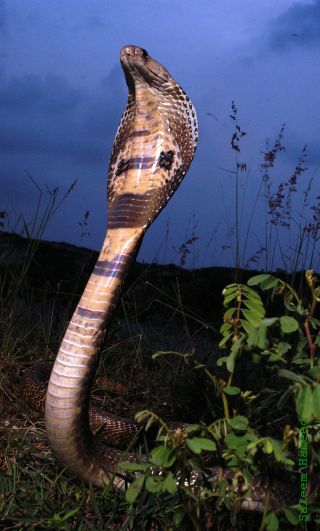
The Indian Cobra (Naja naja) is a reptile in the family Elapidae, order Squamata, and genus Naja. It is native to the Indian subcontinent, with a documented distribution in India, Pakistan, Sri Lanka, Bangladesh, and southern Nepal. It is a moderately sized, heavy-bodied snake with a relatively large hood that expands when threatened.
Written 24 November 2026 from the sources listed below. Each statement was checked against the passage it cites; statements that could not be supported were removed.
Appearance
The Indian Cobra is a moderately sized, heavy-bodied snake with a relatively large hood. It expands its hood when threatened. Many individuals have a hood marking consisting of two circular eye-like patterns connected by a curved line.[1][2][3]
Its head is elliptical and depressed, and only slightly distinct from the neck. Its snout is short and rounded, with large nostrils, while its eyes are medium-sized with round pupils.[4][5][6]
Its dorsal scales are smooth and strongly oblique.[7]
Habitat
The Indian Cobra inhabits dense and open forests, plains, agricultural lands, rocky terrain, and wetlands. It also occurs in populated villages and city outskirts.[8][9]
Its documented habitat range extends from sea level to 2,000 metres in altitude. The species is frequently found near water and is absent from true desert regions.[10][11][12]
Its preferred hiding places include embankment holes, tree hollows, termite mounds, rock piles, and small mammal dens. Sri Lankan populations inhabit terrestrial habitats at elevations of up to 1,500 metres.[13][14]
Diet
The Indian Cobra feeds on rodents, plovers, grebes, lizards, and frogs. It sometimes enters buildings while searching for rodents.[15][16]
Behaviour
The Indian Cobra bites its prey quickly and subsequently waits for its venom to paralyse or kill it. It swallows its prey whole.[17][18]
Reproduction and life cycle
The Indian Cobra is oviparous. Females generally lay between 10 and 30 eggs in rat holes or termite mounds.[19][20][21]
Eggs hatch between 48 and 69 days after being laid. Hatchlings measure between 20 and 30 centimetres in total length.[22][23]
Hatchlings are independent from birth and possess fully functional venom glands.[24]
Conservation
The Indian Cobra is protected under India's Wildlife Protection Act of 1972.[25]
Uses
The Indian Cobra is featured in Hindu mythology and culture. The species is commonly associated with snake charmers.[26][27]
Similar species
The Oriental rat snake (Ptyas mucosa) is frequently mistaken for the Indian Cobra. The monocled cobra can be distinguished from the Indian Cobra by its O-shaped hood marking.[28][29]
Classification of the Indian Cobra
| Kingdom | Animalia |
|---|---|
| Phylum | Chordata |
| Subphylum | Vertebrata |
| Infraphylum | Gnathostomata |
| Parvphylum | Osteichthyes |
| Megaclass | Tetrapoda |
| Class | Reptilia (Reptile) |
| Order | Squamata (Snakes) |
| Suborder | Serpentes (Snakes) |
| Infraorder | Alethinophidia |
| Family | Elapidae (Cobras) |
| Genus | Naja (Cobras) |
| Species | Naja naja (Linnaeus, 1758) |
Where the Indian Cobra is found
Checklists and occurrence records place Naja naja in 15 countries across Asia. GBIF holds 2,471 georeferenced records of it.
Countries
- Bangladesh 21
- Bhutan
- China 13
- India 1,880
- Indonesia 49
- Malaysia 22
- Myanmar 8
- Nepal 24
- Pakistan 115
- Philippines 21
- Singapore 4
- Sri Lanka 175
- Taiwan 27
- Thailand 89
- Vietnam 23
Regions and cities with the most records
- Karnataka, India 378
- Odisha, India 296
- Bengaluru, India 265
- Maharashtra, India 264
- Bhawānipatna, India 257
- Tamil Nadu, India 144
- Gujarat, India 117
- Khadki, India 110
- Pune, India 110
- Kharakvasla, India 109
- Pimpri, India 108
- Pimpri-Chinchwad, India 108
- Dehu Road, India 102
- Yelahanka, India 93
- Kerala, India 77
- Rajasthan, India 67
- Telangana, India 58
- Electronic City Phase I, India 56
- Airoli, India 52
- Thāne, India 51
- Mumbai, India 43
- Amreli, India 42
- Borivli, India 39
- Bihar, India 37
- Hyderabad, India 35
- Bhayandar, India 34
- Kukatpally, India 34
- Chhattisgarh, India 33
- Goa, India 33
- Quthbullapur, India 33
- Malkajgiri, India 32
- West Bengal, India 32
- Gaddi Annaram, India 30
- Himachal Pradesh, India 30
- Dombivali, India 29
- Andhra Pradesh, India 28
6 more countries have a few records outside this range
These countries hold a few records of Naja naja but lie outside the range the checklists give for it. Such records are often zoo or garden specimens, museum material or vagrants, so the species is not counted as occurring there.
Range as the checklists state it
Pakistan, India (throughout most of the country, incl. Madhya Pradesh, Assam, Tamil Nadu, Punjab, [Dino Aulakh, pers. comm.], Maharashtra, Kerala, Gujarat, Jammu and Kashmir, Telangana), Sri Lanka, Bangladesh, Nepal, Bhutan, E Afghanistan (?)
A number beside a place is its count of GBIF occurrence records. A place without a number comes from a checklist alone. Records show where a species has been observed or collected, which can include escapes and vagrants.
Common names
English
- Indian Cobra
- Central Asian Cobra
- Common Cobra
- Indian Spectacled Cobra
- Oxus Cobra
- Spectacled Cobra
Names in 43 other languages
- Afrikaans
- Brilkobra
- Arabic
- الناشر الهندي, كوبرا هندية
- Belarusian
- Змяя-акулярніца
- Bengali
- খৈয়া গোখরা
- Bulgarian
- Индийска кобра
- Catalan
- Cobra d'ulleres
- Cebuano
- agwason
- Chinese
- 印度眼鏡蛇
- Croatian
- Kobre
- Czech
- kobra indická
- Dutch
- Indiase brilcobra
- Finnish
- Silmälasikäärme
- French
- Cobra indien, Cobra à lunettes
- Georgian
- ინდური კობრა
- German
- Brillenschlange, Indische Kobra, Kobra, Südasiatische Kobra
- Gujarati
- નાગ
- Hebrew
- קוברה הודית
- Hindi
- नाग
- Hungarian
- pápaszemes kobra
- Indonesian
- Kobra India
- Italian
- Cobra dagli occhiali, Cobra indiano
- Japanese
- インドコブラ
- Kannada
- ಚೀನೀ ನಾಗರ
- Lithuanian
- Indiškoji kobra
- Malayalam
- ഇന്ത്യൻ മൂർഖൻ
- Mongolian
- Энэтхэг наж могой
- Nepali
- Kopre, गोमन
- Norwegian Bokmål
- Brilleslange, Indisk Kobra
- Polish
- kobra indyjska
- Portuguese
- Cobra-indiana, Cobra-naja, Naja
- Punjabi
- ਨਾਗ
- Russian
- Индийская кобра, Очковая змея
- Sinhala
- නයා, නාගයා
- Slovak
- Kobra okuliarnatá
- Slovenian
- naočarka
- Spanish
- Cobra India, Cobra de Anteojos
- Swedish
- Glasögonorm
- Tamil
- இந்திய நாகம், நாகம்
- Telugu
- నాగుపాము
- Turkish
- Adi kobra
- Ukrainian
- Індійська кобра, Кобра індійська
- ori
- ନାଗ
- pnb
- ڈبویا
Synonyms
22 other scientific names have been used for this species and are now treated as synonyms of Naja naja.
- Coluber caecus Gmelin, 1788
- Coluber naja Linnaeus, 1758
- Coluber rufus Gmelin, 1788
- Naia naia var. polyocellata Deraniyagala, 1939
- Naja brasiliensis Laurenti, 1768
- Naja fasciata Laurenti, 1768
- Naja lutescens Laurenti, 1768
- Naja lutrescens Laurenti, 1768
- Naja maculata Laurenti, 1768
- Naja naja bombaya Deraniyagala, 1961
- Naja naja ceylonicus Chatman & DI Mari, 1974
- Naja naja gangetica Deraniyagala, 1945
- Naja naja indusi Deraniyagala, 1960
- Naja naja karachiensis Deraniyagala, 1961
- Naja naja lutescens Deraniyagala, 1945
- Naja naja madrasiensis Deraniyagala, 1945
- Naja naja polyocellata Mehrtens, 1987
- Naja non-naja Laurenti, 1768
- Naja tripudians Merrem, 1820
- Naja tripudians f. typica Boulenger, 1896
- Naja nigra Gray, 1830 ambiguous synonym
- Naja tripudians var. caeca Boulenger, 1896 ambiguous synonym
Related species
-
 Egyptian CobraNaja haje
-
 Monocled CobraNaja kaouthia
-
 Caspian CobraNaja oxiana
-
 Forest CobraNaja melanoleuca
-
 Cape CobraNaja nivea
-
 Philippine CobraNaja philippinensis
-
 Red Spitting CobraNaja pallida
-
 Black-necked Spitting CobraNaja nigricollis
Compare
Questions and answers
What is the scientific name of the Indian Cobra?
The scientific name of the Indian Cobra is Naja naja. Written with its author, the full name is Naja naja (Linnaeus, 1758).
Which family does the Indian Cobra belong to?
Naja naja belongs to the family Elapidae, in the order Squamata and the class Reptilia.
Where is the Indian Cobra found?
Checklists and occurrence records place Naja naja in 15 countries, including India, Sri Lanka, Pakistan, Thailand, Indonesia and Taiwan.
What is the conservation status of the Indian Cobra?
The IUCN Red List category recorded for Naja naja is Least Concern (LC).
What other names does the Indian Cobra have?
Naja naja is also known in English as Central Asian Cobra, Common Cobra, Indian Spectacled Cobra, Oxus Cobra and Spectacled Cobra.
Whose scientific name is Naja naja?
Naja naja is the scientific name of the Indian Cobra. Carl Linnaeus first described the species in 1758.[30]
What do Indian cobras eat?
Indian Cobras feed on rodents, plovers, grebes, lizards, and frogs.[15]
Sources
Passages the profile rests on
- The Indian cobra is a moderately sized, heavy-bodied snake with a relatively large hood. Source passage: “The Indian cobra is a moderately sized, heavy-bodied species. This cobra species can easily be identified by its relatively large hood” — English Wikipedia
- The cobra expands its hood when threatened. Source passage: “which it expands when threatened.” — English Wikipedia
- Many individuals have a hood marking consisting of two circular eye-like patterns connected by a curved line. Source passage: “it consists of two circular ocelli patterns connected by a curved line, evoking the image of spectacles.” — English Wikipedia
- Its head is elliptical, depressed, and only slightly distinct from the neck. Source passage: “This species has a head that is elliptical, depressed, and very slightly distinct from the neck.” — English Wikipedia
- Its snout is short and rounded, with large nostrils. Source passage: “The snout is short and rounded with large nostrils.” — English Wikipedia
- Its eyes are medium-sized and have round pupils. Source passage: “The eyes are medium in size and the pupils are round.” — English Wikipedia
- Its dorsal scales are smooth and strongly oblique. Source passage: “Dorsal scales are smooth and strongly oblique.” — English Wikipedia
- The Indian cobra inhabits dense and open forests, plains, agricultural lands, rocky terrain, and wetlands. Source passage: “It can be found in dense or open forests, plains, agricultural lands (rice paddy fields, wheat crops), rocky terrain, wetlands” — English Wikipedia
- The species also occurs in populated villages and city outskirts. Source passage: “and it can even be found in heavily populated urban areas, such as villages and city outskirts” — English Wikipedia
- Its documented habitat range extends from sea level to 2,000 metres in altitude. Source passage: “ranging from sea level to 2,000 metres (6,600 ft) in altitude.” — English Wikipedia
- The Indian cobra is frequently found near water. Source passage: “The Indian cobra is often found in the vicinity of water.” — English Wikipedia
- The species is absent from true desert regions. Source passage: “This species is absent from true desert regions.” — English Wikipedia
- Its preferred hiding places include embankment holes, tree hollows, termite mounds, rock piles, and small mammal dens. Source passage: “Preferred hiding locations are holes in embankments, tree hollows, termite mounds, rock piles and small mammal dens.” — English Wikipedia
- Sri Lankan populations inhabit terrestrial habitats at elevations of up to 1,500 metres. Source passage: “the spectacled cobra in Sri Lanka inhabits a wide range of terrestrial habitat, up to an elevation of 1500m” — pmc.ncbi.nlm.nih.gov
- The Indian cobra feeds on rodents, plovers, grebes, lizards, and frogs. Source passage: “The Indian cobra feeds on rodents, plovers, grebes, lizards and frogs.” — English Wikipedia
- The species sometimes enters buildings while searching for rodents. Source passage: “This species sometimes enters buildings in search of rodent prey.” — English Wikipedia
- The Indian cobra bites its prey quickly and subsequently waits for its venom to paralyse or kill it. Source passage: “It bites quickly, and then waits while its venom damages the nervous system of the prey, paralyzing and often killing it.” — English Wikipedia
- The species swallows its prey whole. Source passage: “Like all snakes, N. naja swallows its prey whole.” — English Wikipedia
- The Indian cobra is oviparous. Source passage: “The Indian cobra is oviparous, laying eggs in the months of April through July.” — English Wikipedia
- Females generally lay between 10 and 30 eggs. Source passage: “The female usually lays between 10 and 30 eggs” — English Wikipedia
- Females deposit their eggs in rat holes or termite mounds. Source passage: “in rat holes or termite mounds” — English Wikipedia
- Eggs hatch between 48 and 69 days after being laid. Source passage: “which hatch 48 to 69 days later.” — English Wikipedia
- Hatchlings measure between 20 and 30 centimetres in total length. Source passage: “Each hatchling measures 20–30 cm (8–12 in) in total length (tail included).” — English Wikipedia
- Hatchlings are independent from birth and possess fully functional venom glands. Source passage: “The hatchlings are independent from birth and have fully functional venom glands.” — English Wikipedia
- The Indian cobra is protected under India's Wildlife Protection Act of 1972. Source passage: “It is a protected species under the Indian Wildlife Protection Act (1972).” — English Wikipedia
- The Indian cobra is featured in Hindu mythology and culture. Source passage: “The Indian cobra is revered in Hindu mythology and culture” — English Wikipedia
- The species is commonly associated with snake charmers. Source passage: “and is often seen with snake charmers.” — English Wikipedia
- The Oriental rat snake (Ptyas mucosa) is frequently mistaken for the Indian cobra. Source passage: “The Oriental rat snake Ptyas mucosa is often mistaken for the Indian cobra” — English Wikipedia
- The monocled cobra can be distinguished from the Indian cobra by its O-shaped hood marking. Source passage: “the monocled cobra has an O-shaped pattern on the back of the hood, while the Indian cobra has a spectacles-shaped pattern on its hood.” — English Wikipedia
- Carl Linnaeus first described Naja naja in 1758. Source passage: “The species Naja naja was first described by the Swedish physician, zoologist, and botanist Carl Linnaeus in 1758.” — English Wikipedia
Data
- Catalogue of Life, 2026-10-16 XR cc by
- Global Biodiversity Information Facility CC BY 4.0
- Wikidata CC0
- GeoNames CC BY 4.0
- Wikimedia Commons per image; credit shown with each image
- Within the Catalogue of Life, this name comes from The Reptile Database cc by
References
- Linné, C. [= Linnaeus, C.]. (1758). Systema naturæ per regna tria naturæ, secundum classes, ordines, genera, species, cum characteribus, differentiis, synonymis, locis. Tomus I. Editio decima, reformata. Laurentii Salvii, Holmiæ. 10th Edition: 824 Pp.
- Shaw, George & Nodder, Frederick P. (Eds.). (1791). The Naturalist’s Miscellany [...], Vol. II. London, Nodder & Co., Plates 38- 74, 157 Unnumbered Pages [Published in Monthly Issues between August 1, 1790, and July 1, 1791].
- Shaw, George & Nodder, Frederick P. (Eds.). (1794). The Naturalist’s Miscellany [...], Vol. V. London, Nodder & Co., Plates 147-182, 158 Unnumbered Pages [Published in Monthly Issues between between August 1, 1793, and July 1, 1794].
- Boulenger, George A. (1890). The Fauna of British India, Including Ceylon and Burma. Reptilia and Batrachia. Taylor & Francis, London, Xviii, 541 Pp.
- Sclater, W. L. (1891). Notes on a collection of snakes in the Indian Museum, with descriptions of several new species. J. Asiat. Soc. Bengal LX: 230-250.
- Boulenger, G. A. (1896). Catalogue of the snakes in the British Museum, Vol. 3. London (Taylor & Francis), Xiv + 727 Pp.
- Bannerman, W. B., & Pocha, J. P. (1905). On the Distribution of the Varieties of Cobra (Naia tripudians) in India. J. Bombay Nat. Hist. Soc. 16: 638-643.
- Wall, F. (1906). The poisonous snakes of India and how to recognize them, Part II. J. Bombay Nat. Hist. Soc. 17: 299-334.
- Bannermann, W. B. (1907). A further note on the distribution of the varieties of Cobra in India. J. Bombay Nat. Hist. Soc. 17: 1031-1033.
- Wall, F. (1913). A popular treatise on the common Indian snakes (part 3). J. Bombay Nat. Hist. Soc. 22: 550-568.
- Luard, C. E. (1918). The Varieties of Cobras in Central India. J. Bombay Nat. Hist. Soc. 25: 510.
- Smith, M. A. (1943). The Fauna of British India, Ceylon and Burma, Including the Whole of the Indo-Chinese Sub-Region. Reptilia and Amphibia. 3 (Serpentes). Taylor and Francis, London. 583 Pp.
- Constable, JOHN D. (1949). Reptiles from the Indian Peninsula in the Museum of Comparative Zoology. Bull. Mus. Comp. Zool. Harvard 103: 59-160.
- Tweedie, M. W. F. (1954). Notes on Malayan reptiles, No.3. Bull. Raffles Mus. No 25: 107-117.
- Broadley, D. G. (1958). Snakes of Southern Rhodesia. 6. The Egyptian cobra (Naja haje haje). Afr. Wild Life 12: 125-128.
- Taylor, E. H. (1965). The serpents of Thailand and adjacent waters. Univ. Kansas Sci. Bull. 45 (9): 609-1096.
- Sharma, R. C. (1976). Records of the reptiles of Goa. Records Zool. Survey India 71 (1975): 149-167.
- Branch, W. R. (1981). The venomous snakes of southern Africa 2. Elapidae and Hydrophidae. Bull. Maryland Herp. Soc. 17 (1): 1-47.
- Dowling, H.G., & Jenner, J.V. (1988). Snakes of Burma: checklist of reported species and bibliography. Smithsonian Herp. Inf. Serv. (76): 19 Pp.
- Wüster, W., & Thorpe, R. S. (1991). Asiatic cobras: Systematics and snakebite. Experientia 47: 205-209.
- Wüster, W., & Thorpe, R. S. (1992). Asiatic cobras: population systematics of the Naja naja species complex (Serpentes: Elapidae) in India and Central Asia. Herpetologica 48: 69-85.
- Wüster, & Wolfgang. (1993). A century of confusion: Asiatic cobras revisited. Vivarium 4 (4): 14-18.
- Zug, G. R., & Mitchell, J. C. (1995). Amphibians and Reptiles of the Royal Chitwan National Park, Nepal. Asiatic Herpetological Research 6: 172-180.
- Damm, M. (1996). Naja naja (LINNAEUS, 1758). Sauria 18 Suppl.: 361–364.
- Wüster, & Wolfgang. (1998). The cobras of the genus Naja in India. Hamadryad 23 (1): 15-32.
This species in other databases
- Catalogue of Life 45KXG
- Wikidata Q192754
- iNaturalist 53492
- WoRMS urn:lsid:marinespecies.org:taxname:1560749
- ITIS 700632
Page built on 24 November 2026. See how the catalog is made and all sources and licences.
Cite this page
ScientificNames.org. (2026). Naja naja (Indian Cobra). Retrieved November 24, 2026, from https://scientificnames.org/species/naja-naja
“Naja naja (Indian Cobra).” ScientificNames.org, 2026, scientificnames.org/species/naja-naja. Accessed 24 Nov. 2026.
ScientificNames.org. “Naja naja (Indian Cobra).” Accessed November 24, 2026. https://scientificnames.org/species/naja-naja.
@misc{scientificnames_naja_naja_indian_cobra,
  author = {{ScientificNames.org}},
  title = {Naja naja (Indian Cobra)},
  year = {2026},
  url = {https://scientificnames.org/species/naja-naja},
  note = {Accessed 2026-11-24}
}