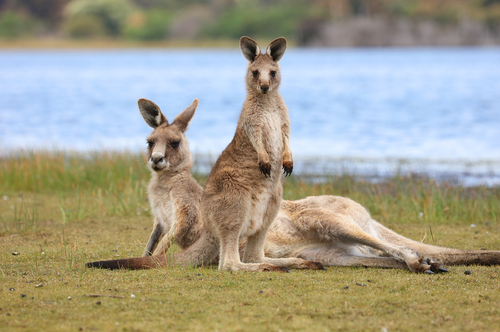
| Appearance | - The Eastern Grey Kangaroo has a light grey woolly coat, a darker face and a dark fur tip on its tail. australian.museum
- Its hind legs are larger than its forelimbs, and its hind feet are large and powerful. australian.museum
- Its long muscular tail provides balance during hopping and acts as a fifth limb during slow movement. australian.museum
- The species has a powerful tail that exceeds one metre in length in adult males. English Wikipedia
| - The quokka has coarse, grey-brown fur with lighter coloration underneath. australian.museum
- The quokka has a short, broad face, a naked nose and rounded furry ears. australian.museum
- The quokka has a relatively short tail that is mostly hairless. australian.museum
|
|---|
| Size | - Adult males commonly weigh between 50 and 66 kilograms. English Wikipedia
- Adult females commonly weigh between 17 and 40 kilograms. English Wikipedia
- Male Eastern Grey Kangaroos can reach 1.3 metres in body length and one metre in tail length. australian.museum
- Female Eastern Grey Kangaroos can reach one metre in body length and 0.84 metres in tail length. australian.museum
| |
|---|
| Habitat | - The species inhabits open grasslands with nearby bushland that provides daytime shelter. English Wikipedia
- Its habitats include coastal areas, woodlands, subtropical forests, mountain forests and inland scrublands. English Wikipedia
- The species occupies habitats ranging from semi-arid mallee scrub to woodlands and forests. australian.museum
- Eastern Grey Kangaroos favour denser scrub and forest habitats. australian.museum
- The species occurs in woodlands at altitudes extending into subalpine areas. australian.museum
| |
|---|
| Diet | | |
|---|
| Behaviour | - Eastern Grey Kangaroos are primarily nocturnal and crepuscular. English Wikipedia
- The species rests in tree or scrub shade during the day and moves into open areas to graze from late afternoon until early morning. australian.museum
- Eastern Grey Kangaroos form social groups that average three individuals. English Wikipedia
- The species also forms mobs containing ten or more individuals. australian.museum
- Eastern Grey Kangaroos are not territorial. English Wikipedia
- The species communicates through a series of clucking sounds. australian.museum
- Aggressive males and alarmed individuals of either sex produce a guttural cough. australian.museum
| |
|---|
| Reproduction | - Eastern Grey Kangaroos have a polygynous mating system in which one male mates with multiple females. English Wikipedia
- Breeding occurs throughout the year, with reproductive activity peaking in summer. australian.museum
- The gestation period is 36 days after mating. australian.museum
- Newborn joeys weigh less than one gram. australian.museum
- Newborn joeys independently climb into their mother's pouch after birth. australian.museum
- Joeys begin leaving the pouch at approximately nine months of age. australian.museum
- Young Eastern Grey Kangaroos become independent at approximately 18 months of age. australian.museum
- Females can suspend embryonic development until an existing joey leaves the pouch. English Wikipedia
- Female Eastern Grey Kangaroos reach sexual maturity between 17 and 28 months. English Wikipedia
- Male Eastern Grey Kangaroos reach sexual maturity at approximately 25 months. English Wikipedia
| - The quokka's gestation period lasts approximately one month. animaldiversity.org
- Female quokkas generally give birth to one offspring per pregnancy. animaldiversity.org
- Quokka joeys remain in their mother's pouch for approximately six months. australian.museum
- Quokka joeys continue suckling from their mother's teats for approximately two months after leaving the pouch. australian.museum
- Quokka joeys are usually weaned by eight months of age. australian.museum
- Female quokkas can reproduce from approximately 18 months of age. australian.museum
- The peak breeding season for quokkas occurs between January and March. animaldiversity.org
- Rottnest Island quokkas have a breeding season extending from January through August. australian.museum
- Male quokkas do not provide parental care to their offspring. animaldiversity.org
- Female quokkas can produce approximately 17 offspring over their lifetimes on the mainland. australian.museum
|
|---|
| Lifespan | | No checked fact yet |
|---|
| Distribution | - The Eastern Grey Kangaroo occurs across the eastern third of Australia. English Wikipedia
- The species occurs across most eastern Australian states, including Tasmania. australian.museum
| - The quokka is restricted to southwestern Western Australia. australian.museum
- Quokka populations occur on Rottnest Island near Perth and Bald Island near Albany. australian.museum
- Mainland quokka populations occur in Two Peoples Bay Nature Reserve, Torndirrup National Park, Mt Manypeaks National Park and Stirling Range National Park. australian.museum
|
|---|
| Conservation | - The Eastern Grey Kangaroo is classified as Least Concern by the IUCN conservation assessment reported by the Australian Museum. australian.museum
- The species is protected by law in Australia. australian.museum
- Commercial harvesting of the species for export is permitted only for licensed hunters. australian.museum
| - The quokka is classified as vulnerable by the IUCN. English Wikipedia
- Introduced European red foxes, cats and dogs threaten mainland quokka populations. animaldiversity.org
- Agricultural development, housing expansion and logging have contributed to reductions in quokka populations. australian.museum
- Island quokka populations are less susceptible to declines because Rottnest Island is free of foxes. australian.museum
|
|---|
| Uses | - Indigenous peoples have hunted Eastern Grey Kangaroos for food and skins for thousands of years. australian.museum
- Kangaroo meat has been considered as an alternative to beef. English Wikipedia
| - Quokkas have been used in medical research investigating muscular dystrophy. australian.museum
|
|---|
| Similar species | No checked fact yet | - Quokkas resemble marsupials belonging to the Petrogale and Macropus giganteus groups. animaldiversity.org
|
|---|
| Name origin | - The scientific name Macropus giganteus is explained as meaning gigantic large-foot. English Wikipedia
| No checked fact yet |
|---|
| Other | - George Shaw described the species in 1790. English Wikipedia
- The species has an estimated Australian-wide population of 11.4 million individuals, based on a 2010 estimate. English Wikipedia
| No checked fact yet |
|---|