Comparison

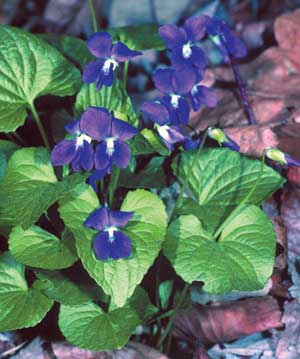
Eggleston's Violet vs North American Common Blue Violet

Eggleston's Violet (Viola egglestonii) and North American Common Blue Violet (Viola sororia) both belong to the genus Viola (violets) and part ways below it. Both are recorded in 2 countries.

Eggleston's Violet

Eggleston's Violet

Viola egglestonii

Mason Brock (Masebrock), Public domain, via Wikimedia Commons

North American Common Blue Violet

North American Common Blue Violet

Viola sororia

Unknown author, Public domain, via Wikimedia Commons

Side by side

Eggleston's VioletNorth American Common Blue Violet
Scientific nameViola egglestonii BrainerdViola sororia Willd.
English nameEggleston's VioletNorth American Common Blue Violet
GroupFlowering plantsFlowering plants
ClassMagnoliopsidaMagnoliopsida
OrderMalpighialesMalpighiales
FamilyViolaceae Violet FamilyViolaceae Violet Family
GenusViola VioletsViola Violets
Countries on record2 countries5 countries
GBIF occurrence records482 records19,318 records

Rows where the two agree are shown in grey.

Where each is found

Both recorded in 2 countries

Only North American Common Blue Violet (3)

From Catalogue of Life checklists and GBIF occurrence records. A country missing from a list means no record is held, which is not proof of absence.

Checked facts

Eggleston's VioletNorth American Common Blue Violet
Appearance
  • Viola egglestonii is a stemless violet with blue to purple flowers and deeply divided leaves. English Wikipedia
  • Its leaves are hairless throughout. people.ohio.edu
  • Its largest leaves are divided into seven or nine lobes. people.ohio.edu
  • Its leaf blades have an ovate to subreniform outline. people.ohio.edu
  • Its leaf lobes have entire proximal margins and serrated distal margins. people.ohio.edu
  • Its flowers are blue to purple, with white coloration extending from the throat onto the lateral petals and halfway down the spurred petal. people.ohio.edu
  • Its lateral petals are densely bearded with narrowly linear to slightly clavate hairs. people.ohio.edu
  • Its spurred petal is sparsely to densely bearded. people.ohio.edu
  • Its calyx is hairless or sparsely ciliate. people.ohio.edu
  • Its mature cleistogamous capsules are green before drying tan and are unspotted and hairless. people.ohio.edu
  • Its seeds are medium to dark brown and unspotted. people.ohio.edu
  • The lower three petals of the flowers are hairy. English Wikipedia
  • The flowers can be white, blue, or purple. English Wikipedia
  • The flowers have five petals, with two pointing upward and three pointing downward. extension.psu.edu
  • The flowers have dark veins radiating from their whitish throats toward the petals. extension.psu.edu
  • The leaves are heart-shaped to oval-shaped with rounded teeth along their margins. extension.umn.edu
  • The leaves grow alternately and have smooth, waxy upper surfaces and hairy undersides. extension.umn.edu
Size
  • Its chasmogamous flowers measure up to 17 mm. people.ohio.edu
  • Its seeds measure 2.7–3.3 mm by 1.3–1.7 mm, with the source also recording a possible smaller length of 1.8 mm. people.ohio.edu
Habitat
  • The species grows in dry rock crevices within limestone cedar glades. people.ohio.edu
  • It sometimes persists in disturbed limestone-overlying habitats such as pastures and roadsides. people.ohio.edu
  • Its native habitat consists of limestone cedar glades in the Interior Highlands. people.ohio.edu
DietNo checked fact yet
  • The plant provides food for wild turkeys, rabbits, deer, livestock, mourning doves, bobwhites, and white-footed mice. English Wikipedia
  • The plant's leaves and flowers are edible, while its roots are not edible. English Wikipedia
  • The plant's leaves can be eaten as a potherb, and its leaves and flowers can be added to salads. naturalresources.extension.iastate.edu
  • The plant serves as a food source for songbirds, wild turkeys, grouse, bobwhites, mourning doves, and mice. extension.psu.edu
Behaviour
  • The species produces cleistogamous flowers after its chasmogamous flowers. people.ohio.edu
Reproduction
  • The species produces chasmogamous flowers from April through May. people.ohio.edu
  • Its chasmogamous fruits develop from May through June. people.ohio.edu
  • Its cleistogamous fruits develop in July. people.ohio.edu
  • Its cleistogamous flower stalks are prostrate and arch shortly before the capsules open. people.ohio.edu
  • A hybrid involving this species and Viola sororia has been identified from a specimen collected in Rutherford County, Tennessee. people.ohio.edu
  • The reported hybrid exhibited intermediate foliage characteristics. people.ohio.edu
  • The source reports that information about hybrid reproduction is unavailable. people.ohio.edu
Distribution
  • The species is native to a small area of eastern North America. English Wikipedia
  • Its documented native range includes Alabama, Georgia, Indiana, Kentucky, and Tennessee. English Wikipedia
  • Its regional range extends from southern Indiana south to northwestern Georgia and northern Alabama. people.ohio.edu
  • Disjunct populations have been reported in southern Ontario and Quebec. people.ohio.edu
  • The species is most common in Tennessee's Nashville Basin. English Wikipedia
  • The plant is native to eastern North America. English Wikipedia
  • The plant occurs across the eastern half of the United States, Canada, and part of eastern Mexico. English Wikipedia
Conservation
  • The species' limestone cedar glade habitat is generally rare. English Wikipedia
  • Populations are tracked in every state in its documented range except Tennessee. English Wikipedia
  • The species is state-listed in Indiana and Kentucky under the name Viola septemloba var. egglestonii. people.ohio.edu
  • The species appears capable of persisting in degraded limestone cedar glades. people.ohio.edu
  • The status and origin of the disjunct Canadian populations require further study. people.ohio.edu
No checked fact yet
UsesNo checked fact yet
Similar species
  • Among regional heterophyllous violets with hairless foliage, the species most closely resembles Viola edulis and Viola viarum. people.ohio.edu
  • It differs from similar violets through its deeply divided leaves with seven to nine narrow lobes, rounded sepals, bearded spurred petal, and unspotted cleistogamous capsules. people.ohio.edu
No checked fact yet
Other
  • The species belongs to the Viarum species group within the Acaulescent Blue Violet lineage. people.ohio.edu
  • The Indiana Plant Atlas classifies the species as a forb with perennial growth duration. indiana.plantatlas.usf.edu
No checked fact yet

In brief

Eggleston's Violet

Viola egglestonii grows in limestone cedar glades in the Interior Highlands and is native to a small area of eastern North America. It is distinguished by deeply divided, hairless leaves with seven or nine lobes and blue to purple flowers with white coloration. Full profile

North American Common Blue Violet

Viola sororia is native to eastern North America and occurs in the eastern half of the United States, Canada, and part of eastern Mexico. It has heart-shaped leaves and five-petaled flowers that can be white, blue, or purple. Full profile

Compare something else

Page built on 29 November 2026 from the data on the two species pages, where every source is listed.

Cite this page

ScientificNames.org. (2026). Eggleston's Violet vs North American Common Blue Violet. Retrieved November 29, 2026, from https://scientificnames.org/compare/egglestons-violet-vs-north-american-common-blue-violet