Species · Flowering plants
North American Common Blue Violet Viola sororia
The scientific name of the North American Common Blue Violet is Viola sororia. It is a species of flowering plant in the family Violaceae (violet family), order Malpighiales.
- Scientific name
- Viola sororia Willd.
- Common name
- North American Common Blue Violet
- Genus
- Viola
- Family
- Violaceae (Violet Family)
- Order
- Malpighiales
- Class
- Magnoliopsida
- Recorded in
- 5 countries
- Name status
- accepted in the Catalogue of Life
Overview
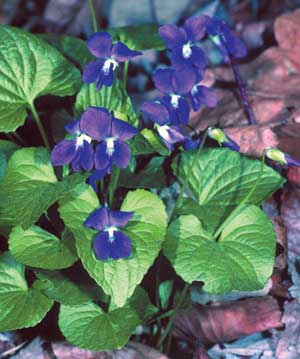
Viola sororia is native to eastern North America and occurs in the eastern half of the United States, Canada, and part of eastern Mexico. It has heart-shaped leaves and five-petaled flowers that can be white, blue, or purple.
Written 26 November 2026 from the sources listed below. Each statement was checked against the passage it cites; statements that could not be supported were removed.
Appearance
The leaves are heart-shaped to oval-shaped, with rounded teeth along their margins. They grow alternately and have smooth, waxy upper surfaces and hairy undersides.[1][2]
The flowers have five petals, with two pointing upward and three pointing downward. They can be white, blue, or purple, and have dark veins radiating from their whitish throats toward the petals.[3][4][5]
The lower three petals of the flowers are hairy.[6]
The plant typically measures 15–25 centimeters in width and can grow approximately 3–10 inches tall.[7][8]
Habitat
The plant occurs in rich, moist woods, swamps, forests, thickets, and areas near stream beds.[9][10]
It also grows in open woods, lawns, gardens, and other human-created habitats. It can grow in full sun or partial shade.[11][12]
It thrives in moist, shaded soils with high organic matter content and can tolerate full sun and clay soils.[13][14]
Reproduction and life cycle
Its seed capsules can eject seeds as far as 2.7 meters from the parent plant. Ants also disperse the seeds by carrying them to their nests, attracted by fatty elaiosomes on the seeds.[15][16][17]
The plant produces underground rhizomes and fibrous root systems capable of producing new plants. It can form vegetative colonies.[18][19]
The plant readily reseeds and can form groundcover without spreading by runners.[20]
Behaviour
The plant's foliage usually declines during hot summers. It can adapt to sunny or partly shady forest conditions and can grow beneath black walnut trees.[21][22][23]
Diet
The plant provides food for wild turkeys, rabbits, deer, livestock, mourning doves, bobwhites, white-footed mice, songbirds, grouse, and mice.[24][25]
Its leaves and flowers are edible, but its roots are not edible. The leaves can be eaten as a potherb, and the leaves and flowers can be added to salads.[26][27]
Uses
The plant has historically been used as a food and medicinal plant. Its young leaves and flower buds can be eaten raw or cooked or brewed into tea.[28][29]
Native Americans have used the plant as a poultice for headaches and boils. It has also been used as an infusion for dysentery, kidney problems, bladder issues, heart pain, colds, and coughs.[30][31]
The plant is used as groundcover in lawns and gardens. It can fill shady garden areas where turfgrass does not grow well.[32][33]
Classification of the North American Common Blue Violet
| Kingdom | Plantae |
|---|---|
| Subkingdom | Pteridobiotina |
| Phylum | Tracheophyta |
| Class | Magnoliopsida |
| Order | Malpighiales |
| Family | Violaceae (Violet Family) |
| Subfamily | Violoideae |
| Genus | Viola (Violets) |
| Species | Viola sororia Willd. |
Where the North American Common Blue Violet is found
Checklists and occurrence records place Viola sororia in 5 countries across Asia and North America. GBIF holds 19,318 georeferenced records of it.
Countries where it is native or its origin is not stated
Countries where it has been introduced
Regions and cities with the most records
- Pennsylvania, United States 1,336
- Wisconsin, United States 841
- Quebec, Canada 470
- New York, United States 435
- Minnesota, United States 396
- North Carolina, United States 314
- Virginia, United States 311
- Connecticut, United States 296
- Michigan, United States 289
- Florida, United States 269
- Maryland, United States 231
- Missouri, United States 216
- Illinois, United States 215
- Indiana, United States 214
- Ontario, Canada 213
- Massachusetts, United States 202
- Silver Spring, United States 192
- Bethesda, United States 191
- Mount Pleasant, United States 190
- Wheaton, United States 190
- Central 14th Street / Spring Road, United States 188
- Takoma Park, United States 188
- Chillum, United States 187
- Brightwood, United States 186
- Arlington, United States 184
- Adams Morgan, United States 183
- Adelphi, United States 183
- Kennedy Street, United States 183
- Petworth, United States 183
- Foggy Bottom, United States 182
- Langley Park, United States 181
- White Oak, United States 181
- Columbia Heights, United States 180
- Golden Triangle, United States 180
- Park View, United States 180
- Pleasant Plains, United States 179
15 more countries have a few records outside this range
These countries hold a few records of Viola sororia but lie outside the range the checklists give for it. Such records are often zoo or garden specimens, museum material or vagrants, so the species is not counted as occurring there.
Range as the checklists state it
Siberia [I] (W-Siberia [I]); South Korea [I]; Japan [I]; Canada (British Columbia, New Brunswick, Newfoundland, Nova Scotia, Ontario, Prince Edward Isl., Québec, Saskatchewan); USA (Alabama, Arkansas, Connecticut, District of Columbia, Delaware, Florida, Georgia, Iowa, Illinois, Indiana, Kansas, Kentucky, Louisiana, Massachusetts, Maryland, Maine, Michigan, Minnesota, Missouri, Mississippi, Montana, North Carolina, North Dakota, Nebraska, New Hampshire, New Jersey, New York, Ohio, Oklahoma, Pennsylvania, Rhode Island, South Carolina, South Dakota, Tennessee, Texas, Virginia, Vermont, Washington State, Wisconsin, West Virginia); Mexico (Veracruz, Coahuila, Nuevo León, etc.)
A number beside a place is its count of GBIF occurrence records. A place without a number comes from a checklist alone. Records show where a species has been observed or collected, which can include escapes and vagrants.
Common names
English
- North American Common Blue Violet
- Bayou Violet
- Blue Praire Violet
- Blue Prairie Violet
- Dooryard Violet
- Downy Blue Violet
- Sister Violet
- Violet
- Woolly Blue Violet
Names in 23 other languages
- Chinese
- 藍堇菜
- Croatian
- Šumska ljubica
- Czech
- fialka motýlkovitá, violka sesterská
- Danish
- pinseviol
- Dutch
- Zusterviooltje
- Estonian
- liblikjas kannike
- Finnish
- perhosorvokki
- French
- Violette de la Pentecôte, Violette papilionacée, Violette septentrional, violette commune, violette parente, violette septentrionale
- German
- Pfingst-Veilchen
- Hungarian
- csíkos ibolya
- Italian
- Viola sorella
- Japanese
- amerika-fuki-sumire, amerika-sumire-saishin, アメリカスミレサイシン(旧名)
- Korean
- 종지나물
- Lithuanian
- Šiaurinė našlaitė
- Polish
- Fiołek motylkowaty, Fiołek motylkowy
- Portuguese
- Violeta-azul-comum-da-américa-do-norte
- Russian
- Фиалка сестринская
- Slovak
- fialka americká
- Slovenian
- ameriška vijolica
- Swedish
- fjärilsviol
- Ukrainian
- Фіалка північноамериканська звичайна
- chr
- ᏗᎾᏓᏍᏓᏍᎩ
- oji
- Waawiyebagoon
Synonyms
28 other scientific names have been used for this species and are now treated as synonyms of Viola sororia.
- Viola alachuana Murrill
- Viola allardii Greene
- Viola cucullata var. alba Torr. & A.Gray
- Viola cucullata var. sororia (Willd.) Torr. & A.Gray
- Viola cuspidata Greene
- Viola domestica E.P.Bicknell
- Viola domestica f. alba Farw.
- Viola laetecaerulea Greene
- Viola nodosa Greene
- Viola palmata var. sororia (Willd.) Pollard
- Viola papilionacea Pursh
- Viola papilionacea f. albiflora Grover
- Viola papilionacea f. michaelii Creutz
- Viola papilionacea f. papilionacea
- Viola papilionacea var. alba (Torr. & A.Gray) Farw.
- Viola papilionacea var. domestica Pollard
- Viola papilionacea var. papilionacea
- Viola papilionacea var. priceana (Pollard) Alexander
- Viola planifolia Greene
- Viola septentrionalis f. septentrionalis
- Viola septentrionalis var. septentrionalis
- Viola sororia f. beckwithiae House
- Viola sororia f. pallida F.Seym.
- Viola sororia f. sororia
- Viola sororia subsp. sororia
- Viola sororia var. incognita J.Lacey
- Viola sororia var. sororia
- Viola thompsoniae Chapm.
Related species
-
 Sweet VioletViola odorata
-
 Wild PansyViola tricolor
-
 Australian VioletViola hederacea
-
 Common Dog-VioletViola riviniana
-
 Horned PansyViola cornuta
-
 Native VioletViola banksii
-
 Manchurian VioletViola mandshurica
-
 American Dog VioletViola labradorica
Compare
Questions and answers
What is the scientific name of the North American Common Blue Violet?
The scientific name of the North American Common Blue Violet is Viola sororia. Written with its author, the full name is Viola sororia Willd..
Which family does the North American Common Blue Violet belong to?
Viola sororia belongs to the family Violaceae, in the order Malpighiales and the class Magnoliopsida.
Where is the North American Common Blue Violet found?
Checklists and occurrence records place Viola sororia in 5 countries, including United States, Canada and Mexico.
What other names does the North American Common Blue Violet have?
Viola sororia is also known in English as Bayou Violet, Blue Praire Violet, Blue Prairie Violet, Dooryard Violet, Downy Blue Violet and Sister Violet.
Why is violet called blue?
The flowers can be white, blue, or purple. They also have dark veins radiating from their whitish throats toward the petals.[3][5]
Sources
Passages the profile rests on
- The leaves are heart-shaped to oval-shaped with rounded teeth along their margins. Source passage: “Wild violet leaves are heart to oval shaped with rounded teeth along the margin.” — extension.umn.edu
- The leaves grow alternately and have smooth, waxy upper surfaces and hairy undersides. Source passage: “Leaves grow alternately with a smooth, waxy surface and hairy underside.” — extension.umn.edu
- The flowers can be white, blue, or purple. Source passage: “Viola sororia can be found in colors of white, blue, or purple.” — English Wikipedia
- The flowers have five petals, with two pointing upward and three pointing downward. Source passage: “The visible flowers of violets have five petals, two pointed up, and three pointed down.” — extension.psu.edu
- The flowers have dark veins radiating from their whitish throats toward the petals. Source passage: “exhibits a whitish throat and dark veins that radiate out toward the petals” — extension.psu.edu
- The lower three petals of the flowers are hairy. Source passage: “The lower three petals are hairy” — English Wikipedia
- The plant typically measures 15–25 centimeters in width. Source passage: “This 15–25 centimeters (6–10 in) wide violet” — English Wikipedia
- The plant can grow approximately 3–10 inches tall. Source passage: “often forms in clumps between 3 and 10 inches tall.” — extension.umn.edu
- The plant occurs in rich, moist woods and swamps. Source passage: “Its native habitats are rich, moist woods, and swamps” — English Wikipedia
- The plant grows in forests, thickets, and areas near stream beds. Source passage: “These flowers can be found in the woods, thickets, and near stream beds.” — English Wikipedia
- The plant can grow in full sun or partial shade. Source passage: “from full sun to partial shade.” — naturalresources.extension.iastate.edu
- The plant occurs in open woods, lawns, gardens, and other human-created habitats. Source passage: “Can be very abundant in open woods, lawns, gardens and other human created habitats.” — naturalresources.extension.iastate.edu
- The plant can tolerate full sun and clay soils. Source passage: “the common blue violet, will tolerate full sun and clay soils.” — extension.psu.edu
- The plant thrives in moist, shaded soils and soils with high organic matter content. Source passage: “Wild violets thrive in moist, shaded soils but can grow in a wide range of environments. Wild violets also thrive in soils with high levels of organic matter” — extension.umn.edu
- The plant's seed capsules can eject seeds as far as 2.7 meters from the parent plant. Source passage: “shoot out their seeds as far as 2.7 meters (9 ft) away from the plant.” — English Wikipedia
- Ants disperse the plant's seeds by carrying them to their nests. Source passage: “The ants then gather the seeds and take them back to their nests.” — English Wikipedia
- The plant's seeds have fatty elaiosomes that attract ants. Source passage: “Their seeds have elaiosomes attached to them, which are fatty deposits attractive to ants.” — extension.psu.edu
- The plant produces underground rhizomes that enable it to form vegetative colonies. Source passage: “They spread by underground rhizomes and can form resilient vegetative colonies.” — extension.psu.edu
- The plant forms fibrous root systems with rhizomes capable of producing new plants. Source passage: “Forms fibrous root systems with rhizomes capable of producing new plants.” — extension.umn.edu
- The plant readily reseeds and can form groundcover without spreading by runners. Source passage: “Plants do not spread by runners but can become a groundcover as they readily (and abundantly) reseed.” — naturalresources.extension.iastate.edu
- The plant's foliage usually declines during hot summers. Source passage: “Its foliage usually declines in hot summers.” — English Wikipedia
- The plant can adapt to sunny or partly shady forest conditions. Source passage: “The species grows on forest floors and can adapt to sunny or partly shady conditions.” — English Wikipedia
- The plant can grow beneath black walnut trees. Source passage: “They are so irrepressible that they can even grow under black walnut trees.” — extension.psu.edu
- The plant provides food for wild turkeys, rabbits, deer, livestock, mourning doves, bobwhites, and white-footed mice. Source passage: “The plants serve as food for wild turkeys, rabbits, deer, livestock, the mourning dove, the bobwhite, and the white-footed mouse.” — English Wikipedia
- The plant serves as a food source for songbirds, wild turkeys, grouse, bobwhites, mourning doves, and mice. Source passage: “These include songbirds, wild turkeys, grouse, bobwhites, mourning doves, and mice, among other small mammals.” — extension.psu.edu
- The plant's leaves and flowers are edible, while its roots are not edible. Source passage: “The flowers and leaves are edible, but the roots are not edible.” — English Wikipedia
- The plant's leaves can be eaten as a potherb, and its leaves and flowers can be added to salads. Source passage: “leaves and flowers are a nice addition to salads; leaves can be used as a potherb.” — naturalresources.extension.iastate.edu
- The plant has historically been used as a food and medicinal plant. Source passage: “Viola sororia has historically been used for food and for medicine.” — English Wikipedia
- The plant's young leaves and flower buds can be eaten raw or cooked or brewed into tea. Source passage: “The young leaves and flower buds can be eaten raw or cooked, or brewed for a tea.” — English Wikipedia
- Native Americans have used the plant as a poultice for headaches and boils. Source passage: “Native Americans have used violets as poultices for headaches and boils” — naturalresources.extension.iastate.edu
- The plant has been used as an infusion for dysentery, kidney problems, bladder issues, heart pain, colds, and coughs. Source passage: “as an infusion for dysentery, kidney problems, bladder issues, heart pain, colds and coughs.” — naturalresources.extension.iastate.edu
- The plant is used as a groundcover in lawns and gardens. Source passage: “Beyond its use as a common lawn and garden plant” — English Wikipedia
- The plant can be used to fill shady garden areas where turfgrass does not grow well. Source passage: “some homeowners have used violets to fill in among shady spots where turfgrass has failed to thrive.” — extension.psu.edu
- The plant is native to eastern North America. Source passage: “native to eastern North America.” — English Wikipedia
- The plant occurs across the eastern half of the United States, Canada, and part of eastern Mexico. Source passage: “This perennial plant is distributed in the eastern half of the United States, Canada, and a part of eastern Mexico.” — English Wikipedia
Data
- Catalogue of Life, 2026-10-16 XR cc by
- Global Biodiversity Information Facility CC BY 4.0
- Wikidata CC0
- GeoNames CC BY 4.0
- Wikimedia Commons per image; credit shown with each image
- Within the Catalogue of Life, this name comes from Synonymic Checklists of the Vascular Plants of the World cc by
References
- Willd. (1809). Hort. Berol. [Willdenow] 1: 72 (1809). where the name was published
This species in other databases
- Catalogue of Life 5BHLM
- Wikidata Q1077055
- iNaturalist 82816
- World Flora Online wfo-0001144694
- GRIN 402751
Page built on 26 November 2026. See how the catalog is made and all sources and licences.
Cite this page
ScientificNames.org. (2026). Viola sororia (North American Common Blue Violet). Retrieved November 26, 2026, from https://scientificnames.org/species/viola-sororia
“Viola sororia (North American Common Blue Violet).” ScientificNames.org, 2026, scientificnames.org/species/viola-sororia. Accessed 26 Nov. 2026.
ScientificNames.org. “Viola sororia (North American Common Blue Violet).” Accessed November 26, 2026. https://scientificnames.org/species/viola-sororia.
@misc{scientificnames_viola_sororia_north_american_common_blue_violet,
  author = {{ScientificNames.org}},
  title = {Viola sororia (North American Common Blue Violet)},
  year = {2026},
  url = {https://scientificnames.org/species/viola-sororia},
  note = {Accessed 2026-11-26}
}