| Appearance | - Eucalyptus lehmannii is a small tree with an oval, spreading crown and dense foliage that can extend to the ground. English Wikipedia
- The species can grow as a multi-trunked mallee with smooth bark that sheds in strips. English Wikipedia
- Its bark ranges from whitish grey to grey-brown and orange-brown. English Wikipedia
- Young plants have initially triangular stems in cross-section. English Wikipedia
- Young leaves are alternate, oblong to elliptical or lance-shaped, and glossy green above with a dull blue-green lower surface. English Wikipedia
- Adult leaves are alternate and have elliptical to oval-shaped blades with glossy light to mid-green surfaces. English Wikipedia
- The leaf oil glands are obscure or scattered. English Wikipedia
- The inflorescences develop in the leaf axils on flattened stalks that curve downwards as the flowers open. English Wikipedia
- The bases of the flower buds in each inflorescence are joined together. English Wikipedia
- The species has erect, greenish-yellow stamens. English Wikipedia
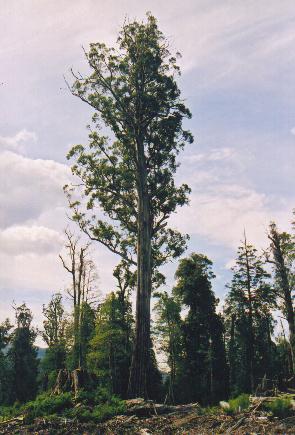
| - Eucalyptus regnans is an evergreen tree with a straight trunk and an open, relatively small crown. English Wikipedia
- The trunk has smooth cream-coloured, greyish or brown bark and rough, fibrous or flaky bark around its base. English Wikipedia
- Adult leaves are glossy green and range from lance-shaped to sickle-shaped. English Wikipedia
- The adult leaves measure 90–230 mm long and 15–50 mm wide. English Wikipedia
- Flower buds occur in groups of nine to fifteen. English Wikipedia
- The flowers are white and bloom between March and May. English Wikipedia
- The fruit is a woody, cup-shaped or conical capsule measuring 5–8 mm long. English Wikipedia
- The seeds are pyramid-shaped and measure 1.5–3 mm long. English Wikipedia
|
|---|
| Size | | - The tree typically reaches heights of 70–114 metres. English Wikipedia
- The trunk typically reaches 2.5 metres in diameter at breast height. English Wikipedia
- The tallest measured living specimen, named Centurion, is 100 metres tall in Tasmania. English Wikipedia
|
|---|
| Habitat | - The species occurs in the Esperance Plains, Jarrah Forest, Mallee and Warren biogeographic regions of Western Australia. English Wikipedia
- The species grows in sandy soils over granite or quartzite, often with gravel, on rocky hills and coastal dunes. English Wikipedia
| - The species grows in tall wet forests, sometimes with rainforest understorey. English Wikipedia
- The species favours deep loam soils in temperate areas with high rainfall. English Wikipedia
- The species grows mainly in cool mountainous areas receiving more than 1,000 millimetres of annual rainfall. English Wikipedia
- The species is particularly suited to deep, friable clay loam soils, often of volcanic origin. English Wikipedia
- On poorer soils, the species may be restricted to watercourses and valleys. English Wikipedia
|
|---|
| Behaviour | - Eucalyptus lehmannii has been described as invasive in southern Africa. English Wikipedia
| - Young trees can grow in height by an average of one to two metres annually. English Wikipedia
- Some individuals grow more than two metres annually during their first 20 years. English Wikipedia
- The species lacks a lignotuber and cannot resprout following intense fires. English Wikipedia
|
|---|
| Reproduction | | - The species regenerates exclusively from seeds after intense fires. English Wikipedia
- Seeds remain enclosed in woody capsules until the branchlets die and the capsules dry out. English Wikipedia
- Seedlings require substantial light to germinate and develop into saplings. English Wikipedia
- Some trees develop mature fruit capsules as early as seven years of age. English Wikipedia
- Most trees probably begin producing seeds after approximately eleven years. English Wikipedia
- The mean age at which trees become reproductively viable is approximately 21 years. English Wikipedia
- Seedling densities following major fires have been recorded at up to 2.5 million per hectare. English Wikipedia
|
|---|
| Distribution | - Eucalyptus lehmannii is endemic to south-western Western Australia. English Wikipedia
- The species occurs in southern coastal and subcoastal areas extending from east of Albany towards Israelite Bay. English Wikipedia
- The species occurs in the Stirling Range. English Wikipedia
| - The species is native to the Australian states of Victoria and Tasmania. English Wikipedia
- Its distribution covers an area approximately 700 kilometres by 500 kilometres in southern Australia. English Wikipedia
|
|---|
| Conservation | No checked fact yet | - Large numbers of trees have been logged, including some of the tallest known specimens. English Wikipedia
- Much of the species' forest distribution across Gippsland was cleared for farmland between 1860 and 1880. English Wikipedia
- Frequent fires occurring before trees reach reproductive maturity can cause local extinction through inadequate regeneration. English Wikipedia
- Modified contemporary fire regimes pose a risk to the species' forests in many regions. English Wikipedia
|
|---|
| Uses | - Bushy yate is cultivated as an ornamental plant in Australia. English Wikipedia
- The species is used as a small screen, an individual specimen or a grove in ornamental plantings. English Wikipedia
- The species is widely cultivated in Australia and the United States for its ornamental form and decorative flowers, buds and fruit. English Wikipedia
- The species has also been cultivated in Europe and South Africa. English Wikipedia
- In the United States, the species has been described as suitable for screens and courtyard trees in locations as far north as San Francisco Bay. English Wikipedia
| - The species is cultivated in plantations in Australia and other countries. English Wikipedia
- Its timber is marketed as Tasmanian oak together with timber from Eucalyptus obliqua and Eucalyptus delegatensis. English Wikipedia
|
|---|
| Similar species | - Eucalyptus lehmannii has sometimes been classified together with Eucalyptus conferruminata. English Wikipedia
- Eucalyptus conferruminata is distinguished from Eucalyptus lehmannii by having a relatively short operculum. English Wikipedia
| - Eucalyptus fastigata is a close relative that shares the unusual characteristic of paired inflorescences arising from axillary buds. English Wikipedia
|
|---|
| Other | - Eucalyptus lehmannii is one of four species in series Lehmannianae whose flower buds are fused basally in each axillary cluster. English Wikipedia
- The third document identifies Bushy Yate as the common name of Eucalyptus lehmannii. earth.callutheran.edu
- The fourth document identifies bushy yate as a common name of Eucalyptus lehmannii. inaturalist.org
| No checked fact yet |
|---|