Comparison
Long-eared Jerboa vs Greater Egyptian Jerboa
Long-eared Jerboa (Euchoreutes naso) and Greater Egyptian Jerboa (Jaculus orientalis) both belong to the family Dipodidae (jerboa) and part ways below it.


Greater Egyptian Jerboa
Jaculus orientalis
Николай Усик / http://paradoxusik.livejournal.com/, CC BY-SA 3.0, via Wikimedia Commons

Side by side
| Long-eared Jerboa | Greater Egyptian Jerboa | |
|---|---|---|
| Scientific name | Euchoreutes naso Sclater, 1891 | Jaculus orientalis Erxleben, 1777 |
| English name | Long-eared Jerboa | Greater Egyptian Jerboa |
| Group | Mammals | Mammals |
| Class | Mammalia Mammal | Mammalia Mammal |
| Order | Rodentia Rodent | Rodentia Rodent |
| Family | Dipodidae Jerboa | Dipodidae Jerboa |
| Genus | Euchoreutes | Jaculus Desert Jerboas |
| Named in | 1891 | 1777 |
| Red List category | Least Concern | Least Concern |
| Countries on record | 2 countries | 6 countries |
| GBIF occurrence records | 111 records | 1,191 records |
Rows where the two agree are shown in grey.
Where each is found
Only Long-eared Jerboa (2)
Only Greater Egyptian Jerboa (6)
From Catalogue of Life checklists and GBIF occurrence records. A country missing from a list means no record is held, which is not proof of absence.
Checked facts
| Long-eared Jerboa | Greater Egyptian Jerboa | |
|---|---|---|
| Appearance |
|
|
| Size |
|
|
| Habitat |
|
|
| Diet |
|
|
| Behaviour |
|
|
| Reproduction |
|
|
| Distribution |
|
|
| Conservation |
|
|
| Other |
|
|
In brief
Long-eared Jerboa
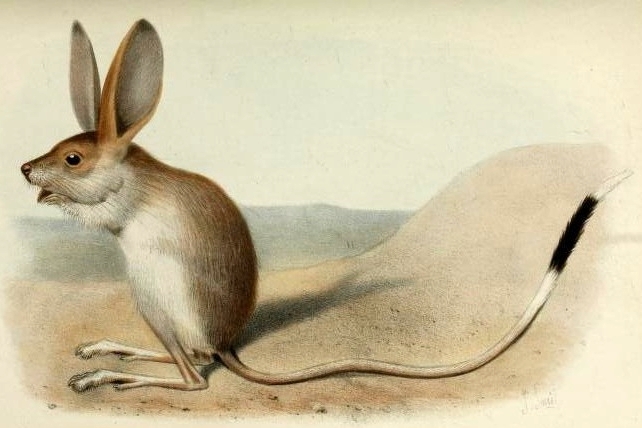
Euchoreutes naso occurs from southernmost Mongolia into northwestern China and inhabits arid desert, semi-desert, and cold, high-elevation desert environments. It is distinguished by ears approximately one-third longer than its head and a tail ending in a tuft of black and white hairs. Full profile
Greater Egyptian Jerboa
Jaculus orientalis occurs in Morocco, Algeria, Tunisia, Libya, Egypt, the Judaean Desert, and on the Sinai Peninsula. It has hind legs approximately four times longer than its forelimbs and three long, flattened toes on its hind feet. Full profile
Compare something else
Page built on 28 November 2026 from the data on the two species pages, where every source is listed.
Cite this page
ScientificNames.org. (2026). Long-eared Jerboa vs Greater Egyptian Jerboa. Retrieved November 28, 2026, from https://scientificnames.org/compare/long-eared-jerboa-vs-greater-egyptian-jerboa
“Long-eared Jerboa vs Greater Egyptian Jerboa.” ScientificNames.org, 2026, scientificnames.org/compare/long-eared-jerboa-vs-greater-egyptian-jerboa. Accessed 28 Nov. 2026.
ScientificNames.org. “Long-eared Jerboa vs Greater Egyptian Jerboa.” Accessed November 28, 2026. https://scientificnames.org/compare/long-eared-jerboa-vs-greater-egyptian-jerboa.
@misc{scientificnames_long_eared_jerboa_vs_greater_egyptian_jerboa,
  author = {{ScientificNames.org}},
  title = {Long-eared Jerboa vs Greater Egyptian Jerboa},
  year = {2026},
  url = {https://scientificnames.org/compare/long-eared-jerboa-vs-greater-egyptian-jerboa},
  note = {Accessed 2026-11-28}
}