Comparison
Long-eared Jerboa vs Baluchistan Pygmy Jerboa
Long-eared Jerboa (Euchoreutes naso) and Baluchistan Pygmy Jerboa (Salpingotulus michaelis) both belong to the family Dipodidae (jerboa) and part ways below it.
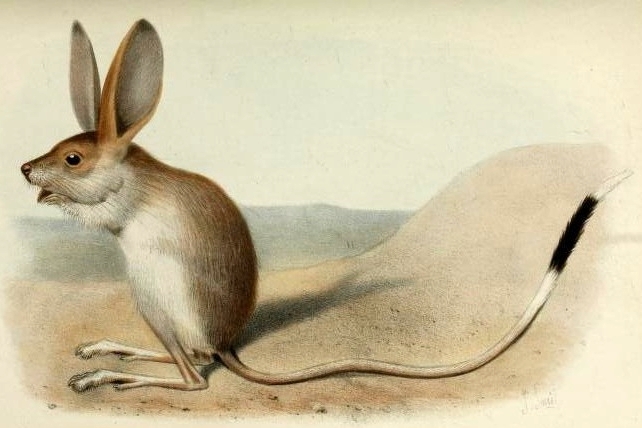


Side by side
| Long-eared Jerboa | Baluchistan Pygmy Jerboa | |
|---|---|---|
| Scientific name | Euchoreutes naso Sclater, 1891 | Salpingotulus michaelis (Fitzgibbon, 1966) |
| English name | Long-eared Jerboa | Baluchistan Pygmy Jerboa |
| Group | Mammals | Mammals |
| Class | Mammalia Mammal | Mammalia Mammal |
| Order | Rodentia Rodent | Rodentia Rodent |
| Family | Dipodidae Jerboa | Dipodidae Jerboa |
| Genus | Euchoreutes | Salpingotulus |
| Named in | 1891 | 1966 |
| Red List category | Least Concern | Data Deficient |
| Countries on record | 2 countries | 1 country |
| GBIF occurrence records | 111 records | 81 records |
Rows where the two agree are shown in grey.
Where each is found
Only Long-eared Jerboa (2)
Only Baluchistan Pygmy Jerboa (1)
From Catalogue of Life checklists and GBIF occurrence records. A country missing from a list means no record is held, which is not proof of absence.
Checked facts
| Long-eared Jerboa | Baluchistan Pygmy Jerboa | |
|---|---|---|
| Appearance |
|
|
| Size |
|
|
| Habitat |
|
|
| Diet |
|
|
| Behaviour |
|
|
| Reproduction |
|
|
| Distribution |
|
|
| Conservation |
| No checked fact yet |
| Similar species | No checked fact yet |
|
| Other |
|
|
In brief
Long-eared Jerboa
Euchoreutes naso occurs from southernmost Mongolia into northwestern China and inhabits arid desert, semi-desert, and cold, high-elevation desert environments. It is distinguished by ears approximately one-third longer than its head and a tail ending in a tuft of black and white hairs. Full profile
Baluchistan Pygmy Jerboa
The Baluchistan Pygmy Jerboa is a mammal in the rodent family Dipodidae and the sole member of the genus Salpingotulus. The species is currently considered endemic to Pakistan. It has an average adult head and body length of 4.3 cm and an average adult tail length of 8 cm. Full profile
Compare something else
Page built on 28 November 2026 from the data on the two species pages, where every source is listed.
Cite this page
ScientificNames.org. (2026). Long-eared Jerboa vs Baluchistan Pygmy Jerboa. Retrieved November 28, 2026, from https://scientificnames.org/compare/long-eared-jerboa-vs-baluchistan-pygmy-jerboa
“Long-eared Jerboa vs Baluchistan Pygmy Jerboa.” ScientificNames.org, 2026, scientificnames.org/compare/long-eared-jerboa-vs-baluchistan-pygmy-jerboa. Accessed 28 Nov. 2026.
ScientificNames.org. “Long-eared Jerboa vs Baluchistan Pygmy Jerboa.” Accessed November 28, 2026. https://scientificnames.org/compare/long-eared-jerboa-vs-baluchistan-pygmy-jerboa.
@misc{scientificnames_long_eared_jerboa_vs_baluchistan_pygmy_jerboa,
  author = {{ScientificNames.org}},
  title = {Long-eared Jerboa vs Baluchistan Pygmy Jerboa},
  year = {2026},
  url = {https://scientificnames.org/compare/long-eared-jerboa-vs-baluchistan-pygmy-jerboa},
  note = {Accessed 2026-11-28}
}