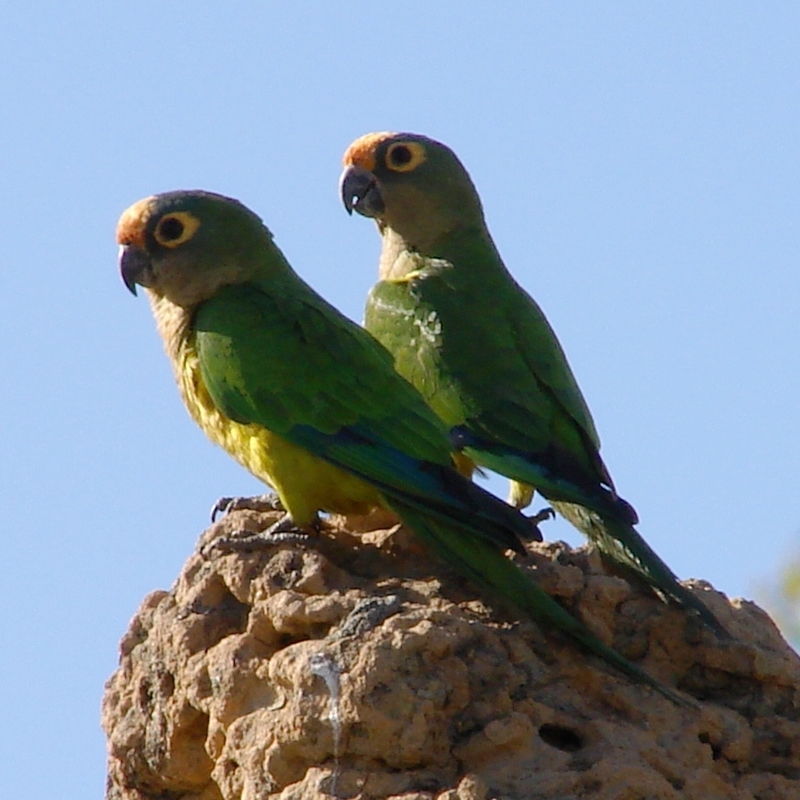
Comparison

Orange-fronted Parakeet vs Peach-fronted Parakeet

Orange-fronted Parakeet (Eupsittula canicularis) and Peach-fronted Parakeet (Eupsittula aurea) both belong to the genus Eupsittula (eupsittula parakeets) and part ways below it.

Orange-fronted Parakeet

Orange-fronted Parakeet

Eupsittula canicularis

Tina Lapointe, CC BY 2.0, via Wikimedia Commons

Peach-fronted Parakeet

Peach-fronted Parakeet

Eupsittula aurea

derivative work: Snowmanradio (talk) Aratinga_aurea_-Brazil-8.jpg: Glauco Umbelino, CC BY 2.0, via Wikimedia Commons

Side by side

Orange-fronted ParakeetPeach-fronted Parakeet
Scientific nameEupsittula canicularis (Linnaeus, 1758)Eupsittula aurea (J. F. Gmelin, 1788)
English nameOrange-fronted ParakeetPeach-fronted Parakeet
GroupBirdsBirds
ClassAves BirdAves Bird
OrderPsittaciformes ParrotPsittaciformes Parrot
FamilyPsittacidae MacawsPsittacidae Macaws
GenusEupsittula Eupsittula ParakeetsEupsittula Eupsittula Parakeets
Named in17581788
Red List categoryVulnerableLeast Concern
EnvironmentterrestrialNot recorded
Countries on record8 countries8 countries
GBIF occurrence records101,539 records60,419 records

Rows where the two agree are shown in grey.

Where each is found

Only Orange-fronted Parakeet (8)

Only Peach-fronted Parakeet (8)

From Catalogue of Life checklists and GBIF occurrence records. A country missing from a list means no record is held, which is not proof of absence.

Checked facts

Orange-fronted ParakeetPeach-fronted Parakeet
Appearance
  • Adults of the nominate subspecies have an orange-peach forehead and lores, a dull blue midcrown, and a dull green hindcrown, nape, and back. English Wikipedia
  • The species has a ring of bare yellow skin surrounding each eye. English Wikipedia
  • Its throat and breast are pale olive brown, while the remaining underparts are yellowish green. English Wikipedia
  • Its wings are green with bluish flight feathers. English Wikipedia
  • Its tail has a green upper surface and a yellowish underside. English Wikipedia
  • Immature birds resemble adults but have substantially less orange coloring on the forehead. English Wikipedia
  • Adult birds have a peachy-orange forehead and forecrown, a dull blue hindcrown, and bare yellow skin surrounding the eyes. English Wikipedia
  • The species has dull green upperparts, nape, and tail, with pale olive-brown cheeks and throat. English Wikipedia
  • The breast and belly transition into a greenish-yellow vent and undertail coverts. English Wikipedia
  • The wings are predominantly green above and yellow-green below, with greenish-blue flight feathers. English Wikipedia
  • Immature birds have less orange and blue coloration on the head than adults. English Wikipedia
  • Male and female peach-fronted parakeets have similar external coloration. English Wikipedia
Size
Habitat
  • The species inhabits predominantly semi-open and open landscapes. English Wikipedia
  • Its habitats include forest edges, deciduous woodlands, Pacific swamp forests, savannas, and thorn scrub. English Wikipedia
  • The species also occurs in pastures containing scattered trees and plantations of palms and fruiting trees. English Wikipedia
  • The species primarily inhabits lowlands and foothills, reaching elevations of up to 1,500 m above sea level. English Wikipedia
  • The species inhabits semi-open and wooded landscapes. English Wikipedia
  • Its habitats include Mauritia palm groves, cerrado, and gallery forests. English Wikipedia
  • The species also occurs in campo rupestre grasslands with shrubs and scattered trees. English Wikipedia
  • The species inhabits open woodlands, savannas, and agricultural areas. ebird.org
  • The species frequently ventures into urban environments. ebird.org
Diet
Behaviour
  • Outside the breeding season, the species forms nomadic flocks. English Wikipedia
  • Its nomadic flocks can contain several hundred individuals. English Wikipedia
  • Outside the breeding season, flocks reach higher elevations within the species' range. English Wikipedia
  • Its calls include a scratchy, high-pitched keea'ah and a lower keh'keh'keh'keh'keh. English Wikipedia
  • The species conducts much of its foraging on the ground. English Wikipedia
  • The species usually forages in pairs or small groups. ebird.org
  • The species appears to make local movements in response to food availability rather than following a regular movement pattern. English Wikipedia
  • The species produces a rolling call that varies irregularly from low to very high pitch. English Wikipedia
Reproduction
  • In Mexico and El Salvador, the species nests between January and May. English Wikipedia
  • In Costa Rica, the species nests between December and March. English Wikipedia
  • The species usually excavates nesting cavities in arboreal termite nests belonging to Nasutitermes nigriceps. English Wikipedia
  • The species occasionally nests in natural fissures or cavities excavated by woodpeckers. English Wikipedia
  • Clutches contain three to five eggs. English Wikipedia
  • The female alone incubates the eggs. English Wikipedia
  • The incubation period lasts approximately 30 days. English Wikipedia
  • Young birds fledge approximately six weeks after hatching. English Wikipedia
  • Both parents excavate the nesting cavity using their beaks, with the male performing most of the initial digging. English Wikipedia
  • The parents spend approximately one week excavating the termite mound cavity. English Wikipedia
  • After excavation, the birds leave the cavity undisturbed for 7–10 days to allow termites to seal off and abandon the damaged area. English Wikipedia
Distribution
  • The species occurs from western Mexico south through Central America to northwestern Costa Rica. English Wikipedia
  • The subspecies E. c. clarae occurs in western Mexico from Sinaloa and Durango south to Michoacán. English Wikipedia
  • The subspecies E. c. eburnirostrum occurs in southwestern Mexico from Michoacán to Oaxaca. English Wikipedia
  • The nominate subspecies occurs along the Pacific coast from Chiapas in southern Mexico through Guatemala, Honduras, El Salvador, and Nicaragua to northwestern Costa Rica. English Wikipedia
  • The species has been introduced to Puerto Rico. English Wikipedia
Conservation
  • The IUCN classifies the peach-fronted parakeet as Least Concern. English Wikipedia
  • The species has a very large geographic range. English Wikipedia
  • Although its population size is unknown, the population is believed to be stable. English Wikipedia
  • The pet trade is identified as the species' only apparent major threat. English Wikipedia
  • The species is considered common in Suriname and abundant in Paraguay. English Wikipedia
  • The species is the most common Eupsittula parakeet in Brazil. English Wikipedia
  • Forest clearance for agriculture may benefit the species. English Wikipedia
  • The species experiences extensive removal of nestlings for the pet trade, with very high mortality during rearing. English Wikipedia
UsesNo checked fact yet
OtherNo checked fact yet

In brief

Orange-fronted Parakeet

Adults of the nominate subspecies have an orange-peach forehead and lores, a dull blue midcrown, and a dull green hindcrown, nape, and back. Full profile

Peach-fronted Parakeet

The Peach-fronted Parakeet (Eupsittula aurea) is a bird in the family Psittacidae, order Psittaciformes, and class Aves. It was formally described in 1788 by Johann Friedrich Gmelin and has no recognized subspecies. It occurs in extreme southern Suriname, most of the eastern half of Brazil, eastern Bolivia, extreme southeastern Peru, central and eastern Paraguay, and northeastern Argentina. Adults are distinguished by a peachy-orange forehead and forecrown, a dull blue hindcrown, and bare yellow skin surrounding the eyes. Full profile

Compare something else

Page built on 26 November 2026 from the data on the two species pages, where every source is listed.

Cite this page

ScientificNames.org. (2026). Orange-fronted Parakeet vs Peach-fronted Parakeet. Retrieved November 26, 2026, from https://scientificnames.org/compare/orange-fronted-parakeet-vs-peach-fronted-parakeet