Species · Birds
Orange-fronted Parakeet Eupsittula canicularis
The scientific name of the Orange-fronted Parakeet is Eupsittula canicularis. It is a species of bird in the family Psittacidae (macaws), order Psittaciformes. The name dates from 1758.
- Scientific name
- Eupsittula canicularis (Linnaeus, 1758)
- Common name
- Orange-fronted Parakeet
- Genus
- Eupsittula
- Family
- Psittacidae (Macaws)
- Order
- Psittaciformes
- Class
- Aves
- Red List category
- VU Vulnerable
- Environment
- terrestrial
- Recorded in
- 8 countries
- Name status
- accepted in the Catalogue of Life

Overview
Adults of the nominate subspecies have an orange-peach forehead and lores, a dull blue midcrown, and a dull green hindcrown, nape, and back.
Written 26 November 2026 from the sources listed below. Each statement was checked against the passage it cites; statements that could not be supported were removed.
Appearance
Adults of the nominate subspecies have an orange-peach forehead and lores, a dull blue midcrown, and a dull green hindcrown, nape, and back. A ring of bare yellow skin surrounds each eye.[1][2]
The throat and breast are pale olive brown, while the remaining underparts are yellowish green. The wings are green with bluish flight feathers, and the tail has a green upper surface and a yellowish underside.[3][4][5]
Immature birds resemble adults but have substantially less orange coloring on the forehead.[6]
The species measures 23–25 cm in length and weighs 68–80 g.[7][8]
Habitat
The Orange-fronted Parakeet inhabits predominantly semi-open and open landscapes. Its habitats include forest edges, deciduous woodlands, Pacific swamp forests, savannas, and thorn scrub.[9][10]
It also occurs in pastures containing scattered trees and plantations of palms and fruiting trees. It primarily inhabits lowlands and foothills, reaching elevations of up to 1,500 m above sea level.[11][12]
The species occurs from western Mexico south through Central America to northwestern Costa Rica. The subspecies E. c. clarae occurs in western Mexico from Sinaloa and Durango south to Michoacán, while E. c. eburnirostrum occurs in southwestern Mexico from Michoacán to Oaxaca.[13][14][15]
The nominate subspecies occurs along the Pacific coast from Chiapas in southern Mexico through Guatemala, Honduras, El Salvador, and Nicaragua to northwestern Costa Rica. The species has been introduced to Puerto Rico.[16][17]
Diet
The Orange-fronted Parakeet feeds on fruits, including those of Ficus, and consumes flowers, including those of Gliricidia.[18][19]
Behaviour
Outside the breeding season, the species forms nomadic flocks that can contain several hundred individuals. These flocks reach higher elevations within the species' range.[20][21][22]
Its calls include a scratchy, high-pitched keea'ah and a lower keh'keh'keh'keh'keh.[23]
Reproduction and life cycle
In Mexico and El Salvador, the species nests between January and May. In Costa Rica, it nests between December and March.[24][25]
The species usually excavates nesting cavities in arboreal termite nests belonging to Nasutitermes nigriceps. It occasionally nests in natural fissures or cavities excavated by woodpeckers.[26][27]
Both parents excavate the nesting cavity using their beaks, with the male performing most of the initial digging. The parents spend approximately one week excavating the termite mound cavity.[28][29]
After excavation, the birds leave the cavity undisturbed for 7–10 days to allow termites to seal off and abandon the damaged area.[30]
Clutches contain three to five eggs, and the female alone incubates them. The incubation period lasts approximately 30 days.[31][32][33]
Young birds fledge approximately six weeks after hatching.[34]
Conservation
The IUCN classified the species as vulnerable from 2020 onward. The estimated population is between 500,000 and 4,999,999 mature individuals, and the population is believed to be decreasing.[35][36][37]
Illegal trapping for the parrot trade threatens the species. It appears to tolerate some habitat destruction.[38][39]
Uses
The Orange-fronted Parakeet is sometimes kept as a companion parrot.[40]
Classification of the Orange-fronted Parakeet
| Kingdom | Animalia |
|---|---|
| Phylum | Chordata |
| Subphylum | Vertebrata |
| Infraphylum | Gnathostomata |
| Parvphylum | Osteichthyes |
| Megaclass | Tetrapoda |
| Class | Aves (Bird) |
| Order | Psittaciformes (Parrot) |
| Family | Psittacidae (Macaws) |
| Genus | Eupsittula (Eupsittula Parakeets) |
| Species | Eupsittula canicularis (Linnaeus, 1758) |
Where the Orange-fronted Parakeet is found
Checklists and occurrence records place Eupsittula canicularis in 8 countries across North America. GBIF holds 101,539 georeferenced records of it.
Countries
- Costa Rica 33,681
- El Salvador 6,333
- Guatemala 5,154
- Honduras 4,996
- Mexico 38,448
- Nicaragua 11,707
- Puerto Rico 1,078
- United States 142
Regions and cities with the most records
- Guanacaste Province, Costa Rica 17,867
- Jalisco, Mexico 10,028
- Nayarit, Mexico 9,891
- Puntarenas Province, Costa Rica 9,224
- Bucerías, Mexico 6,977
- Oaxaca, Mexico 6,675
- Managua, Nicaragua 5,649
- Alajuela Province, Costa Rica 5,582
- Managua Department, Nicaragua 5,520
- El Crucero, Nicaragua 5,228
- Puerto Vallarta, Mexico 5,033
- Ciudad Sandino, Nicaragua 4,084
- Mezcales, Mexico 4,075
- Francisco Morazán Department, Honduras 3,994
- Ixtapa, Mexico 3,637
- Tegucigalpa, Honduras 3,606
- Masaya, Nicaragua 3,490
- San José del Valle, Mexico 3,460
- Liberia, Costa Rica 3,134
- Chiapas, Mexico 2,926
- Antiguo Cuscatlán, El Salvador 2,925
- Apopa, El Salvador 2,896
- San Marcos, El Salvador 2,880
- Crucecita, Mexico 2,872
- Soyapango, El Salvador 2,871
- San Marcos, Nicaragua 2,870
- San Salvador, El Salvador 2,866
- Delgado, El Salvador 2,865
- Mejicanos, El Salvador 2,863
- Cuscatancingo, El Salvador 2,820
- Ilopango, El Salvador 2,807
- Ayutuxtepeque, El Salvador 2,779
- Santa Bárbara, Guatemala 2,759
- Patulul, Guatemala 2,749
- Masatepe, Nicaragua 2,741
- Santa Tecla, El Salvador 2,731
Range as the checklists state it
Middle America
Caribbean
A number beside a place is its count of GBIF occurrence records. A place without a number comes from a checklist alone. Records show where a species has been observed or collected, which can include escapes and vagrants.
Common names
English
- Orange-fronted Parakeet
- American Orange-fronted Parakeet
- Half-Moon Conure
Names in 26 other languages
- Arabic
- ببغاء برتقالي الجبهة
- Catalan
- Aratinga de front taronja, aratinga de front carbassa
- Chinese
- 橙額鸚哥, 橙额鹦哥
- Croatian
- narančastočela jandaja
- Czech
- aratinga oranžovočelý
- Danish
- Elfenbensparakit
- Dutch
- Ivooraratinga
- Esperanto
- oranĝfrunta papago
- Estonian
- ranniku-aratinga
- Finnish
- termiittiaratti
- French
- Conure à front rouge
- German
- Elfenbeinsittich
- Hungarian
- narancshomlokú aratinga, narancshomlokú ékfarkúpapagáj
- Italian
- Parrocchetto frontearancio
- Japanese
- メキシコインコ
- Lithuanian
- rudakaklė aratinga
- Norwegian
- oransjepanneparakitt
- Polish
- Konura pomaranczowoczelna, konura pomarańczowoczelna
- Portuguese
- periquito-de-testa-laranja
- Russian
- Оранжеволобая аратинга
- Serbian
- Narandžastočela aratinga
- Slovak
- klinochvost malý
- Spanish
- Aratinga frentinaranja, Atolero, Perico Frentinaranja, Perico atolero, Perico frente naranja, Periquito frentianaranjado
- Turkish
- Turuncu Alınlı Papağan
- Ukrainian
- аратинга мексиканський
- Welsh
- conwra talcen oren
Synonyms
4 other scientific names have been used for this species and are now treated as synonyms of Eupsittula canicularis.
- Aratinga canicularis (Linnaeus, 1758)
- Petacula canicularia Wood, CT, 1836
- Psittacus canicularis Linnaeus, 1758
- Psittacus petzii Linnaeus, C, 1758
Subspecies and varieties
- Eupsittula canicularis canicularis subspecies
- Eupsittula canicularis clarae (Western Mexican Orange-fronted Parakeet) subspecies
- Eupsittula canicularis eburnirostrum (Southern Mexican Orange-fronted Parakeet) subspecies
Related species
-
 Brown-throated ParakeetEupsittula pertinax
-
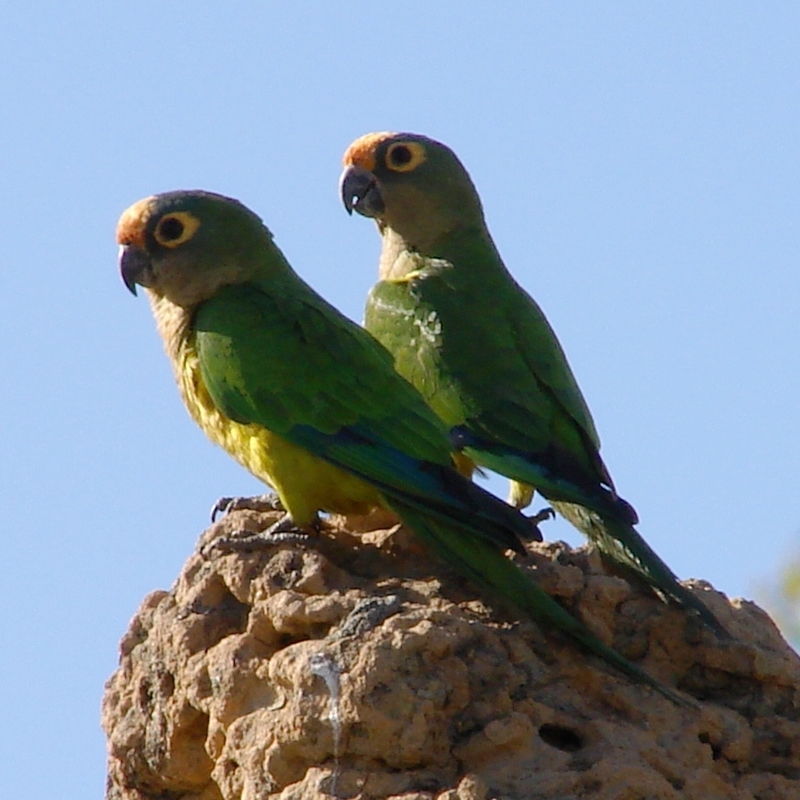 Peach-fronted ParakeetEupsittula aurea
-
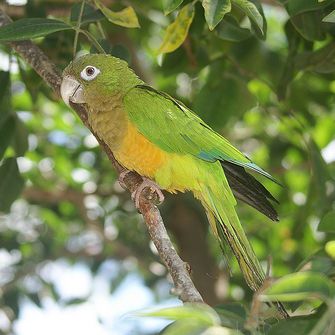 Caatinga ParakeetEupsittula cactorum
-
 Jamaican ParakeetEupsittula nana
-
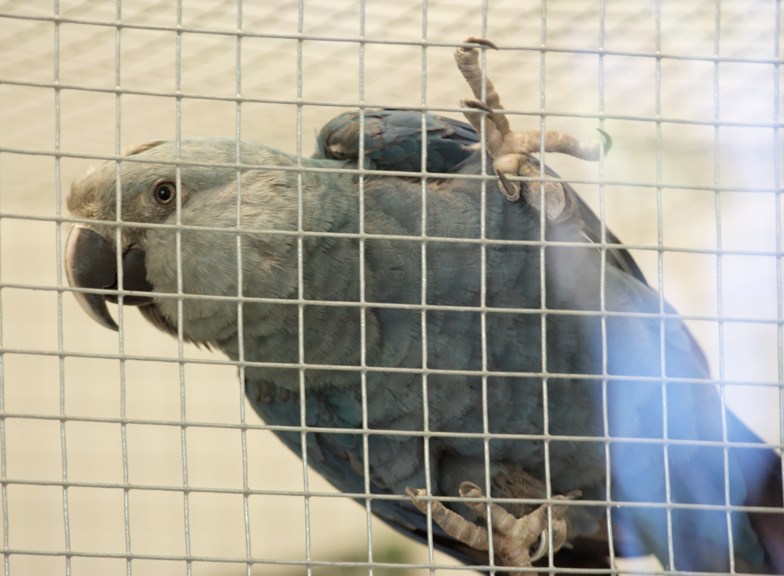 Spix's MacawCyanopsitta spixii
-
 Grey ParrotPsittacus erithacus
-
 Scarlet MacawAra macao
-
 Hyacinth MacawAnodorhynchus hyacinthinus
Compare
Questions and answers
What is the scientific name of the Orange-fronted Parakeet?
The scientific name of the Orange-fronted Parakeet is Eupsittula canicularis. Written with its author, the full name is Eupsittula canicularis (Linnaeus, 1758).
Which family does the Orange-fronted Parakeet belong to?
Eupsittula canicularis belongs to the family Psittacidae, in the order Psittaciformes and the class Aves.
Where is the Orange-fronted Parakeet found?
Checklists and occurrence records place Eupsittula canicularis in 8 countries, including Mexico, Costa Rica, Nicaragua, El Salvador, Guatemala and Honduras.
What is the conservation status of the Orange-fronted Parakeet?
The IUCN Red List category recorded for Eupsittula canicularis is Vulnerable (VU).
What other names does the Orange-fronted Parakeet have?
Eupsittula canicularis is also known in English as American Orange-fronted Parakeet and Half-Moon Conure.
Are orange-fronted parakeets rare?
The Orange-fronted Parakeet is classified as vulnerable by the IUCN, and its population is believed to be decreasing.[35][37]
How many orange-fronted parakeets are there?
The estimated population is between 500,000 and 4,999,999 mature individuals.[36]
Are there orange parakeets?
Yes. The Orange-fronted Parakeet has an orange-peach forehead and lores in adults of the nominate subspecies.[1]
What are the orange parrots called?
One species with orange coloring is the Orange-fronted Parakeet (Eupsittula canicularis).[1]
Sources
Passages the profile rests on
- Adults of the nominate subspecies have an orange-peach forehead and lores, a dull blue midcrown, and a dull green hindcrown, nape, and back. Source passage: “Adults of the nominate subspecies E. c. canicularis have an orange-peach forehead (the "front") and lores, a dull blue midcrown, and a dull green hindcrown, nape, and back.” — English Wikipedia
- The species has a ring of bare yellow skin surrounding each eye. Source passage: “A ring of bare yellow skin surrounds the eyes.” — English Wikipedia
- Its throat and breast are pale olive brown, while the remaining underparts are yellowish green. Source passage: “Their throat and breast are pale olive brown and the rest of their underparts are yellowish green.” — English Wikipedia
- Its wings are green with bluish flight feathers. Source passage: “Their wings are green with bluish flight feathers.” — English Wikipedia
- Its tail has a green upper surface and a yellowish underside. Source passage: “The top surface of their tail is green and the bottom surface is yellowish.” — English Wikipedia
- Immature birds resemble adults but have substantially less orange coloring on the forehead. Source passage: “Immatures are like adults, but with much less orange on the forehead.” — English Wikipedia
- The species measures 23–25 cm in length. Source passage: “The orange-fronted parakeet is 23 to 25 cm (9.1 to 9.8 in) long” — English Wikipedia
- The species weighs 68–80 g. Source passage: “weighs 68 to 80 g (2.4 to 2.8 oz).” — English Wikipedia
- The species inhabits predominantly semi-open and open landscapes. Source passage: “The orange-fronted parakeet inhabits a variety of landscapes, most of them semiopen to open.” — English Wikipedia
- Its habitats include forest edges, deciduous woodlands, Pacific swamp forests, savannas, and thorn scrub. Source passage: “These include the edges of forest, deciduous woodlands, Pacific swamp forest, savanna, and thorn scrub.” — English Wikipedia
- The species also occurs in pastures containing scattered trees and plantations of palms and fruiting trees. Source passage: “It also occurs in pastures with scattered trees and plantations of palms and fruiting trees such as mangoes and bananas.” — English Wikipedia
- The species primarily inhabits lowlands and foothills, reaching elevations of up to 1,500 m above sea level. Source passage: “It is primarily a bird of lowlands and foothills, but ranges as high as 1,500 m (4,900 ft) above sea level.” — English Wikipedia
- The species occurs from western Mexico south through Central America to northwestern Costa Rica. Source passage: “It is found from western Mexico to Costa Rica.” — English Wikipedia
- The subspecies E. c. clarae occurs in western Mexico from Sinaloa and Durango south to Michoacán. Source passage: “E. c. clarae, western Mexico from Sinaloa and Durango south to Michoacán” — English Wikipedia
- The subspecies E. c. eburnirostrum occurs in southwestern Mexico from Michoacán to Oaxaca. Source passage: “E. c. eburnirostrum, southwestern Mexico from Michoacán to Oaxaca” — English Wikipedia
- The nominate subspecies occurs along the Pacific coast from Chiapas in southern Mexico through Guatemala, Honduras, El Salvador, and Nicaragua to northwestern Costa Rica. Source passage: “E. c. canicularis, Pacific coast from Chiapas in southern Mexico through Guatemala, Honduras, El Salvador, and Nicaragua into northwestern Costa Rica;” — English Wikipedia
- The species has been introduced to Puerto Rico. Source passage: “introduced to Puerto Rico” — English Wikipedia
- The species feeds on fruits, including those of Ficus. Source passage: “The orange-fronted parakeet feeds on fruits (e.g. Ficus)” — English Wikipedia
- The species consumes flowers, including those of Gliricidia. Source passage: “flowers (e.g. Gliricidia)” — English Wikipedia
- Outside the breeding season, the species forms nomadic flocks. Source passage: “The orange-fronted parakeet forms nomadic flocks outside the breeding season” — English Wikipedia
- Its nomadic flocks can contain several hundred individuals. Source passage: “the flocks can contain several hundred individuals.” — English Wikipedia
- Outside the breeding season, flocks reach higher elevations within the species' range. Source passage: “and at that time reaches the higher elevations of its range” — English Wikipedia
- Its calls include a scratchy, high-pitched keea'ah and a lower keh'keh'keh'keh'keh. Source passage: “a scratchy, high-pitched keea'ah! and a lower keh'keh'keh'keh'keh” — English Wikipedia
- In Mexico and El Salvador, the species nests between January and May. Source passage: “The orange-fronted parakeet nests between January and May in Mexico and El Salvador” — English Wikipedia
- In Costa Rica, the species nests between December and March. Source passage: “and December to March in Costa Rica.” — English Wikipedia
- The species usually excavates nesting cavities in arboreal termite nests belonging to Nasutitermes nigriceps. Source passage: “It usually excavates a cavity in a nest of the arboreal termite Nasutitermes nigriceps” — English Wikipedia
- The species occasionally nests in natural fissures or cavities excavated by woodpeckers. Source passage: “but sometimes uses a natural fissure or a cavity dug by a woodpecker.” — English Wikipedia
- Both parents excavate the nesting cavity using their beaks, with the male performing most of the initial digging. Source passage: “Both the male and female orange-fronted parakeets excavate a cavity in the termite mound using their beaks (the male doing the majority of the early digging)” — English Wikipedia
- The parents spend approximately one week excavating the termite mound cavity. Source passage: “over the course of about a week.” — English Wikipedia
- After excavation, the birds leave the cavity undisturbed for 7–10 days to allow termites to seal off and abandon the damaged area. Source passage: “the birds leave the new cavity alone for 7–10 days, to allow time for the termites to seal off and abandon the damaged area.” — English Wikipedia
- Clutches contain three to five eggs. Source passage: “The clutch size is three to five eggs;” — English Wikipedia
- The female alone incubates the eggs. Source passage: “the female alone incubates them.” — English Wikipedia
- The incubation period lasts approximately 30 days. Source passage: “The incubation period is about 30 days” — English Wikipedia
- Young birds fledge approximately six weeks after hatching. Source passage: “fledging occurs about six weeks after hatch.” — English Wikipedia
- The IUCN classified the species as vulnerable from 2020 onward. Source passage: “but since 2020, has listed it as vulnerable.” — English Wikipedia
- The estimated population is between 500,000 and 4,999,999 mature individuals. Source passage: “Number of mature individuals 500,000 - 4,999,999” — datazone.birdlife.org
- The species' population is believed to be decreasing. Source passage: “which is believed to be decreasing.” — English Wikipedia
- Illegal trapping for the parrot trade threatens the species. Source passage: “The species is threatened by illegal trapping for the parrot trade.” — English Wikipedia
- The species appears to tolerate some habitat destruction. Source passage: “It does appear to tolerate some habitat destruction.” — English Wikipedia
- The species is sometimes kept as a companion parrot. Source passage: “is sometimes kept as a companion parrot.” — English Wikipedia
Data
- Catalogue of Life, 2026-10-16 XR cc by
- Global Biodiversity Information Facility CC BY 4.0
- Wikidata CC0
- GeoNames CC BY 4.0
- Wikimedia Commons per image; credit shown with each image
- Within the Catalogue of Life, this name comes from The Integrated Taxonomic Information System cc0
References
- Dickinson, E. C., and L. Christidis, eds. (2014). The Howard and Moore Complete Checklist of the Birds of the World, 4th Edition, Vol. 2 Passerines.
This species in other databases
Page built on 26 November 2026. See how the catalog is made and all sources and licences.
Cite this page
ScientificNames.org. (2026). Eupsittula canicularis (Orange-fronted Parakeet). Retrieved November 26, 2026, from https://scientificnames.org/species/eupsittula-canicularis
“Eupsittula canicularis (Orange-fronted Parakeet).” ScientificNames.org, 2026, scientificnames.org/species/eupsittula-canicularis. Accessed 26 Nov. 2026.
ScientificNames.org. “Eupsittula canicularis (Orange-fronted Parakeet).” Accessed November 26, 2026. https://scientificnames.org/species/eupsittula-canicularis.
@misc{scientificnames_eupsittula_canicularis_orange_fronted_parakeet,
  author = {{ScientificNames.org}},
  title = {Eupsittula canicularis (Orange-fronted Parakeet)},
  year = {2026},
  url = {https://scientificnames.org/species/eupsittula-canicularis},
  note = {Accessed 2026-11-26}
}