Comparison

Orange-fronted Parakeet vs Caatinga Parakeet

Orange-fronted Parakeet (Eupsittula canicularis) and Caatinga Parakeet (Eupsittula cactorum) both belong to the genus Eupsittula (eupsittula parakeets) and part ways below it.

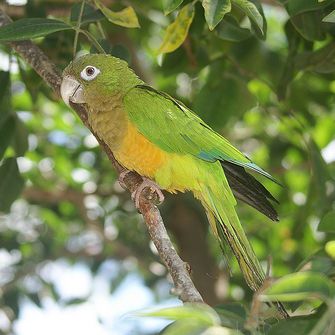
Orange-fronted Parakeet

Orange-fronted Parakeet

Eupsittula canicularis

Tina Lapointe, CC BY 2.0, via Wikimedia Commons

Caatinga Parakeet

Caatinga Parakeet

Eupsittula cactorum

Aratinga_cactorum_-Brazil-8.jpg: Phillipe derivative work: Snowmanradio (talk), CC BY-SA 3.0, via Wikimedia Commons

Side by side

Orange-fronted ParakeetCaatinga Parakeet
Scientific nameEupsittula canicularis (Linnaeus, 1758)Eupsittula cactorum (Kuhl, 1820)
English nameOrange-fronted ParakeetCaatinga Parakeet
GroupBirdsBirds
ClassAves BirdAves Bird
OrderPsittaciformes ParrotPsittaciformes Parrot
FamilyPsittacidae MacawsPsittacidae Macaws
GenusEupsittula Eupsittula ParakeetsEupsittula Eupsittula Parakeets
Named in17581820
Red List categoryVulnerableLeast Concern
EnvironmentterrestrialNot recorded
Countries on record8 countries1 country
GBIF occurrence records101,539 records15,242 records

Rows where the two agree are shown in grey.

Where each is found

Only Orange-fronted Parakeet (8)

Only Caatinga Parakeet (1)

From Catalogue of Life checklists and GBIF occurrence records. A country missing from a list means no record is held, which is not proof of absence.

Checked facts

Orange-fronted ParakeetCaatinga Parakeet
Appearance
  • Adults of the nominate subspecies have an orange-peach forehead and lores, a dull blue midcrown, and a dull green hindcrown, nape, and back. English Wikipedia
  • The species has a ring of bare yellow skin surrounding each eye. English Wikipedia
  • Its throat and breast are pale olive brown, while the remaining underparts are yellowish green. English Wikipedia
  • Its wings are green with bluish flight feathers. English Wikipedia
  • Its tail has a green upper surface and a yellowish underside. English Wikipedia
  • Immature birds resemble adults but have substantially less orange coloring on the forehead. English Wikipedia
  • Adult individuals of the nominate subspecies have pale brown forecrowns, cheeks, throats, sides of the neck, and breasts. English Wikipedia
  • Adults have bare whitish skin surrounding their eyes. English Wikipedia
  • The belly and vent area of adults are yellow-orange. English Wikipedia
  • The nape, ear coverts, upperparts, and tail are green. English Wikipedia
  • The wings are mostly green and have bluish flight feathers. English Wikipedia
  • Immature birds have completely green crowns and duller underparts compared with adults. English Wikipedia
  • The subspecies E. c. caixana has the same plumage pattern as the nominate subspecies but is paler overall. English Wikipedia
Size
Habitat
  • The species inhabits predominantly semi-open and open landscapes. English Wikipedia
  • Its habitats include forest edges, deciduous woodlands, Pacific swamp forests, savannas, and thorn scrub. English Wikipedia
  • The species also occurs in pastures containing scattered trees and plantations of palms and fruiting trees. English Wikipedia
  • The species primarily inhabits lowlands and foothills, reaching elevations of up to 1,500 m above sea level. English Wikipedia
  • The species inhabits both pristine and second-growth Caatinga vegetation. English Wikipedia
  • Its Caatinga habitat is characterized by thorny vegetation, shrubs, and succulents. English Wikipedia
  • The species also occurs in cerrado and moister woodlands. English Wikipedia
Diet
Behaviour
  • Outside the breeding season, the species forms nomadic flocks. English Wikipedia
  • Its nomadic flocks can contain several hundred individuals. English Wikipedia
  • Outside the breeding season, flocks reach higher elevations within the species' range. English Wikipedia
  • Its calls include a scratchy, high-pitched keea'ah and a lower keh'keh'keh'keh'keh. English Wikipedia
  • The species has no established movement pattern, although local movements in response to food availability are considered probable. English Wikipedia
Reproduction
  • In Mexico and El Salvador, the species nests between January and May. English Wikipedia
  • In Costa Rica, the species nests between December and March. English Wikipedia
  • The species usually excavates nesting cavities in arboreal termite nests belonging to Nasutitermes nigriceps. English Wikipedia
  • The species occasionally nests in natural fissures or cavities excavated by woodpeckers. English Wikipedia
  • Clutches contain three to five eggs. English Wikipedia
  • The female alone incubates the eggs. English Wikipedia
  • The incubation period lasts approximately 30 days. English Wikipedia
  • Young birds fledge approximately six weeks after hatching. English Wikipedia
  • Both parents excavate the nesting cavity using their beaks, with the male performing most of the initial digging. English Wikipedia
  • The parents spend approximately one week excavating the termite mound cavity. English Wikipedia
  • After excavation, the birds leave the cavity undisturbed for 7–10 days to allow termites to seal off and abandon the damaged area. English Wikipedia
  • The breeding season is not precisely established but is thought to occur between August and March. English Wikipedia
  • The species typically excavates its nests in arboreal termite mounds. English Wikipedia
  • Wild nests have been recorded containing as many as six eggs. English Wikipedia
  • The typical clutch size in captivity is six eggs. English Wikipedia
  • The incubation period in captivity lasts at least 16 days. English Wikipedia
  • Captive young typically fledge approximately six weeks after hatching. English Wikipedia
Distribution
  • The species occurs from western Mexico south through Central America to northwestern Costa Rica. English Wikipedia
  • The subspecies E. c. clarae occurs in western Mexico from Sinaloa and Durango south to Michoacán. English Wikipedia
  • The subspecies E. c. eburnirostrum occurs in southwestern Mexico from Michoacán to Oaxaca. English Wikipedia
  • The nominate subspecies occurs along the Pacific coast from Chiapas in southern Mexico through Guatemala, Honduras, El Salvador, and Nicaragua to northwestern Costa Rica. English Wikipedia
  • The species has been introduced to Puerto Rico. English Wikipedia
Conservation
  • The IUCN classifies the Caatinga parakeet as Least Concern. English Wikipedia
  • The species has a large geographical range. English Wikipedia
  • Although its population size is unknown, the species is believed to have a stable population. English Wikipedia
  • No immediate threats to the species have been identified. English Wikipedia
  • The species is the most common parrot in some parts of its geographical range. English Wikipedia
  • Only 0.1% of the original Caatinga area is protected within reserves, while the habitat is steadily degraded. English Wikipedia
UsesNo checked fact yet
Similar speciesNo checked fact yet
  • The Caatinga parakeet and the brown-throated parakeet (Eupsittula pertinax) form a species pair. English Wikipedia

In brief

Orange-fronted Parakeet

Adults of the nominate subspecies have an orange-peach forehead and lores, a dull blue midcrown, and a dull green hindcrown, nape, and back. Full profile

Caatinga Parakeet

The species is endemic to eastern Brazil and the Caatinga region. Adults of the nominate subspecies have pale brown forecrowns and underparts, green upperparts, and yellow-orange bellies and vent areas. Full profile

Compare something else

Page built on 26 November 2026 from the data on the two species pages, where every source is listed.

Cite this page

ScientificNames.org. (2026). Orange-fronted Parakeet vs Caatinga Parakeet. Retrieved November 26, 2026, from https://scientificnames.org/compare/orange-fronted-parakeet-vs-caatinga-parakeet