Comparison

European Dwarf Cherry vs Blackthorn

European Dwarf Cherry (Prunus fruticosa) and Blackthorn (Prunus spinosa) both belong to the genus Prunus (plum) and part ways below it. Both are recorded in 23 countries.
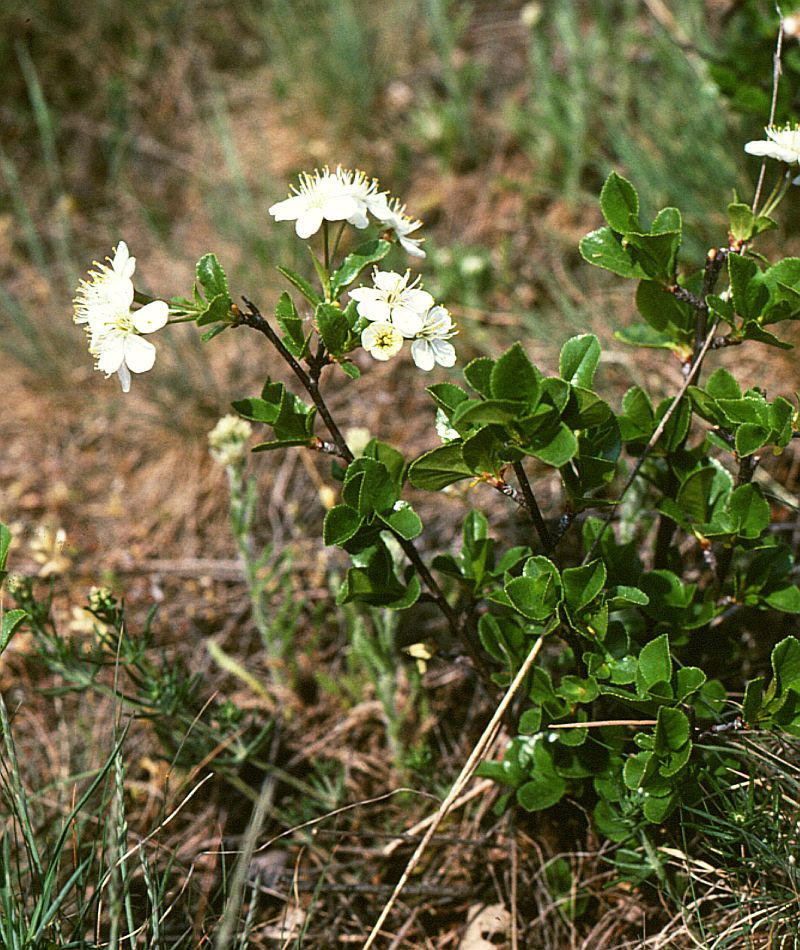
European Dwarf Cherry

European Dwarf Cherry

Prunus fruticosa

Franz Xaver, CC BY-SA 3.0, via Wikimedia Commons

Blackthorn

Blackthorn

Prunus spinosa

Martin Olsson (mnemo on en/sv wikipedia and commons, martin@minimum.se), CC BY-SA 3.0, via Wikimedia Commons

Side by side

European Dwarf CherryBlackthorn
Scientific namePrunus fruticosa Pall.Prunus spinosa L.
English nameEuropean Dwarf CherryBlackthorn
GroupFlowering plantsFlowering plants
ClassMagnoliopsidaMagnoliopsida
OrderRosalesRosales
FamilyRosaceae Rose FamilyRosaceae Rose Family
GenusPrunus PlumPrunus Plum
Red List categoryLeast ConcernLeast Concern
Countries on record23 countries66 countries
GBIF occurrence records7,607 records1,031,674 records

Rows where the two agree are shown in grey.

Where each is found

Both recorded in 23 countries

Only Blackthorn (43)

From Catalogue of Life checklists and GBIF occurrence records. A country missing from a list means no record is held, which is not proof of absence.

Checked facts

European Dwarf CherryBlackthorn
Appearance
  • Prunus fruticosa is a deciduous, xerophytic, winter-hardy shrub that produces cherries. English Wikipedia
  • The bark is dark brown and bears yellow lenticels. English Wikipedia
  • The leaves are oblanceolate to obovate and measure approximately 12 by 6 millimetres. English Wikipedia
  • The leaves have acuminate tips and are hairless on their upper surfaces. English Wikipedia
  • The leaves are thick, serrated, dark green, and turn yellow during autumn. English Wikipedia
  • The flowers are white and hermaphroditic. English Wikipedia
  • The flowers occur in groups of two to four on short peduncles in sessile umbels. English Wikipedia
  • The fruits range from light red to dark red and are globose to pear-shaped. English Wikipedia
  • Prunus spinosa typically grows as a large deciduous shrub, although it can also develop into a small tree. English Wikipedia
  • The plant has blackish bark and dense, stiff, thorny branches that commonly form tangled growth. English Wikipedia
  • Its leaves are oval, with serrated margins. English Wikipedia
  • Its flowers have five creamy-white petals and measure approximately 1.5 centimetres in diameter. English Wikipedia
  • Its fruit is a single-seeded drupe with a black skin and a purple-blue waxy coating. English Wikipedia
  • Blackthorn fruits are described as tiny and globose, with a deep purple colour. pmc.ncbi.nlm.nih.gov
Size
  • The shrub typically reaches 1–2 metres in height and approximately the same width. English Wikipedia
  • The fruits measure approximately 8–25 millimetres in diameter. English Wikipedia
Habitat
  • The species grows in steppe environments rather than forests, although it can form thickets along open forest edges. English Wikipedia
  • The species can grow in almost any soil type but performs best in loamy soil. English Wikipedia
  • The shrub requires full sunlight for growth. English Wikipedia
Diet
  • The foliage is consumed by larvae of several Lepidoptera species, including the small eggar moth and emperor moth. English Wikipedia
  • Dead blackthorn wood provides food for the caterpillars of the concealer moth Esperia oliviella. English Wikipedia
Behaviour
ReproductionNo checked fact yet
LifespanNo checked fact yet
Distribution
  • The species is native to central and southeastern Europe, Ukraine, European Russia, the northern Caucasus, Kazakhstan, and the Altai. English Wikipedia
  • The species is native to Europe, western Asia, and locally to northwestern Africa. English Wikipedia
  • The species has become locally naturalised in Tasmania and eastern North America. English Wikipedia
  • The species is widely cultivated in New Zealand, Tasmania, and eastern North America. pmc.ncbi.nlm.nih.gov
Uses
  • The fruits are used in cooking because of their sour taste. English Wikipedia
  • The fruits are used to make jams and jellies. English Wikipedia
  • The species has medicinal uses as an astringent. English Wikipedia
  • The flowers are used as a source for honey production in beekeeping. English Wikipedia
  • The shrub is planted in hedgerows as an ornamental privacy screen and windbreak. English Wikipedia
  • The shrub is cultivated as a host plant for bees, other beneficial insects, and birds. English Wikipedia
  • Its extensive root network is used for soil stabilization in designed landscapes and habitat restoration projects. English Wikipedia
  • The species is used as a grafting stock because of its winter hardiness. English Wikipedia
  • The species is grafted onto Prunus avium tree rootstock to produce trees with rounded tops. English Wikipedia
  • The fruits are used to prepare jams, drinks, and supplements. pmc.ncbi.nlm.nih.gov
  • The fruits are used to make sloe gin in Great Britain and patxaran in the Basque Country. English Wikipedia
  • The plant's wood is used to manufacture walking sticks, including Irish shillelaghs. English Wikipedia
  • The thorny shrub is traditionally planted as a cattle-proof hedge in Britain and other parts of northern Europe. English Wikipedia
  • The species is used as a rootstock for other plum species and some additional fruit species. English Wikipedia
  • Blackthorn extracts can be used as natural colourants and preservatives in the food industry. pmc.ncbi.nlm.nih.gov
  • Blackthorn fruit extracts are suitable for cosmetic applications because of their photoprotective effects. pmc.ncbi.nlm.nih.gov
  • Blackthorn leaves and fruits have historically been used in traditional medicine as laxatives. pmc.ncbi.nlm.nih.gov
  • Blackthorn flowers have historically been used as a natural vermicidal treatment. pmc.ncbi.nlm.nih.gov
  • Blackthorn fruit has been used traditionally to treat inflammatory conditions affecting the mouth and throat, diabetes, pneumonia, and diarrhoea. pmc.ncbi.nlm.nih.gov
Similar species
  • Prunus fruticosa is considered one of the parental species of the sour cherry, Prunus cerasus, through ancient crosses with Prunus avium. English Wikipedia
  • Prunus fruticosa naturally hybridizes with Prunus cerasus to produce Prunus × eminens. English Wikipedia
  • Prunus fruticosa naturally hybridizes with Prunus avium to produce Prunus × stacei. English Wikipedia
  • Prunus spinosa is frequently confused with Prunus cerasifera, commonly known as cherry plum. English Wikipedia
  • Prunus spinosa flowers are approximately 15 millimetres across, whereas Prunus cerasifera flowers are approximately 20 millimetres across. English Wikipedia
  • Prunus cerasifera flowers approximately a month or more earlier than Prunus spinosa. English Wikipedia
OtherNo checked fact yet
  • The fruit persists on the plant for an average of 36.7 days. English Wikipedia
  • The fruits have an astringent flavour. pmc.ncbi.nlm.nih.gov
  • The fruits contain flavonoids, anthocyanins, phenolic acids, vitamins, minerals, and organic acids. pmc.ncbi.nlm.nih.gov
  • The fruits contain polyphenolic compounds including rutin, catechins, procyanidins, quercetin, and kaempferol. pmc.ncbi.nlm.nih.gov
  • Blackthorn fruits are reported to have antioxidant and antibacterial properties. pmc.ncbi.nlm.nih.gov

In brief

European Dwarf Cherry

European Dwarf Cherry is a deciduous, xerophytic, winter-hardy shrub that produces cherries. It grows in steppe environments across central and southeastern Europe, Ukraine, European Russia, the northern Caucasus, Kazakhstan, and the Altai. It has white flowers and light-red to dark-red fruits that range from globose to pear-shaped. Full profile

Blackthorn

Blackthorn is native to Europe, western Asia, and locally to northwestern Africa. It is a thorny shrub with blackish bark, creamy-white spring flowers, and small, purple-blue fruits. Full profile

Compare something else

Page built on 29 November 2026 from the data on the two species pages, where every source is listed.

Cite this page

ScientificNames.org. (2026). European Dwarf Cherry vs Blackthorn. Retrieved November 29, 2026, from https://scientificnames.org/compare/european-dwarf-cherry-vs-blackthorn