Species · Flowering plants
European Dwarf Cherry Prunus fruticosa
The scientific name of the European Dwarf Cherry is Prunus fruticosa. It is a species of flowering plant in the family Rosaceae (rose family), order Rosales.
- Scientific name
- Prunus fruticosa Pall.
- Common name
- European Dwarf Cherry
- Genus
- Prunus
- Family
- Rosaceae (Rose Family)
- Order
- Rosales
- Class
- Magnoliopsida
- Red List category
- LC Least Concern
- Recorded in
- 23 countries
- Name status
- accepted in the Catalogue of Life
Overview
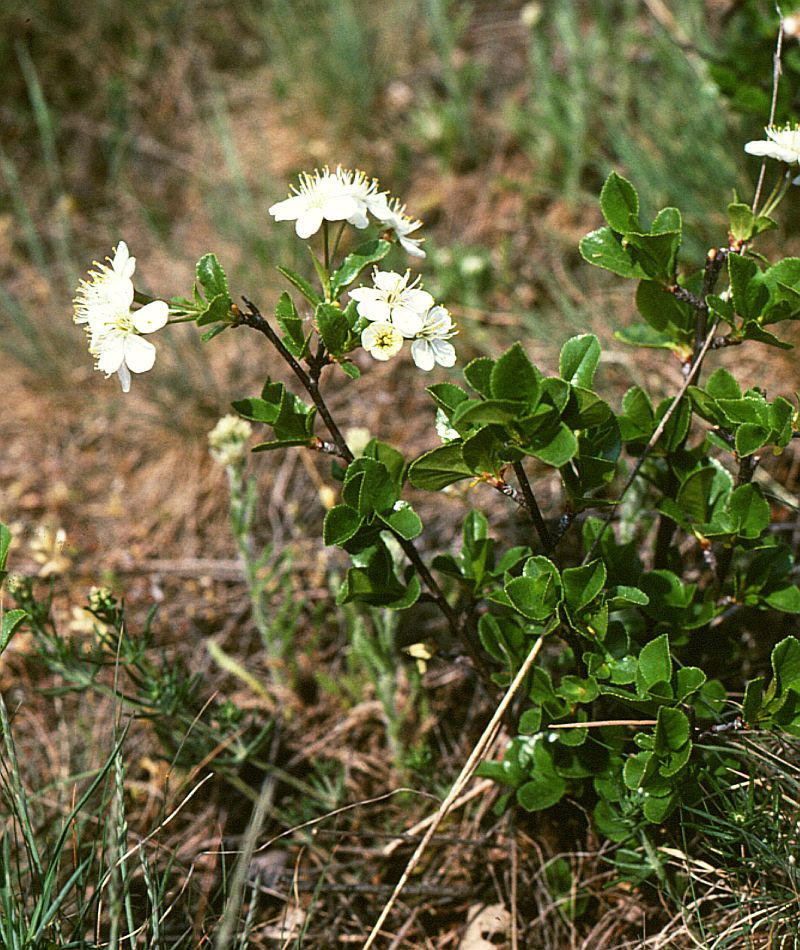
European Dwarf Cherry is a deciduous, xerophytic, winter-hardy shrub that produces cherries. It grows in steppe environments across central and southeastern Europe, Ukraine, European Russia, the northern Caucasus, Kazakhstan, and the Altai. It has white flowers and light-red to dark-red fruits that range from globose to pear-shaped.
Written 26 November 2026 from the sources listed below. Each statement was checked against the passage it cites; statements that could not be supported were removed.
Similar species
Prunus fruticosa is considered one of the parental species of the sour cherry, Prunus cerasus, through ancient crosses with Prunus avium.[1]
It naturally hybridizes with Prunus cerasus to produce Prunus × eminens and with Prunus avium to produce Prunus × stacei.[2][3]
The species can interbreed with Prunus avium and Prunus cerasus.[4]
Appearance
The shrub typically reaches 1–2 metres in height and approximately the same width. Its bark is dark brown and bears yellow lenticels.[5][6]
The leaves are oblanceolate to obovate and measure approximately 12 by 6 millimetres. They have acuminate tips, are hairless on their upper surfaces, and are thick, serrated, and dark green.[7][8][9]
The leaves turn yellow during autumn.[9]
The flowers are white and hermaphroditic. They occur in groups of two to four on short peduncles in sessile umbels.[10][11]
The fruits range from light red to dark red and are globose to pear-shaped. They measure approximately 8–25 millimetres in diameter.[12][13]
Habitat
The species grows in steppe environments rather than forests, although it can form thickets along open forest edges.[14]
It can grow in almost any soil type but performs best in loamy soil. The shrub requires full sunlight for growth.[15][16]
Diet
The fruits have a sour-sweet or tart taste.[17]
Behaviour
The shrub spreads through suckers.[18]
Reproduction and life cycle
Bees pollinate the flowers. In the Northern Hemisphere, the species flowers in May.[19][20]
Prunus fruticosa is tetraploid and has 32 chromosomes.[21]
Uses
The fruits are used in cooking because of their sour taste and are used to make jams and jellies.[22][23]
The species has medicinal uses as an astringent.[24]
The flowers are used as a source for honey production in beekeeping.[25]
The shrub is planted in hedgerows as an ornamental privacy screen and windbreak.[26]
The shrub is cultivated as a host plant for bees, other beneficial insects, and birds.[27]
Its extensive root network is used for soil stabilization in designed landscapes and habitat restoration projects.[28]
The species is used as a grafting stock because of its winter hardiness. It is grafted onto Prunus avium tree rootstock to produce trees with rounded tops.[29][30]
Classification of the European Dwarf Cherry
| Kingdom | Plantae |
|---|---|
| Subkingdom | Pteridobiotina |
| Phylum | Tracheophyta |
| Class | Magnoliopsida |
| Order | Rosales |
| Family | Rosaceae (Rose Family) |
| Subfamily | Amygdaloideae |
| Tribe | Amygdaleae |
| Genus | Prunus (Plum) |
| Species | Prunus fruticosa Pall. |
Where the European Dwarf Cherry is found
Checklists and occurrence records place Prunus fruticosa in 23 countries across Asia, Europe and North America. GBIF holds 7,607 georeferenced records of it.
Countries where it is native or its origin is not stated
- Afghanistan 13
- Austria 403
- Bulgaria 5
- China 10
- Croatia 2
- Czechia 467
- Estonia 7
- France 13
- Hungary 56
- Italy 6
- Kazakhstan 133
- Kosovo
- Luxembourg 4
- Moldova 19
- Montenegro
- Poland 1,043
- Romania 25
- Russia 4,238
- Serbia 3
- Slovakia 384
- Ukraine 535
Countries where it has been introduced
Regions and cities with the most records
- Samara Oblast, Russia 1,233
- Zhigulëvsk, Russia 1,061
- Moscow Oblast, Russia 527
- Pushchino, Russia 491
- Serpukhov, Russia 477
- Chelyabinsk, Russia 407
- Lower Austria, Austria 201
- Świętokrzyskie, Poland 199
- Bashkortostan Republic, Russia 193
- Penza Oblast, Russia 159
- Voronezh Oblast, Russia 159
- Líšeň, Czechia 120
- Kurgan Oblast, Russia 114
- Brno, Czechia 113
- Brno střed, Czechia 113
- Královo Pole, Czechia 113
- Žabovřesky, Czechia 113
- Židenice, Czechia 113
- Bystrc, Czechia 106
- Blansko, Czechia 104
- Chelyabinsk, Russia 103
- Sandomierz, Poland 102
- Świdnik, Poland 99
- Lublin, Poland 98
- Miass, Russia 98
- Tyumen Oblast, Russia 97
- Tarnobrzeg, Poland 91
- Volgograd Oblast, Russia 88
- Lipetsk Oblast, Russia 82
- Nitra Region, Slovakia 79
- Tolyatti, Russia 78
- Kursk Oblast, Russia 77
- Tula Oblast, Russia 75
- Vienna, Austria 74
- Košice Region, Slovakia 72
- Rheinland-Pfalz, Germany 69
1 more country has a few records outside this range
These countries hold a few records of Prunus fruticosa but lie outside the range the checklists give for it. Such records are often zoo or garden specimens, museum material or vagrants, so the species is not counted as occurring there.
Range as the checklists state it
Germany (Bayern [I], Rheinland-Pfalz, Sachsen-Anhalt, Thüringen); Austria; Poland; Czech Republic; Slovakia; Hungary; Italy; Croatia; Montenegro; Serbia; Kosovo; Romania; Bulgaria; European Russia; Moldova; Ukraine; Siberia (W-Siberia/Siberian Urals, SW-Siberia, Altay-Yenisey region [I], Baikal region [I]); Kazakhstan; Northern Caucasus; China (Xinjiang); USA [I] (Montana [I], New York [I])
A number beside a place is its count of GBIF occurrence records. A place without a number comes from a checklist alone. Records show where a species has been observed or collected, which can include escapes and vagrants.
Common names
English
- European Dwarf Cherry
- European Ground Cherry
- Mongolian Cherry
- Steppe Cherry
- Ground Cherry
Names in 16 other languages
- Chinese
- cao yuan ying tao, 灌木櫻
- Czech
- třešeň křovitá
- Danish
- Dværg Kirsebær
- Estonian
- stepi-kirsipuu
- Finnish
- arokirsikka
- French
- Cerisier des steppes, Prunier nain
- German
- Steppen-Kirsche, Steppenkirsche, Zwerg-Kirsche, Zwerg-Weichsel, Zwergekirsche
- Hungarian
- csepleszmeggy
- Polish
- Wisienka stepowa, Wiśnia karłowata
- Portuguese
- cereja-anã
- Russian
- Вишня кустарниковая
- Serbian
- Степска вишња
- Slovak
- čerešňa krovitá
- Swedish
- stäppkörsbär
- Turkish
- Step kirazı
- Ukrainian
- Вишня степова, Слива чагарникова
Synonyms
39 other scientific names have been used for this species and are now treated as synonyms of Prunus fruticosa.
- Cerasus caproniana var. umbraculifera Lavallée
- Cerasus chamaecerasus Loisel.
- Cerasus chamaecerasus var. floribunda Lavallée
- Cerasus chamaecerasus var. umbraculifera Lavallée
- Cerasus fruticosa (Pall.) Borkh.
- Cerasus fruticosa Pall.
- Cerasus fruticosa (Pall.) Woronow
- Cerasus fruticosa f. acuta (Borbás) Jáv.
- Cerasus fruticosa f. arborescens Nyár.
- Cerasus fruticosa f. dispar (Beck) S.Ya.Sokolov
- Cerasus fruticosa f. pendula (Dippel) S.Ya.Sokolov
- Cerasus fruticosa f. typica (C.K.Schneid.) S.Ya.Sokolov
- Cerasus fruticosa f. varigata Browicz & Bugała
- Prunus cerasus subsp. chamaecerasus (Jacq.) Schübl. & G.Martens
- Prunus cerasus var. chamaecerasus (Jacq.) Döll
- Prunus chamaecerasus Jacq.
- Prunus chamaecerasus f. salicifolia Zabel
- Prunus chamaecerasus var. dispar Beck
- Prunus chamaecerasus var. elatior Wallr.
- Prunus chamaecerasus var. fruticosa Willd.
- Prunus chamaecerasus var. pendula Murr
- Prunus chamaecerasus var. pygmaea Wallr.
- Prunus fruticosa f. aucta (Borbás) Jáv.
- Prunus fruticosa f. dubia Miyoshi
- Prunus fruticosa f. fruticosa
- Prunus fruticosa f. pendula Dippel
- Prunus fruticosa subvar. umbelliflora Asch. & Graebn.
- Prunus fruticosa var. dispar (Beck) C.K.Schneid.
- Prunus fruticosa var. intermedia (Poir.) Hegi
- Prunus fruticosa var. pendula (Dippel) C.K.Schneid.
- Prunus fruticosa var. typica C.K.Schneid.
- Prunus intermedia f. marasca Zabel
- Prunus intermedia f. semperflorens Zabel
- Prunus pumila var. acuta Borbás
- Cerasus pumila C.Bauhin ex Borkh. ambiguous synonym
- Cerasus pumila Pall. ambiguous synonym
- Prunus cerasus var. pumila L. ambiguous synonym
- Prunus cerasus var. pumila Roth ambiguous synonym
- Prunus intermedia Poir. ambiguous synonym
Related species
-
 AlmondPrunus amygdalus
-
 BlackthornPrunus spinosa
-
 Chinese PlumPrunus mume
-
 Black CherryPrunus serotina
-
 Wild CherryPrunus avium
-
 Cherry-laurelPrunus laurocerasus
-
 Cherry-plumPrunus cerasifera
-
 Sour CherryPrunus cerasus
Compare
Questions and answers
What is the scientific name of the European Dwarf Cherry?
The scientific name of the European Dwarf Cherry is Prunus fruticosa. Written with its author, the full name is Prunus fruticosa Pall..
Which family does the European Dwarf Cherry belong to?
Prunus fruticosa belongs to the family Rosaceae, in the order Rosales and the class Magnoliopsida.
Where is the European Dwarf Cherry found?
Checklists and occurrence records place Prunus fruticosa in 23 countries, including Russia, Poland, Ukraine, Czechia, Austria and Slovakia.
What is the conservation status of the European Dwarf Cherry?
The IUCN Red List category recorded for Prunus fruticosa is Least Concern (LC).
What other names does the European Dwarf Cherry have?
Prunus fruticosa is also known in English as European Ground Cherry, Mongolian Cherry, Steppe Cherry and Ground Cherry.
Do Prunus like full sun?
The European Dwarf Cherry requires full sunlight for growth.[16]
Sources
Passages the profile rests on
- Prunus fruticosa is considered one of the parental species of the sour cherry, Prunus cerasus, through ancient crosses with Prunus avium. Source passage: “is thought to be one of the parent species of Prunus cerasus (the sour cherry) by way of ancient crosses between it and Prunus avium” — English Wikipedia
- Prunus fruticosa naturally hybridizes with Prunus cerasus to produce Prunus × eminens. Source passage: “It hybridizes naturally with Prunus cerasus to form Prunus × eminens” — English Wikipedia
- Prunus fruticosa naturally hybridizes with Prunus avium to produce Prunus × stacei. Source passage: “and with Prunus avium to form Prunus × stacei.” — English Wikipedia
- Prunus fruticosa can interbreed with Prunus avium and Prunus cerasus. Source passage: “Both species can interbreed with each other, as well as with Prunus cerasus.” — English Wikipedia
- The shrub typically reaches 1–2 metres in height and approximately the same width. Source passage: “grows 1–2 metres (3–7 ft) high and as wide” — English Wikipedia
- The bark is dark brown and bears yellow lenticels. Source passage: “The bark is dark brown with yellow lenticels.” — English Wikipedia
- The leaves are oblanceolate to obovate and measure approximately 12 by 6 millimetres. Source passage: “The leaves are oblanceolate to obovate, about 12 mm by 6 mm” — English Wikipedia
- The leaves have acuminate tips and are hairless on their upper surfaces. Source passage: “with acuminate apex, glabrous above” — English Wikipedia
- The leaves are thick, serrated, dark green, and turn yellow during autumn. Source passage: “thick, serrated with crenate margin, dark green, yellow in autumn” — English Wikipedia
- The flowers are white and hermaphroditic. Source passage: “The flowers are white hermaphroditic blossoms” — English Wikipedia
- The flowers occur in groups of two to four on short peduncles in sessile umbels. Source passage: “located 2-4 each on short peduncles in sessile umbels.” — English Wikipedia
- The fruits range from light red to dark red and are globose to pear-shaped. Source passage: “The fruit is light to dark red, globose to pyriform” — English Wikipedia
- The fruits measure approximately 8–25 millimetres in diameter. Source passage: “about 8–25 mm in diameter” — English Wikipedia
- The species grows in steppe environments rather than forests, although it can form thickets along open forest edges. Source passage: “it is a steppe rather than a forest plant, although it does form thickets at the edges of open forest.” — English Wikipedia
- The species can grow in almost any soil type but performs best in loamy soil. Source passage: “in almost any soil, but best in loamy soil” — English Wikipedia
- The shrub requires full sunlight for growth. Source passage: “The plant requires full sun” — English Wikipedia
- The fruits have a sour-sweet or tart taste. Source passage: “The taste is sour-sweet, or tart.” — English Wikipedia
- The shrub spreads through suckers. Source passage: “spreading via suckers.” — English Wikipedia
- Bees pollinate the flowers of this species. Source passage: “They are pollinated by bees.” — English Wikipedia
- In the Northern Hemisphere, the species flowers in May. Source passage: “In the Northern Hemisphere, the plant flowers in May.” — English Wikipedia
- Prunus fruticosa is tetraploid and has 32 chromosomes. Source passage: “a tetraploid with 2n=32 chromosomes” — English Wikipedia
- The fruits are used in cooking because of their sour taste. Source passage: “As a sour tasting cherry, the fruit is used in cooking” — English Wikipedia
- The fruits are used to make jams and jellies. Source passage: “for jams and jellies.” — English Wikipedia
- The species has medicinal uses as an astringent. Source passage: “It has medicinal uses as an astringent.” — English Wikipedia
- The flowers are used as a source for honey production in beekeeping. Source passage: “The flowers are its basis of bee-keeping honey plant.” — English Wikipedia
- The shrub is planted in hedgerows as an ornamental privacy screen and windbreak. Source passage: “planted in hedgerows as an ornamental plant privacy screen and windbreak” — English Wikipedia
- The shrub is cultivated as a host plant for bees, other beneficial insects, and birds. Source passage: “as a host plant for bees and other beneficial insects and birds.” — English Wikipedia
- Its extensive root network is used for soil stabilization in designed landscapes and habitat restoration projects. Source passage: “The shrub's network of penetrating roots are useful for soil stabilization in designed landscapes and habitat restoration projects.” — English Wikipedia
- The species is used as a grafting stock because of its winter hardiness. Source passage: “The hardiness of Prunus fruticosa is a desirable quality in grafting” — English Wikipedia
- The species is grafted onto Prunus avium tree rootstock to produce trees with rounded tops. Source passage: “It is grafted to Prunus avium 'tree' rootstock, forming rounded top trees.” — English Wikipedia
Data
- Catalogue of Life, 2026-10-16 XR cc by
- Global Biodiversity Information Facility CC BY 4.0
- Wikidata CC0
- GeoNames CC BY 4.0
- Wikimedia Commons per image; credit shown with each image
- Within the Catalogue of Life, this name comes from Synonymic Checklists of the Vascular Plants of the World cc by
References
- Pall. (1784). Fl. Ross. [Pallas] 1: 19 (1784). where the name was published
This species in other databases
- Catalogue of Life 6VZYQ
- Wikidata Q164174
- iNaturalist 167459
- World Flora Online wfo-0001013852
- GRIN 29899
Page built on 27 November 2026. See how the catalog is made and all sources and licences.
Cite this page
ScientificNames.org. (2026). Prunus fruticosa (European Dwarf Cherry). Retrieved November 27, 2026, from https://scientificnames.org/species/prunus-fruticosa
“Prunus fruticosa (European Dwarf Cherry).” ScientificNames.org, 2026, scientificnames.org/species/prunus-fruticosa. Accessed 27 Nov. 2026.
ScientificNames.org. “Prunus fruticosa (European Dwarf Cherry).” Accessed November 27, 2026. https://scientificnames.org/species/prunus-fruticosa.
@misc{scientificnames_prunus_fruticosa_european_dwarf_cherry,
  author = {{ScientificNames.org}},
  title = {Prunus fruticosa (European Dwarf Cherry)},
  year = {2026},
  url = {https://scientificnames.org/species/prunus-fruticosa},
  note = {Accessed 2026-11-27}
}