Comparison

Texas Blind Salamander vs Northern Two-lined Salamander

Texas Blind Salamander (Eurycea rathbuni) and Northern Two-lined Salamander (Eurycea bislineata) both belong to the genus Eurycea (brook salamander) and part ways below it. Both are recorded in 1 country.
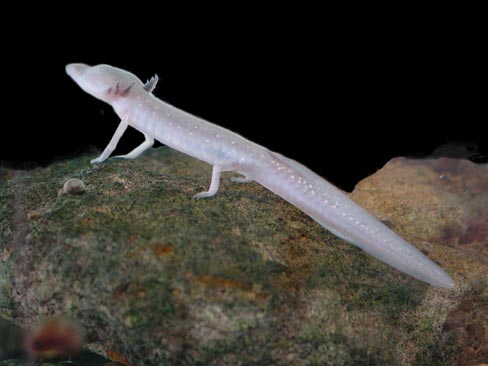
Texas Blind Salamander

Texas Blind Salamander

Eurycea rathbuni

Photograph courtesy of Joe N. Fries, U.S. Fish and Wildlife Service, Public domain, via Wikimedia Commons

Northern Two-lined Salamander

Northern Two-lined Salamander

Eurycea bislineata

Brian Gratwicke, CC BY 2.0, via Wikimedia Commons

Side by side

Texas Blind SalamanderNorthern Two-lined Salamander
Scientific nameEurycea rathbuni (Stejneger, 1896)Eurycea bislineata (Green, 1818)
English nameTexas Blind SalamanderNorthern Two-lined Salamander
GroupAmphibiansAmphibians
ClassAmphibia AmphibiansAmphibia Amphibians
OrderCaudata SalamandersCaudata Salamanders
FamilyPlethodontidae Lungless SalamandersPlethodontidae Lungless Salamanders
GenusEurycea Brook SalamanderEurycea Brook Salamander
Named in18961818
Red List categoryCritically EndangeredLeast Concern
Countries on record1 country2 countries
GBIF occurrence records388 records32,342 records

Rows where the two agree are shown in grey.

Where each is found

Both recorded in 1 country

Only Northern Two-lined Salamander (1)

From Catalogue of Life checklists and GBIF occurrence records. A country missing from a list means no record is held, which is not proof of absence.

Checked facts

Texas Blind SalamanderNorthern Two-lined Salamander
Appearance
  • Adults have yellow to yellowish-brown coloration with two black stripes running along the back. English Wikipedia
  • The flanks are mottled grayish or brown, and the belly is pale yellowish and nearly transparent. English Wikipedia
  • Adults have four toes on their forefeet and five toes on their hind feet. English Wikipedia
  • Adults have 14–16 costal grooves along their sides. English Wikipedia
  • Adult coloration includes a broad yellow, greenish-yellow, or tan stripe bordered by narrow black lines. animaldiversity.org
  • The dorsal stripe may contain a central row of dark spots. animaldiversity.org
  • Breeding males develop whitish lower eyelid glands, a mental gland on the chin, and protruding cirri. animaldiversity.org
  • Young larvae have yellowish ground coloration with gray or brown spots on the head and back. animaldiversity.org
  • Young larvae have short reddish-brown gills. animaldiversity.org
Size
Habitat
  • The species inhabits underground streams and deep pools in caves. English Wikipedia
  • Its underground pools are generally cool, measuring approximately 21–22 °C. English Wikipedia
  • It inhabits underground water-filled caves in the Edwards Aquifer. tpwd.texas.gov
  • The species is usually restricted to caves, although it has also been found in wells. animaldiversity.org
  • The species inhabits temperate forests, temperate shrublands, rivers, intermittent rivers, freshwater marshes, and freshwater springs. English Wikipedia
  • The species prefers small rocky streams and forest seeps. English Wikipedia
  • Adults commonly occur along stream banks and prefer habitats with cover from fallen leaves, logs, or rocks. animaldiversity.org
  • Adults may remain active in springs, streams, or waterlogged soil during winter when temperatures remain above freezing. animaldiversity.org
Diet
  • Its diet includes blind shrimp, snails, and amphipods. English Wikipedia
  • Tiny snails, shrimp, and other aquatic invertebrates form its diet. tpwd.texas.gov
  • Its diet varies according to the food material flowing into its cave habitat. English Wikipedia
  • Adult prey includes beetles, mayflies, springtails, spiders, pillbugs, centipedes, earthworms, and snails. animaldiversity.org
  • Larvae consume chironomid larvae, other dipteran larvae, stonefly larvae, cladocerans, and copepods. English Wikipedia
  • Adult diets also include wood roaches, millipedes, flies, hymenopterans, sowbugs, caddisfly larvae, and occasionally trout fry. English Wikipedia
  • Larvae consume aquatic larvae of midges, mosquitoes, caddisflies, stoneflies, and beetles. animaldiversity.org
Behaviour
  • The species hunts by moving its head from side to side while searching the bottom for food. tpwd.texas.gov
  • It detects prey by sensing water-pressure waves in underground water. tpwd.texas.gov
  • The species is neotenic and retains external gills throughout its life. animaldiversity.org
  • Adults and juveniles commonly hide under rocks and debris along stream edges during daylight. English Wikipedia
  • Most above-ground movements occur after dark and during wet weather. English Wikipedia
  • Adults are territorial, and population density can decrease when resources are scarce. English Wikipedia
  • Adults may drop their tails when threatened by predators, allowing them to escape while the detached tail continues moving. animaldiversity.org
  • Aquatic larvae use chemical cues in water to detect predatory fish and may hide for several days after detecting them. animaldiversity.org
Reproduction
  • Courtship may occur between September in southern populations and May in northern populations. English Wikipedia
  • The breeding season extends from October through May. animaldiversity.org
  • Females generally lay eggs in April or May. animaldiversity.org
  • Fertilization is internal and occurs after the female collects a spermatophore in her cloaca. animaldiversity.org
  • Females may deposit between fifteen and more than one hundred eggs beneath firm substrates, usually rocks, in flowing streams or spring water. animaldiversity.org
  • Females may guard their nests during part of an incubation period lasting 30–60 days. animaldiversity.org
  • Larvae generally transform into semiterrestrial juveniles after two to three years. animaldiversity.org
  • Sexual maturity is generally reached at three to four years of age. English Wikipedia
DistributionNo checked fact yet
  • The species occurs in Canada and the United States. English Wikipedia
  • Its range includes southern Quebec, New Brunswick, northeastern Ontario, and northeastern regions of the United States. English Wikipedia
  • The southern extent of its range reaches northern Virginia, while its western extent reaches northeastern Ohio. animaldiversity.org
Conservation
  • The species was listed as endangered on March 11, 1967. English Wikipedia
  • The species is listed as endangered under the U.S. Endangered Species Act. animaldiversity.org
  • Groundwater pumping for commercial or domestic purposes threatens the species by increasing its vulnerability to predators and potentially causing extinction. English Wikipedia
  • Stormwater runoff and chemical spills are sources of pollution affecting the Edwards Aquifer. English Wikipedia
  • Urban growth, water overuse, and pollution threaten the species' survival. tpwd.texas.gov
  • The species depends on a continuous supply of clean, cool water from the Edwards Aquifer. tpwd.texas.gov
  • Habitat destruction and collection for fish bait could reduce or eliminate local populations. animaldiversity.org
Uses
Similar species
  • The Texas blind salamander resembles the European olm. English Wikipedia
  • Unlike the olm, it has four digits on its front limbs and five on its back limbs. English Wikipedia
  • The northern two-lined salamander is more associated with aquatic environments than the northern redback salamander. English Wikipedia

In brief

Texas Blind Salamander

Eurycea rathbuni inhabits underground water-filled caves in the Edwards Aquifer. It has vestigial eyes covered by skin, red external gills, and a white body with little skin pigment. Full profile

Northern Two-lined Salamander

The Northern Two-lined Salamander occurs in Canada and the United States, including southern Quebec, New Brunswick, northeastern Ontario, and northeastern regions of the United States. Adults have yellow to yellowish-brown coloration with a broad dorsal stripe bordered by black lines. Full profile

Compare something else

Page built on 26 November 2026 from the data on the two species pages, where every source is listed.

Cite this page

ScientificNames.org. (2026). Texas Blind Salamander vs Northern Two-lined Salamander. Retrieved November 26, 2026, from https://scientificnames.org/compare/texas-blind-salamander-vs-northern-two-lined-salamander