Comparison

Texas Blind Salamander vs Barton Springs Salamander

Texas Blind Salamander (Eurycea rathbuni) and Barton Springs Salamander (Eurycea sosorum) both belong to the genus Eurycea (brook salamander) and part ways below it. Both are recorded in 1 country.
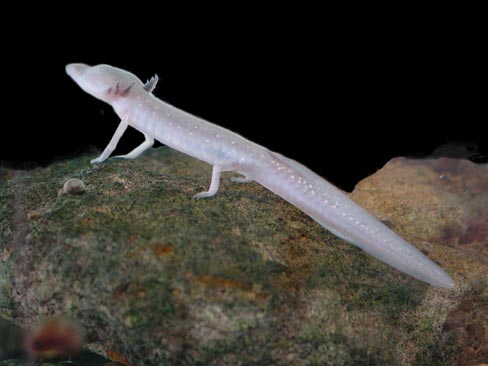
Texas Blind Salamander

Texas Blind Salamander

Eurycea rathbuni

Photograph courtesy of Joe N. Fries, U.S. Fish and Wildlife Service, Public domain, via Wikimedia Commons

Barton Springs Salamander

Barton Springs Salamander

Eurycea sosorum

U.S. Environmental Protection Agency, Public domain, via Wikimedia Commons

Side by side

Texas Blind SalamanderBarton Springs Salamander
Scientific nameEurycea rathbuni (Stejneger, 1896)Eurycea sosorum Chippindale, Price & Hillis, 1993
English nameTexas Blind SalamanderBarton Springs Salamander
GroupAmphibiansAmphibians
ClassAmphibia AmphibiansAmphibia Amphibians
OrderCaudata SalamandersCaudata Salamanders
FamilyPlethodontidae Lungless SalamandersPlethodontidae Lungless Salamanders
GenusEurycea Brook SalamanderEurycea Brook Salamander
Named in18961993
Red List categoryCritically EndangeredEndangered
Countries on record1 country1 country
GBIF occurrence records388 records147 records

Rows where the two agree are shown in grey.

Where each is found

Both recorded in 1 country

From Catalogue of Life checklists and GBIF occurrence records. A country missing from a list means no record is held, which is not proof of absence.

Checked facts

Texas Blind SalamanderBarton Springs Salamander
Appearance
  • The species has a slender body, elongated limbs, a small narrow head, and greatly reduced eyes. tpwd.texas.gov
  • Its dorsal coloration ranges from dark gray and purplish-gray to gray-brown and yellowish-brown. tpwd.texas.gov
  • Most individuals have dark salt-and-pepper mottling on their backs. tpwd.texas.gov
  • The species has red external gills. tpwd.texas.gov
  • Its ventral coloration is cream or translucent, allowing stomach contents and eggs to be seen. English Wikipedia
  • A yellow-orange stripe runs along the underside of its tail from the cloaca to the tail tip. English Wikipedia
  • The species has four fingers on each forelimb and five toes on each hindlimb. English Wikipedia
Size
Habitat
  • The species inhabits underground streams and deep pools in caves. English Wikipedia
  • Its underground pools are generally cool, measuring approximately 21–22 °C. English Wikipedia
  • It inhabits underground water-filled caves in the Edwards Aquifer. tpwd.texas.gov
  • The species is usually restricted to caves, although it has also been found in wells. animaldiversity.org
  • The species inhabits both surface waters and subterranean groundwater habitats. pmc.ncbi.nlm.nih.gov
  • Individuals are typically found near spring openings in clear water. English Wikipedia
  • The salamanders shelter beneath rocks and gravel and among aquatic vegetation and algae. English Wikipedia
  • The species occupies water depths ranging from 0.1 to 5 metres. English Wikipedia
  • Its spring habitats flow throughout the year and maintain temperatures of approximately 20 °C. English Wikipedia
  • The species occurs exclusively at the spring outflows of Barton Springs. tpwd.texas.gov
  • The salamanders depend on clear, clean, continuously flowing spring water. tpwd.texas.gov
  • The species is capable of living underground when surface conditions become unsuitable. tpwd.texas.gov
  • Eliza Springs supports one of the largest known populations of the species. English Wikipedia
Diet
  • Its diet includes blind shrimp, snails, and amphipods. English Wikipedia
  • Tiny snails, shrimp, and other aquatic invertebrates form its diet. tpwd.texas.gov
  • Its diet varies according to the food material flowing into its cave habitat. English Wikipedia
  • The species feeds on small aquatic crustaceans and planarian flatworms. English Wikipedia
  • Its supplementary prey includes earthworms, snails, leeches, and insect larvae. English Wikipedia
  • The species is known to consume amphipods and other small aquatic animals. tpwd.texas.gov
  • Captive individuals consume amphipods, earthworms, white worms, and brine shrimp. tpwd.texas.gov
  • The species shows a preference for flatworms even when amphipods are substantially more abundant. cns.utexas.edu
  • The salamanders switch to alternative prey when flatworms become scarce. cns.utexas.edu
Behaviour
  • The species hunts by moving its head from side to side while searching the bottom for food. tpwd.texas.gov
  • It detects prey by sensing water-pressure waves in underground water. tpwd.texas.gov
  • The species is neotenic and retains external gills throughout its life. animaldiversity.org
  • The species is strictly aquatic and retains its juvenile characteristics into adulthood. English Wikipedia
  • The salamanders use innate predator recognition when responding to potential predators. English Wikipedia
  • The species increases its body movement when exposed to low dissolved oxygen levels. English Wikipedia
  • Larger individuals are more likely to temporarily move into subterranean habitats between sampling intervals. pmc.ncbi.nlm.nih.gov
  • Body size predicts temporary emigration and survival more effectively than the environmental variables examined in the study. pmc.ncbi.nlm.nih.gov
Reproduction
  • The species has separate male and female individuals. English Wikipedia
  • Females can carry up to 40 eggs at one time. English Wikipedia
  • The eggs measure approximately 1.5 millimetres in diameter. English Wikipedia
  • Females deposit eggs in clusters on different substrates throughout the year. English Wikipedia
  • Males deposit spermatophores on substrates, which females store in their spermathecae. English Wikipedia
  • The species reproduces through internal fertilization. English Wikipedia
  • Recently hatched individuals have been recorded in November, March, and April. tpwd.texas.gov
  • Females carrying well-developed eggs have been observed from September through January. tpwd.texas.gov
Conservation
  • The species was listed as endangered on March 11, 1967. English Wikipedia
  • The species is listed as endangered under the U.S. Endangered Species Act. animaldiversity.org
  • Groundwater pumping for commercial or domestic purposes threatens the species by increasing its vulnerability to predators and potentially causing extinction. English Wikipedia
  • Stormwater runoff and chemical spills are sources of pollution affecting the Edwards Aquifer. English Wikipedia
  • Urban growth, water overuse, and pollution threaten the species' survival. tpwd.texas.gov
  • The species depends on a continuous supply of clean, cool water from the Edwards Aquifer. tpwd.texas.gov
  • The species was added to the federal List of Threatened and Endangered Species in 1997. English Wikipedia
  • The species is classified as vulnerable by the IUCN Red List. English Wikipedia
  • The species is federally classified as endangered in the United States. English Wikipedia
  • The salamander population declined sharply between 1970 and 1992. tpwd.texas.gov
  • High-pressure hoses, hot water, and chemicals used in pool maintenance harmed the salamanders and their aquatic plant habitat. tpwd.texas.gov
  • The species' population declined after substantial aquatic vegetation was removed from Barton Springs and recovered following habitat restoration. English Wikipedia
  • Urban runoff and increased development in the Barton Creek watershed threaten the quality of the salamander's habitat. tpwd.texas.gov
UsesNo checked fact yet
Similar species
  • The Texas blind salamander resembles the European olm. English Wikipedia
  • Unlike the olm, it has four digits on its front limbs and five on its back limbs. English Wikipedia
No checked fact yet

In brief

Texas Blind Salamander

Eurycea rathbuni inhabits underground water-filled caves in the Edwards Aquifer. It has vestigial eyes covered by skin, red external gills, and a white body with little skin pigment. Full profile

Barton Springs Salamander

Eurycea sosorum occurs exclusively at the spring outflows of Barton Springs. It has greatly reduced eyes, red external gills, and a yellow-orange stripe along the underside of its tail. Full profile

Compare something else

Page built on 26 November 2026 from the data on the two species pages, where every source is listed.

Cite this page

ScientificNames.org. (2026). Texas Blind Salamander vs Barton Springs Salamander. Retrieved November 26, 2026, from https://scientificnames.org/compare/texas-blind-salamander-vs-barton-springs-salamander