Comparison
Lesser Kestrel vs Gyrfalcon
Lesser Kestrel (Falco naumanni) and Gyrfalcon (Falco rusticolus) both belong to the genus Falco (falcons) and part ways below it. Both are recorded in 17 countries.


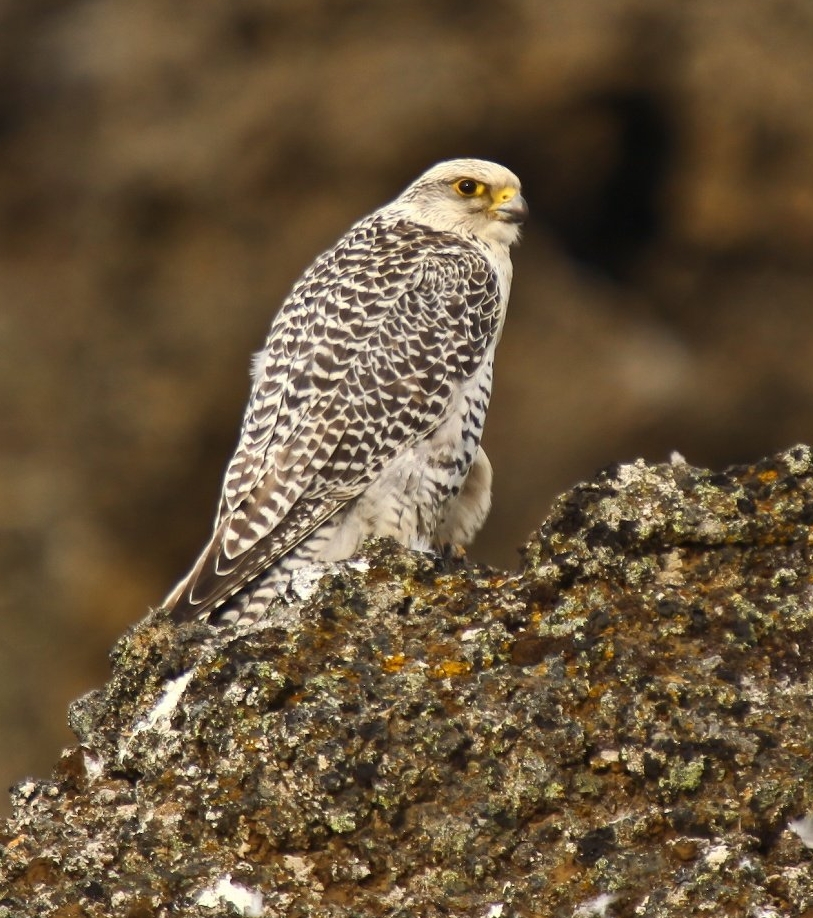
Gyrfalcon
Falco rusticolus
Falco_rusticolus_white.jpg: Ólafur Larsen derivative work: Bogbumper (talk), CC BY-SA 2.0, via Wikimedia Commons

Side by side
| Lesser Kestrel | Gyrfalcon | |
|---|---|---|
| Scientific name | Falco naumanni J. G. Fleischer, 1818 | Falco rusticolus Linnaeus, 1758 |
| English name | Lesser Kestrel | Gyrfalcon |
| Group | Birds | Birds |
| Class | Aves Bird | Aves Bird |
| Order | Falconiformes Falcons | Falconiformes Falcons |
| Family | Falconidae Falcons | Falconidae Falcons |
| Genus | Falco Falcons | Falco Falcons |
| Named in | 1818 | 1758 |
| Red List category | Least Concern | Least Concern |
| Environment | terrestrial | terrestrial |
| Countries on record | 106 countries | 24 countries |
| GBIF occurrence records | 223,252 records | 26,842 records |
Rows where the two agree are shown in grey.
Where each is found
Both recorded in 17 countries
- Austria
- Belgium
- China
- Denmark
- Estonia
- Finland
- France
- Germany
- Greece
- Norway
- Russia
- Spain
- Svalbard and Jan Mayen
- Sweden
- The Netherlands
- Ukraine
- United Kingdom
Only Lesser Kestrel (89)
- Afghanistan
- Albania
- Algeria
- Angola
- Armenia
- Azerbaijan
- Bahrain
- Benin
- Bosnia and Herzegovina
- Botswana
- Bulgaria
- Burkina Faso
- Burundi
- Cameroon
- Chad
- Croatia
- Cyprus
- Democratic Republic of the Congo
- Djibouti
- Egypt
- Eritrea
- Ethiopia
- Gambia
- Georgia
- Ghana
- Gibraltar
- Guinea
- Hungary
- India
- Iran
- Iraq
- Israel
- Italy
- Jordan
- Kazakhstan
- Kenya
- Kuwait
- Kyrgyzstan
- Laos
- Lebanon
- Lesotho
- Libya
- Malawi
- Mali
- Malta
- Mauritania
- Moldova
- Mongolia
- Montenegro
- Morocco
- Mozambique
- Myanmar
- Namibia
- Nepal
- Niger
- Nigeria
- North Macedonia
- Oman
- Palestinian Territory
- Poland
- Portugal
- Qatar
- Republic of the Congo
- Romania
- Rwanda
- Saudi Arabia
- Senegal
- Serbia
- Seychelles
- Singapore
- Slovenia
- Somalia
- South Africa
- Sudan
- Switzerland
- Syria
- Tajikistan
- Tanzania
- Thailand
- Tunisia
- Turkey
- Turkmenistan
- Uganda
- United Arab Emirates
- Uzbekistan
- Western Sahara
- Yemen
- Zambia
- Zimbabwe
Only Gyrfalcon (7)
From Catalogue of Life checklists and GBIF occurrence records. A country missing from a list means no record is held, which is not proof of absence.
Checked facts
| Lesser Kestrel | Gyrfalcon | |
|---|---|---|
| Appearance |
|
|
| Size | No checked fact yet |
|
| Habitat |
|
|
| Diet | No checked fact yet |
|
| Behaviour |
|
|
| Reproduction |
|
|
| Lifespan | No checked fact yet |
|
| Distribution | No checked fact yet |
|
| Conservation |
|
|
| Uses |
|
|
| Similar species |
| No checked fact yet |
In brief
Lesser Kestrel
Falco naumanni inhabits bushed, wooded and open grassland environments as well as cultivated areas. Both sexes have unusually whitish-horn-coloured talons. Full profile
Gyrfalcon
Falco rusticolus has a Holarctic distribution, with most of its breeding range north of 60 degrees latitude. It exhibits four principal colour morphs: white, silver, brown and black. Full profile
Compare something else
Page built on 28 November 2026 from the data on the two species pages, where every source is listed.
Cite this page
ScientificNames.org. (2026). Lesser Kestrel vs Gyrfalcon. Retrieved November 28, 2026, from https://scientificnames.org/compare/lesser-kestrel-vs-gyrfalcon
“Lesser Kestrel vs Gyrfalcon.” ScientificNames.org, 2026, scientificnames.org/compare/lesser-kestrel-vs-gyrfalcon. Accessed 28 Nov. 2026.
ScientificNames.org. “Lesser Kestrel vs Gyrfalcon.” Accessed November 28, 2026. https://scientificnames.org/compare/lesser-kestrel-vs-gyrfalcon.
@misc{scientificnames_lesser_kestrel_vs_gyrfalcon,
  author = {{ScientificNames.org}},
  title = {Lesser Kestrel vs Gyrfalcon},
  year = {2026},
  url = {https://scientificnames.org/compare/lesser-kestrel-vs-gyrfalcon},
  note = {Accessed 2026-11-28}
}