Species · Birds
Lesser Kestrel Falco naumanni
The scientific name of the Lesser Kestrel is Falco naumanni. It is a species of bird in the family Falconidae (falcons), order Falconiformes. The name dates from 1818.
- Scientific name
- Falco naumanni J. G. Fleischer, 1818
- Common name
- Lesser Kestrel
- Genus
- Falco
- Family
- Falconidae (Falcons)
- Order
- Falconiformes
- Class
- Aves
- Red List category
- LC Least Concern
- Environment
- terrestrial
- Recorded in
- 106 countries
- Name status
- accepted in the Catalogue of Life

Overview
Falco naumanni inhabits bushed, wooded and open grassland environments as well as cultivated areas. Both sexes have unusually whitish-horn-coloured talons.
Written 26 November 2026 from the sources listed below. Each statement was checked against the passage it cites; statements that could not be supported were removed.
Appearance
Males have a chestnut back and blue-grey crown, neck, rump and tail, with grey patches on their wings. Females have brown backs and heads with pale bellies.[1][2][3]
Females and juveniles are slightly paler than their related species. Juveniles resemble adult females.[4][5]
Habitat
Lesser Kestrels inhabit bushed, wooded and open grassland environments as well as cultivated areas. Their nesting habitats include mountain slopes, gorges, deep ravines and rocky terrain surrounded by open hunting areas.[6][7]
They are particularly numerous in highland farming regions and grassy plains during winter.[8]
Behaviour
Lesser Kestrels are migratory birds that travel to African wintering grounds. They migrate individually or in flocks of 40–50 birds at approximately 2,000 metres altitude.[9][10]
They are gregarious and usually occur in loose flocks. They sometimes roost communally in large groups, and communal tree roosts can contain thousands of birds.[11][12][13]
A communal roost discovered in Senegal contained 28,600 Lesser Kestrels. During flight, they use shallow wing beats interspersed with gliding.[14][15]
Lesser Kestrels spend considerable time displaying to maintain pair bonds and fighting to defend territories.[16]
Reproduction and life cycle
Lesser Kestrels breed between March and June. They breed colonially in groups of up to 100 pairs.[17][18]
Incubation lasts 28–31 days and begins after the third egg is laid. Parents continue feeding their offspring for two to four weeks after hatching.[19][20]
Conservation
The Lesser Kestrel is classified as Least Concern by the IUCN. Its European populations have experienced declines.[21][22]
The species is affected by indiscriminate pesticide use because of its insectivorous diet.[23]
Uses
The Lesser Kestrel provides agricultural benefits by eating mice and insects that damage crops.[24]
Similar species
The Lesser Kestrel closely resembles the common kestrel in outward appearance.[25]
Classification of the Lesser Kestrel
| Kingdom | Animalia |
|---|---|
| Phylum | Chordata |
| Subphylum | Vertebrata |
| Infraphylum | Gnathostomata |
| Parvphylum | Osteichthyes |
| Megaclass | Tetrapoda |
| Class | Aves (Bird) |
| Order | Falconiformes (Falcons) |
| Family | Falconidae (Falcons) |
| Subfamily | Falconinae |
| Genus | Falco (Falcons) |
| Species | Falco naumanni J. G. Fleischer, 1818 |
Where the Lesser Kestrel is found
Checklists and occurrence records place Falco naumanni in 106 countries across Africa and Asia. GBIF holds 223,252 georeferenced records of it.
Countries
- Afghanistan 22
- Albania 140
- Algeria 444
- Angola 15
- Armenia 712
- Austria 32
- Azerbaijan 987
- Bahrain 17
- Belgium 36
- Benin 198
- Bosnia and Herzegovina 15
- Botswana 400
- Bulgaria 361
- Burkina Faso 4
- Burundi 5
- Cameroon 5
- Chad 14
- China 509
- Croatia 281
- Cyprus 558
- Democratic Republic of the Congo 22
- Denmark 95
- Djibouti 18
- Egypt 276
- Eritrea 6
- Estonia 9
- Ethiopia 553
- Finland 10
- France 14,644
- Gambia 54
- Georgia 1,026
- Germany 23
- Ghana 3
- Gibraltar 118
- Greece 5,000
- Guinea 3
- Hungary 14
- India 952
- Iran 1,298
- Iraq 177
- Israel 7,375
- Italy 2,435
- Jordan 303
- Kazakhstan 860
- Kenya 2,218
- Kuwait 495
- Kyrgyzstan 132
- Laos 8
- Lebanon 43
- Lesotho 63
- Libya 14
- Malawi 109
- Mali 7
- Malta 239
- Mauritania 11
- Moldova 10
- Mongolia 951
- Montenegro 31
- Morocco 2,195
- Mozambique 45
- Myanmar 4
- Namibia 256
- Nepal 126
- Niger 11
- Nigeria 374
- North Macedonia 188
- Norway 62
- Oman 120
- Palestinian Territory 870
- Poland 7
- Portugal 11,105
- Qatar 158
- Republic of the Congo 5
- Romania 52
- Russia 1,370
- Rwanda 24
- Saudi Arabia 271
- Senegal 516
- Serbia 11
- Seychelles 4
- Singapore 17
- Slovenia 23
- Somalia 9
- South Africa 22,847
- Spain 129,420
- Sudan 35
- Svalbard and Jan Mayen 3
- Sweden 1,229
- Switzerland 10
- Syria 56
- Tajikistan 22
- Tanzania 1,805
- Thailand 30
- The Netherlands 3
- Tunisia 262
- Turkey 3,288
- Turkmenistan 24
- Uganda 237
- Ukraine 149
- United Arab Emirates 1,057
- United Kingdom 103
- Uzbekistan 86
- Western Sahara 20
- Yemen 12
- Zambia 146
- Zimbabwe 225
Regions and cities with the most records
- Extremadura, Spain 15,836
- Beja, Portugal 10,064
- Provence-Alpes-Côte d'Azur, France 8,081
- Eastern Cape, South Africa 8,044
- Whittlesea, South Africa 7,148
- Occitanie, France 6,136
- Istres, France 5,541
- Miramas, France 5,447
- Algeciras, Spain 5,428
- Free State, South Africa 5,138
- Tarifa, Spain 5,006
- Fos-sur-Mer, France 4,897
- Cáceres, Spain 3,701
- Los Barrios, Spain 3,690
- Aragon, Spain 3,689
- Arles, France 2,832
- Port-de-Bouc, France 2,813
- Southern District, Israel 2,752
- North West, South Africa 2,274
- Catalonia, Spain 2,159
- Northern District, Israel 1,976
- San Roque, Spain 1,944
- La Línea de la Concepción, Spain 1,932
- Gibraltar, Gibraltar 1,899
- Northern Cape, South Africa 1,881
- Madrid, Spain 1,791
- Salon-de-Provence, France 1,682
- Estepona, Spain 1,543
- Martigues, France 1,537
- Benavente, Spain 1,522
- Mairena del Aljarafe, Spain 1,515
- Barbate, Spain 1,507
- Bormujos, Spain 1,486
- Coria del Río, Spain 1,462
- Camas, Spain 1,430
- Narbonne, France 1,426
1 more country has a few records outside this range
These countries hold a few records of Falco naumanni but lie outside the range the checklists give for it. Such records are often zoo or garden specimens, museum material or vagrants, so the species is not counted as occurring there.
Range as the checklists state it
Europe & Northern Asia (excluding China)
Southern Asia
Africa
A number beside a place is its count of GBIF occurrence records. A place without a number comes from a checklist alone. Records show where a species has been observed or collected, which can include escapes and vagrants.
Common names
English
- Lesser Kestrel
Names in 67 other languages
- Afrikaans
- Kleinrooivalk, Kleinrooivalkie
- Albanian
- Skifteri kthetraverdhë
- Arabic
- العويسق, عوسق صغير, عويسق
- Armenian
- Բազե հողմավար տափաստանային
- Asturian
- peñerina pequeña
- Azerbaijani
- Çöl muymulu
- Basque
- Neumann belatz
- Breton
- Falc'hun ruz
- Bulgarian
- Белошипа ветрушка, Степна ветрушка
- Catalan
- xoriguer petit
- Chinese
- 黃爪隼, 黄爪隼
- Croatian
- bjelonokta vjetruša
- Czech
- poštolka jižní
- Danish
- Lille Tårnfalk
- Dutch
- Kleine Torenvalk
- Esperanto
- Malgranda turfalko, ruĝa falko
- Estonian
- stepi-tuuletallaja
- Faroese
- Rey?smyril, reyðsmyril
- Finnish
- pikkutuulihaukka
- French
- Cresserellette, Crécerine, Faucon crécerellette
- Galician
- Lagarteiro das torres
- Georgian
- ველის კირკიტა
- German
- Rötelfalke
- Greek
- Κιρκινέζι
- Hebrew
- בז אדום
- Hungarian
- fehérkarmú vércse
- Icelandic
- Kliðfálki
- Irish
- Mionphocaire gaoithe
- Italian
- Grillaio
- Japanese
- ヒメチョウゲンボウ
- Kazakh
- Дала күйкентай, Дала күйкентайы
- Korean
- 흰발톱황조롱이
- Latvian
- Piekūns Naumana, mazais piekūns
- Lithuanian
- stepinis pelėsakalis
- Macedonian
- Степска (Белоноќна) ветрушка, степска ветрушка
- Malayalam
- ചെറുവിറയൻപുള്ള്
- Maltese
- Spanjulett Sekond
- Mongolian
- Зээрд шонхор
- Northern Sami
- Ruksesfálli
- Norwegian
- rødfalk
- Norwegian Nynorsk
- raudfalk
- Persian
- دلیجه کوچک
- Polish
- pustułeczka
- Portuguese
- Peneireiro-de-dorso-liso, Peneireiro-pequeno, francelho, francelho-das-torres, peneireiro-das-torres
- Romanian
- Vânturel mic
- Russian
- Степная пустельга
- Serbian
- Belonokta vetruša - Белонокта ветрушка, Belonokta vetruška
- Slovak
- sokol bielopazúravý
- Slovenian
- južna postovka
- Sotho
- Seotsanyana
- Spanish
- Cernicalo primilla, Cernícalo primilla
- Swahili
- Kozi Mdogo
- Swedish
- rödfalk
- Thai
- เหยี่ยวเคสเตรลเล็ก
- Tswana
- Seotsanyane
- Turkish
- Küçük Kerkenez, Kızıl Kerkenez
- Ukrainian
- боривітер степовий
- Welsh
- Cudyll coch lleiaf, cudyll coch bach
- arg
- Ciquilín de canalera
- chv
- Шур чӗрнеллӗ якӑлпай
- ext
- Mícal
- glv
- Stannair ruy beg
- kwn
- Kakodi
- pnb
- نکا کیسٹرل
- roh
- Crivel pitschen
- sna
- Rukodzi
- tyv
- Хову шаңгыр
Synonyms
9 other scientific names have been used for this species and are now treated as synonyms of Falco naumanni.
- Cerchneis naumanni Fleischer, JG, 1818
- Falco cenchris Naumann
- Falco cenchris pekinensis Swinhoe, R, 1870
- Falco cenchris var. pekinensis Swinhoe, R, 1870
- Falco naumanni naumanni Fleischer, JG, 1818
- Falco naumanni pekinensis Swinhoe, R, 1870
- Falco tinnuncularius Vieillot, LJP, 1823
- Falco tinnuncularius Roux, JLFP, 1825
- Falco xantonyx Fleischer, JG, 1818
Related species
-
 Peregrine FalconFalco peregrinus
-
 Common KestrelFalco tinnunculus
-
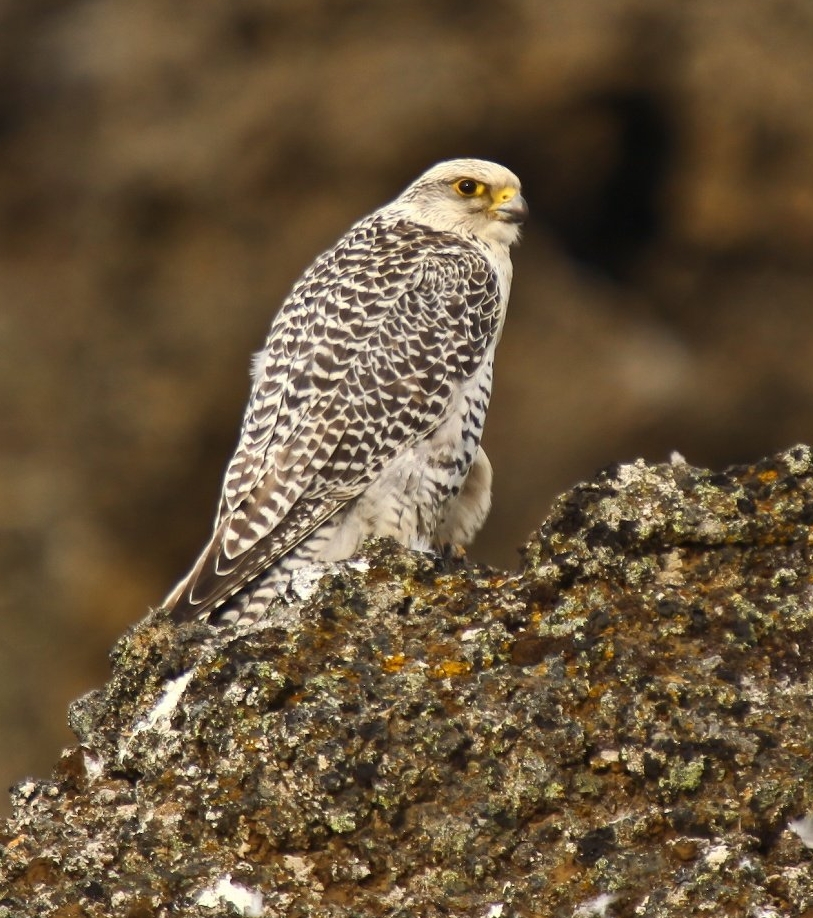 GyrfalconFalco rusticolus
-
 MerlinFalco columbarius
-
 American KestrelFalco sparverius
-
 Saker FalconFalco cherrug
-
 Eurasian HobbyFalco subbuteo
-
 Amur FalconFalco amurensis
Compare
Questions and answers
What is the scientific name of the Lesser Kestrel?
The scientific name of the Lesser Kestrel is Falco naumanni. Written with its author, the full name is Falco naumanni J. G. Fleischer, 1818.
Which family does the Lesser Kestrel belong to?
Falco naumanni belongs to the family Falconidae, in the order Falconiformes and the class Aves.
Where is the Lesser Kestrel found?
Checklists and occurrence records place Falco naumanni in 106 countries, including Spain, South Africa, France, Portugal, Israel and Greece.
What is the conservation status of the Lesser Kestrel?
The IUCN Red List category recorded for Falco naumanni is Least Concern (LC).
Sources
Passages the profile rests on
- Male lesser kestrels have grey heads and tails and grey patches on their wings. Source passage: “The male has a grey head and tail like male common kestrels, but lacks the dark spotting on the back, the black malar stripe, and has grey patches in the wings.” — English Wikipedia
- Male lesser kestrels have a chestnut back and blue-grey crown, neck, rump and tail. Source passage: “Males have a chestnut back and a blue-grey crown, neck, rump, and tail.” — animaldiversity.org
- Female lesser kestrels have brown backs and heads with pale bellies. Source passage: “Females have a brown back and head with a pale belly.” — animaldiversity.org
- Female and juvenile lesser kestrels are slightly paler than their related species. Source passage: “The female and young birds are slightly paler than their relative” — English Wikipedia
- Juvenile lesser kestrels resemble adult females. Source passage: “Juvenile lesser kestrels look similar to the females.” — animaldiversity.org
- Lesser kestrels inhabit bushed, wooded and open grassland environments as well as cultivated areas. Source passage: “Lesser kestrels are found in bushed, wooded, and open grassland and cultivation.” — animaldiversity.org
- Their nesting habitats include mountain slopes, gorges, deep ravines and rocky terrain surrounded by open hunting areas. Source passage: “They nest on mountain slopes, gorges, deep ravines, and other rocky terrain, all of which must have open areas around them for the birds to hunt.” — animaldiversity.org
- Lesser kestrels are particularly numerous in highland farming regions and grassy plains during winter. Source passage: “They are found most numerously in highland farming regions and on grassy plains during the winter range.” — animaldiversity.org
- Lesser kestrels are migratory birds that travel to African wintering grounds. Source passage: “It is a summer migrant, wintering in Africa and Pakistan” — English Wikipedia
- Lesser kestrels migrate individually or in flocks of 40–50 birds at approximately 2,000 metres altitude. Source passage: “They migrate singly or in small flocks of 40 to 50 birds at about 2,000m above sea level.” — animaldiversity.org
- Lesser kestrels sometimes roost communally in large groups. Source passage: “Surveys of lesser kestrels wintering in January 2007 by the Ligue pour la Protection des Oiseaux revealed them roosting communally.” — English Wikipedia
- Lesser kestrels are gregarious and usually occur in loose flocks. Source passage: “Lesser kestrels are gregarious, usually found in loose flocks.” — animaldiversity.org
- Communal tree roosts can contain thousands of lesser kestrels. Source passage: “Sometimes thousands of birds are found together in the same tree.” — animaldiversity.org
- A communal roost discovered in Senegal contained 28,600 lesser kestrels. Source passage: “A roost in Senegal discovered during one of the surveys held 28,600 birds” — English Wikipedia
- Lesser kestrels use shallow wing beats interspersed with gliding during flight. Source passage: “They fly with light shallow wing beats and lots of gliding.” — animaldiversity.org
- Lesser kestrels spend considerable time displaying to maintain pair bonds and fighting to defend territories. Source passage: “Kestrels spend a large amount of time displaying in order to maintain their pair bond and fighting to defend their territory.” — animaldiversity.org
- Lesser kestrels breed between March and June. Source passage: “Breeding occurs during the months of March through June.” — animaldiversity.org
- Lesser kestrels breed colonially in groups of up to 100 pairs. Source passage: “They breed in colonies of up to 100 pairs.” — animaldiversity.org
- Incubation lasts 28–31 days and begins after the third egg is laid. Source passage: “Incubation starts after the third egg is laid and lasts 28 to 31 days.” — animaldiversity.org
- Parents continue feeding their offspring for two to four weeks after hatching. Source passage: “Parents continue to feed their young for 2 to 4 weeks after hatching.” — animaldiversity.org
- The lesser kestrel is classified as Least Concern by the IUCN. Source passage: “the IUCN have classed it as Least Concern.” — English Wikipedia
- The lesser kestrel's European populations have experienced declines. Source passage: “and declining in its European range.” — English Wikipedia
- The species is affected by indiscriminate pesticide use because of its insectivorous diet. Source passage: “it appears that indiscriminate use of pesticides has a strong effect on this species due to its insectivorous habits.” — English Wikipedia
- The lesser kestrel provides agricultural benefits by eating mice and insects that damage crops. Source passage: “This bird eats mice and insects that damage human crops.” — animaldiversity.org
- The lesser kestrel closely resembles the common kestrel in outward appearance. Source passage: “It looks very much like the larger common kestrel” — English Wikipedia
Data
- Catalogue of Life, 2026-10-16 XR cc by
- Global Biodiversity Information Facility CC BY 4.0
- Wikidata CC0
- GeoNames CC BY 4.0
- Wikimedia Commons per image; credit shown with each image
- Within the Catalogue of Life, this name comes from The Integrated Taxonomic Information System cc0
References
- Sylvan [Laurop & Fischer] [1817-1818] p. 174 where the name was published
- Mayr, Ernst, and G. William Cottrell, eds. (1979). Check-List of Birds of the World, Vol. 1, Second Edition.
- Dickinson, Edward C., ed. (2003). The Howard and Moore Complete Checklist of the Birds of the World, 3rd Edition.
- Gill, Frank, & and Minturn Wright. (2006). Birds of the World: Recommended English Names.
- Dickinson, E. C., and J. V. Remsen Jr., eds. (2013). The Howard and Moore Complete Checklist of the Birds of the World, 4th Edition, Vol. 1 Non-Passerines.
This species in other databases
- Catalogue of Life 3DTGF
- Wikidata Q229408
- iNaturalist 59845
- WoRMS urn:lsid:marinespecies.org:taxname:1731512
- Avibase leskes1
Page built on 28 November 2026. See how the catalog is made and all sources and licences.
Cite this page
ScientificNames.org. (2026). Falco naumanni (Lesser Kestrel). Retrieved November 28, 2026, from https://scientificnames.org/species/falco-naumanni
“Falco naumanni (Lesser Kestrel).” ScientificNames.org, 2026, scientificnames.org/species/falco-naumanni. Accessed 28 Nov. 2026.
ScientificNames.org. “Falco naumanni (Lesser Kestrel).” Accessed November 28, 2026. https://scientificnames.org/species/falco-naumanni.
@misc{scientificnames_falco_naumanni_lesser_kestrel,
  author = {{ScientificNames.org}},
  title = {Falco naumanni (Lesser Kestrel)},
  year = {2026},
  url = {https://scientificnames.org/species/falco-naumanni},
  note = {Accessed 2026-11-28}
}