Comparison
Fishberry vs Bastard Jasmine
Fishberry (Anamirta cocculus) and Bastard Jasmine (Cestrum elegans) both belong to the class Magnoliopsida and part ways below it. Both are recorded in 5 countries.
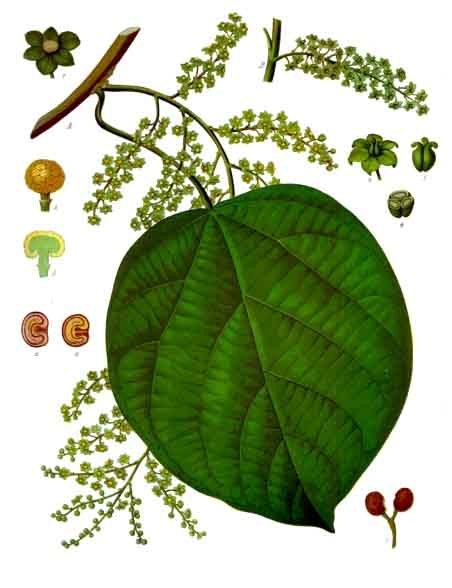
Fishberry
Anamirta cocculus
Franz Eugen Köhler, Köhler's Medizinal-Pflanzen, Public domain, via Wikimedia Commons


Side by side
| Fishberry | Bastard Jasmine | |
|---|---|---|
| Scientific name | Anamirta cocculus (L.) Wight & Arn. | Cestrum elegans (Brongn. ex Neumann) Schltdl. |
| English name | Fishberry | Bastard Jasmine |
| Group | Flowering plants | Flowering plants |
| Class | Magnoliopsida | Magnoliopsida |
| Order | Ranunculales | Solanales |
| Family | Menispermaceae Moonseed Family | Solanaceae Nightshades |
| Genus | Anamirta | Cestrum Cestrums |
| Red List category | Not recorded | Least Concern |
| Countries on record | 12 countries | 26 countries |
| GBIF occurrence records | 378 records | 1,869 records |
Rows where the two agree are shown in grey.
Where each is found
Both recorded in 5 countries
Only Fishberry (7)
Only Bastard Jasmine (21)
- Australia
- Bhutan
- China
- Colombia
- Democratic Republic of the Congo
- Eritrea
- Germany
- Kenya
- Malawi
- Mexico
- Nepal
- New Caledonia
- New Zealand
- Portugal
- Rwanda
- South Africa
- Taiwan
- Tanzania
- United States
- Zambia
- Zimbabwe
From Catalogue of Life checklists and GBIF occurrence records. A country missing from a list means no record is held, which is not proof of absence.
Checked facts
| Fishberry | Bastard Jasmine | |
|---|---|---|
| Appearance |
|
|
| Size |
|
|
| Habitat |
|
|
| Behaviour | No checked fact yet |
|
| Reproduction | No checked fact yet |
|
| Distribution |
|
|
| Conservation | No checked fact yet |
|
| Uses |
|
|
| Other |
| No checked fact yet |
In brief
Fishberry
Fishberry (Anamirta cocculus) is a climbing flowering plant in the family Menispermaceae, order Ranunculales, and class Magnoliopsida. It grows primarily in wet tropical biomes and occurs in Southeast Asia and India. Its seeds contain picrotoxin, and are traditionally used to stun fish. Full profile
Bastard Jasmine
Bastard jasmine (Cestrum elegans) is a slender evergreen shrub in the family Solanaceae, order Solanales, and class Magnoliopsida. The species occurs in the tropical regions of the Americas, from Florida to central Chile, and has also been recorded in parts of Britain. It is distinguished by bright purplish-red, sweetly fragrant flowers and crimson to dark red berries. Full profile
Compare something else
Page built on 29 November 2026 from the data on the two species pages, where every source is listed.
Cite this page
ScientificNames.org. (2026). Fishberry vs Bastard Jasmine. Retrieved November 29, 2026, from https://scientificnames.org/compare/fishberry-vs-bastard-jasmine
“Fishberry vs Bastard Jasmine.” ScientificNames.org, 2026, scientificnames.org/compare/fishberry-vs-bastard-jasmine. Accessed 29 Nov. 2026.
ScientificNames.org. “Fishberry vs Bastard Jasmine.” Accessed November 29, 2026. https://scientificnames.org/compare/fishberry-vs-bastard-jasmine.
@misc{scientificnames_fishberry_vs_bastard_jasmine,
  author = {{ScientificNames.org}},
  title = {Fishberry vs Bastard Jasmine},
  year = {2026},
  url = {https://scientificnames.org/compare/fishberry-vs-bastard-jasmine},
  note = {Accessed 2026-11-29}
}