Species · Flowering plants
Fishberry Anamirta cocculus
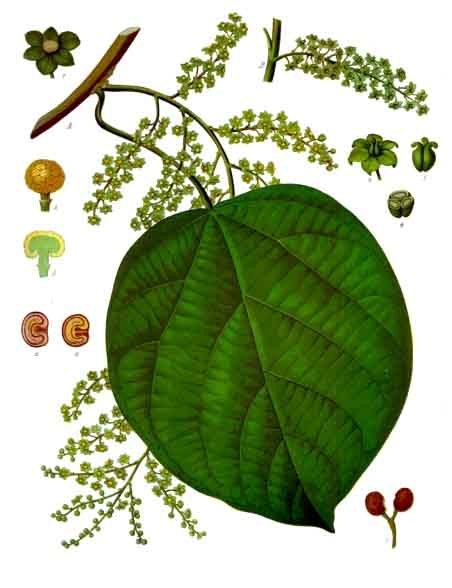
The scientific name of the Fishberry is Anamirta cocculus. It is a species of flowering plant in the family Menispermaceae (moonseed family), order Ranunculales.
- Scientific name
- Anamirta cocculus (L.) Wight & Arn.
- Common name
- Fishberry
- Genus
- Anamirta
- Family
- Menispermaceae (Moonseed Family)
- Order
- Ranunculales
- Class
- Magnoliopsida
- Recorded in
- 12 countries
- Name status
- accepted in the Catalogue of Life
Overview
Fishberry (Anamirta cocculus) is a climbing flowering plant in the family Menispermaceae, order Ranunculales, and class Magnoliopsida. It grows primarily in wet tropical biomes and occurs in Southeast Asia and India. Its seeds contain picrotoxin, and are traditionally used to stun fish.
Written 26 November 2026 from the sources listed below. Each statement was checked against the passage it cites; statements that could not be supported were removed.
Appearance
Fishberry is a climbing plant with large stems that can reach 10 cm in diameter. Its bark is corky and gray, and its wood is white.[1][2][3]
Its flowers are small, yellowish-white, and sweet-scented, measuring between 6 and 10 millimeters across. The plant produces drupe fruits, and the dried fruits measure approximately 1 cm in diameter.[4][5][6][7]
Habitat
Fishberry grows primarily in wet tropical biomes. Its natural distribution includes the Philippines, East India, Malaysia, and New Guinea.[8][9]
Uses
The crushed seeds are used as an anti-lice treatment, and the seeds are traditionally used to stun fish. The plant's wood is used as fuel and for carving.[10][11][12]
The plant is a source of picrotoxin, a poisonous compound with stimulant properties.[13]
Classification of the Fishberry
| Kingdom | Plantae |
|---|---|
| Subkingdom | Pteridobiotina |
| Phylum | Tracheophyta |
| Class | Magnoliopsida |
| Order | Ranunculales |
| Family | Menispermaceae (Moonseed Family) |
| Subfamily | Chasmantheroideae |
| Tribe | Coscinieae |
| Genus | Anamirta |
| Species | Anamirta cocculus (L.) Wight & Arn. |
Where the Fishberry is found
Checklists and occurrence records place Anamirta cocculus in 12 countries across Asia, Oceania and South America. GBIF holds 378 georeferenced records of it.
Countries
- Bangladesh
- Cambodia
- India 79
- Indonesia 104
- Laos 1
- Myanmar 1
- Papua New Guinea 2
- Philippines 92
- Sri Lanka 62
- Thailand 29
- Timor Leste 6
- Vietnam 2
Regions and cities with the most records
- Kerala, India 21
- Aroor, India 9
- Arukutti, India 9
- Ezhupunna, India 9
- Kochi, India 9
- Kodamthuruth, India 9
- Kumbalam, India 9
- Kutiatodu, India 9
- Manakunnam, India 9
- Maradu, India 9
- Mulamthuruthy, India 9
- Pallipuram, India 9
- Thaikkattussery, India 9
- Tripunittura, India 9
- Cherthala, India 8
- Kokōtamangalam South, India 8
- Shertallai, India 8
- Srīkandamangalam, India 8
- Thanneermukkom, India 8
- Vaikam, India 8
- Vayalār, India 8
- Gampola, Sri Lanka 7
- Kandy, Sri Lanka 7
- Tamil Nadu, India 7
- Thiruvankulam, India 7
- Bogor, Indonesia 5
- Caringin, Indonesia 5
- Ciampea, Indonesia 5
- Cibinong, Indonesia 5
- Citeureup, Indonesia 5
- Kanayannur, India 5
- Maluku, Indonesia 5
- Parung, Indonesia 5
- Valparai, India 5
- Candi Prambanan, Indonesia 4
- Depok, Indonesia 4
1 more country has a few records outside this range
These countries hold a few records of Anamirta cocculus but lie outside the range the checklists give for it. Such records are often zoo or garden specimens, museum material or vagrants, so the species is not counted as occurring there.
Range as the checklists state it
India (Karnataka, Kerala, Maharashtra, Tamil Nadu, Uttarakhand); Sri Lanka; Bangladesh; Andaman Isl. (Narcondum Isl.); Nicobar Isl. (Car Nicobar Isl., North Nicobar Isl., Central Nicobar Isl., Great Nicobar Isl., Little Nicobar Isl.); Myanmar (widespread); Thailand; Laos; Cambodia; Vietnam; Sumatera; Philippines (Luzon, Mindoro, Basilan, Mindanao); Jawa; Lesser Sunda Isl. (Sumba, Flores, Alor, Timor, Wetar, Damar); Moluccas (Tanimbar, Kei Isl., Seram, Sula Isl., Halmaheira, Aru, Babar); New Guinea (Irian Jaya, Papua New Guinea); South America [I]
A number beside a place is its count of GBIF occurrence records. A place without a number comes from a checklist alone. Records show where a species has been observed or collected, which can include escapes and vagrants.
Common names
English
- Fishberry
- Levantnut
- Poison-berry
Names in 10 other languages
- Arabic
- سم السمك, عنيبية حورية الأوراق
- Cebuano
- lagtang
- Chinese
- 印防己
- Czech
- chebule korková
- Finnish
- intiananamirta
- French
- Coque du Levant
- Indonesian
- tuba biji
- Slovak
- anamirta metlinatá
- Swedish
- kockel-lian
- Turkish
- balık otu
Synonyms
17 other scientific names have been used for this species and are now treated as synonyms of Anamirta cocculus.
- Anamirta baueriana Endl.
- Anamirta jucunda Miers
- Anamirta paniculata Colebr.
- Anamirta populifolia (DC.) Miers
- Anamirta racemosa Colebr. ex Steud.
- Anamirta toxifera Miers
- Cocculus indicus Royle
- Cocculus lacunosus (Lam.) DC.
- Cocculus populifolius DC.
- Cocculus suberosus DC.
- Menispermum cocculiferum Stokes
- Menispermum heteroclitum Roxb.
- Menispermum lacunosum Lam.
- Menispermum monadelphum Roxb. ex Wight & Arn.
- Menispermum populifolium Spreng.
- Tinospora lacunosus Miers
- Menispermum cocculus L. ambiguous synonym
Related species
-
 Canada MoonseedMenispermum canadense
- Carolina SnailseedNephroia carolina
-
 Chondrodendron tomentosum
-
 Cocculus hirsutus
-
 Tiliacora triandra
-
 Stephania cephalantha
-
 Yellow VineCoscinium fenestratum
- FibraureaFibraurea tinctoria
Compare
Questions and answers
What is the scientific name of the Fishberry?
The scientific name of the Fishberry is Anamirta cocculus. Written with its author, the full name is Anamirta cocculus (L.) Wight & Arn..
Which family does the Fishberry belong to?
Anamirta cocculus belongs to the family Menispermaceae, in the order Ranunculales and the class Magnoliopsida.
Where is the Fishberry found?
Checklists and occurrence records place Anamirta cocculus in 12 countries, including Indonesia, Philippines, India, Sri Lanka, Thailand and Timor Leste.
What other names does the Fishberry have?
Anamirta cocculus is also known in English as Levantnut and Poison-berry.
What is cocculus indicus?
Cocculus Indicus is the name used for Anamirta cocculus in pharmacology.[14]
Sources
Passages the profile rests on
- Anamirta cocculus is a climbing plant with large stems. Source passage: “Anamirta cocculus (Marathi: काकमारी) is a Southeast Asian and Indian climbing plant.” — English Wikipedia
- The plant's stems can reach 10 cm in diameter. Source passage: “The plant is large-stemmed (up to 10 cm in diameter)” — English Wikipedia
- The plant has corky gray bark and white wood. Source passage: “The bark is "corky gray" with white wood.” — English Wikipedia
- Its flowers are small, yellowish-white, and sweet-scented. Source passage: “"small, yellowish-white, sweet-scented" flowers” — English Wikipedia
- The flowers measure between 6 and 10 millimeters across. Source passage: “flowers vary between 6 and 10 millimeters across” — English Wikipedia
- The plant produces drupe fruits. Source passage: “the fruit produced is a drupe” — English Wikipedia
- The dried fruits measure approximately 1 cm in diameter. Source passage: “"about 1 cm in diameter when dry"” — English Wikipedia
- The species grows primarily in wet tropical biomes. Source passage: “grows primarily in the wet tropical biome.” — powo.science.kew.org
- The species' natural distribution includes the Philippines, East India, Malaysia, and New Guinea. Source passage: “throughout its natural distribution (the Philippines, East India, Malaysia, and New Guinea).” — English Wikipedia
- The crushed seeds are used as an anti-lice treatment. Source passage: “Its crushed seeds are an effective pediculicide (anti-lice)” — English Wikipedia
- The seeds are traditionally used to stun fish. Source passage: “and are also traditionally used to stun fish” — English Wikipedia
- The plant's wood is used as fuel and for carving. Source passage: “The wood of the plant is used for fuel and carving.” — English Wikipedia
- The plant is a source of picrotoxin, a poisonous compound with stimulant properties. Source passage: “It is the source of picrotoxin, a poisonous compound with stimulant properties.” — English Wikipedia
- The species is known in pharmacology as Cocculus Indicus. Source passage: “In pharmacology, it is known as Cocculus Indicus.” — English Wikipedia
Data
- Catalogue of Life, 2026-10-16 XR cc by
- Global Biodiversity Information Facility CC BY 4.0
- Wikidata CC0
- GeoNames CC BY 4.0
- Wikimedia Commons per image; credit shown with each image
- iNaturalist per image; credit shown with each image
- Within the Catalogue of Life, this name comes from Synonymic Checklists of the Vascular Plants of the World cc by
References
- Wight & Arn. (1834). Prodr. Fl. Ind. Orient. [Wight & Arnott] 1: 446 (1834). where the name was published
This species in other databases
- Catalogue of Life 66JJX
- Wikidata Q2007832
- iNaturalist 900868
- World Flora Online wfo-0000533338
- GRIN 3069
Page built on 26 November 2026. See how the catalog is made and all sources and licences.
Cite this page
ScientificNames.org. (2026). Anamirta cocculus (Fishberry). Retrieved November 26, 2026, from https://scientificnames.org/species/anamirta-cocculus
“Anamirta cocculus (Fishberry).” ScientificNames.org, 2026, scientificnames.org/species/anamirta-cocculus. Accessed 26 Nov. 2026.
ScientificNames.org. “Anamirta cocculus (Fishberry).” Accessed November 26, 2026. https://scientificnames.org/species/anamirta-cocculus.
@misc{scientificnames_anamirta_cocculus_fishberry,
  author = {{ScientificNames.org}},
  title = {Anamirta cocculus (Fishberry)},
  year = {2026},
  url = {https://scientificnames.org/species/anamirta-cocculus},
  note = {Accessed 2026-11-26}
}