Comparison

Five-toed Pygmy Jerboa vs Long-eared Jerboa

Five-toed Pygmy Jerboa (Cardiocranius paradoxus) and Long-eared Jerboa (Euchoreutes naso) both belong to the family Dipodidae (jerboa) and part ways below it. Both are recorded in 2 countries.

Five-toed Pygmy Jerboa

Five-toed Pygmy Jerboa

Cardiocranius paradoxus

А. Исаков, В. Колганов, Public domain, via Wikimedia Commons
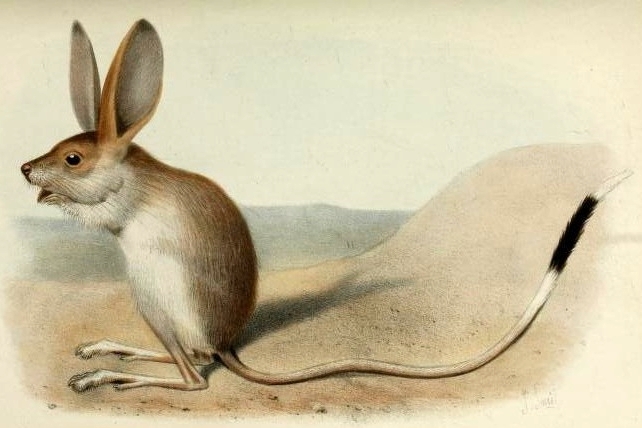
Long-eared Jerboa

Long-eared Jerboa

Euchoreutes naso

Joseph Smit (1836–1929), Public domain, via Wikimedia Commons

Side by side

Five-toed Pygmy JerboaLong-eared Jerboa
Scientific nameCardiocranius paradoxus Satunin, 1903Euchoreutes naso Sclater, 1891
English nameFive-toed Pygmy JerboaLong-eared Jerboa
GroupMammalsMammals
ClassMammalia MammalMammalia Mammal
OrderRodentia RodentRodentia Rodent
FamilyDipodidae JerboaDipodidae Jerboa
GenusCardiocranius Five-toed Pygmy JerboaEuchoreutes
Named in19031891
Red List categoryData DeficientLeast Concern
Countries on record2 countries2 countries
GBIF occurrence records117 records111 records

Rows where the two agree are shown in grey.

Where each is found

Both recorded in 2 countries

From Catalogue of Life checklists and GBIF occurrence records. A country missing from a list means no record is held, which is not proof of absence.

Checked facts

Five-toed Pygmy JerboaLong-eared Jerboa
Appearance
  • The long-eared jerboa has reddish-yellow to light russet upperparts and a white belly. animaldiversity.org
  • The long-eared jerboa has ears approximately one-third longer than its head. animaldiversity.org
  • The long-eared jerboa has a tail with short hairs and a terminal tuft of black and white hairs. animaldiversity.org
  • The long-eared jerboa has five digits on each hind foot, with shorter lateral digits than central digits. animaldiversity.org
  • The central metatarsals of the long-eared jerboa are fused over a short distance. animaldiversity.org
  • The long-eared jerboa has tufts of bristly hairs covering its feet. animaldiversity.org
  • The long-eared jerboa has thin, white incisors. animaldiversity.org
  • The long-eared jerboa has a small premolar on each side of its upper jaw. animaldiversity.org
  • Female long-eared jerboas have eight mammary glands. animaldiversity.org
Size
Habitat
  • Long-eared jerboas have been collected in sandy valleys covered with low-growing bushes. animaldiversity.org
  • The long-eared jerboa inhabits arid desert and semi-desert environments in the Mengxin and Aerjin Mountain regions. animaldiversity.org
  • The long-eared jerboa also inhabits cold, high-elevation desert environments in the Qing-Zang Plateau region. animaldiversity.org
  • Haloxylon ammodendron has been documented at some long-eared jerboa capture sites. animaldiversity.org
Diet
Behaviour
  • The species burrows underground to avoid overheating in its desert environment. English Wikipedia
  • The species uses its burrows for storing food and obtaining shelter. English Wikipedia
  • The species hibernates in burrows during cold winters to conserve energy. English Wikipedia
  • The species forages at night when environmental conditions are less severe. English Wikipedia
  • The species is strictly nocturnal and is most active between 22:00 and 04:00. animaldiversity.org
  • Approximately 90% of the active period is spent exploring. animaldiversity.org
  • The species moves primarily by making small hops, although it sometimes crawls. animaldiversity.org
  • When moving, individuals continually change direction rather than travelling in straight lines. animaldiversity.org
  • When startled, an individual can jump vertically to a height of 20–30 cm. animaldiversity.org
  • Individuals may excavate their own burrows or occupy burrows abandoned by other animals. animaldiversity.org
  • Individuals use their hind legs to rake and kick soil when excavating burrows. animaldiversity.org
  • Burrows are generally excavated beneath bushes that provide cover. animaldiversity.org
  • Burrow entrances are often concealed by piles of dry grass. animaldiversity.org
  • Observed burrows are approximately 25–30 cm deep. animaldiversity.org
  • The central nesting chamber of a burrow measures approximately 10–11 cm in diameter. animaldiversity.org
  • Burrows serve as locations for resting, hibernating, and raising young. animaldiversity.org
  • The typical home range of the species covers approximately 14,300 square metres. animaldiversity.org
  • When escaping predators, individuals rapidly hop in a zigzag pattern toward shrubs or burrows for cover. animaldiversity.org
  • Long-eared jerboas are presumed to be mainly nocturnal. animaldiversity.org
  • The long-eared jerboa locates flying insects using sound and captures them by leaping rapidly into the air. animaldiversity.org
  • The long-eared jerboa belongs to a species whose mating system has not been established. animaldiversity.org
  • The long-eared jerboa is gonochoric, with separate male and female sexes. animaldiversity.org
Reproduction
  • Female long-eared jerboas nurse and care for their offspring at least until weaning. animaldiversity.org
Distribution
  • The long-eared jerboa occurs from southernmost Mongolia into northwestern China. animaldiversity.org
Conservation
  • The population size and conservation status of the species remain unresolved. English Wikipedia
  • The long-eared jerboa was identified as one of the ten focal species of the EDGE project in 2007. English Wikipedia
  • Ongoing human disturbance is identified as a major threat to the long-eared jerboa. animaldiversity.org
  • The long-eared jerboa's population has experienced an observed or probable reduction of at least 80 percent over ten years. animaldiversity.org
Other
  • The species is the only member of the genus Cardiocranius. English Wikipedia
  • The species is classified as a rodent in the family Dipodidae. fws.gov
  • The long-eared jerboa is the only recognized member of its genus, Euchoreutes. English Wikipedia
  • The long-eared jerboa is also the only recognized member of its subfamily, Euchoreutinae. English Wikipedia

In brief

Five-toed Pygmy Jerboa

The Five-toed Pygmy Jerboa is a mammal in the family Dipodidae, order Rodentia, and the only member of the genus Cardiocranius. The species occurs in China, Kazakhstan, Mongolia, and the Ubsu-Nur Depression of the Tuva Autonomous Region in Russia. It is distinguished by having five separate toes on each hind foot and a heart-shaped skull. Full profile

Long-eared Jerboa

Euchoreutes naso occurs from southernmost Mongolia into northwestern China and inhabits arid desert, semi-desert, and cold, high-elevation desert environments. It is distinguished by ears approximately one-third longer than its head and a tail ending in a tuft of black and white hairs. Full profile

Compare something else

Page built on 29 November 2026 from the data on the two species pages, where every source is listed.

Cite this page

ScientificNames.org. (2026). Five-toed Pygmy Jerboa vs Long-eared Jerboa. Retrieved November 29, 2026, from https://scientificnames.org/compare/five-toed-pygmy-jerboa-vs-long-eared-jerboa