Comparison
Flathead Sole vs European Plaice
Flathead Sole (Hippoglossoides elassodon) and European Plaice (Pleuronectes platessa) both belong to the subfamily Pleuronectinae and part ways below it.
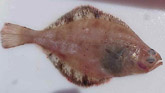
Flathead Sole
Hippoglossoides elassodon
Alaska Fisheries Science Center, Public domain, via Wikimedia Commons


Side by side
| Flathead Sole | European Plaice | |
|---|---|---|
| Scientific name | Hippoglossoides elassodon Jordan & Gilbert, 1880 | Pleuronectes platessa Linnaeus, 1758 |
| English name | Flathead Sole | European Plaice |
| Group | Fishes | Fishes |
| Class | Teleostei Teleost | Teleostei Teleost |
| Order | Pleuronectiformes | Pleuronectiformes |
| Family | Pleuronectidae Dabs | Pleuronectidae Dabs |
| Genus | Hippoglossoides | Pleuronectes Plaices |
| Named in | 1880 | 1758 |
| Red List category | Least Concern | Least Concern |
| Environment | marine | brackish, marine |
| Countries on record | 2 countries | 23 countries |
| GBIF occurrence records | 73,875 records | 880,461 records |
Rows where the two agree are shown in grey.
Where each is found
Only Flathead Sole (2)
Only European Plaice (23)
- Belgium
- Denmark
- Estonia
- Finland
- France
- Germany
- Guernsey
- Iceland
- Ireland
- Isle of Man
- Italy
- Jersey
- Latvia
- Lithuania
- Norway
- Poland
- Portugal
- Russia
- Spain
- Sweden
- The Netherlands
- Ukraine
- United Kingdom
From Catalogue of Life checklists and GBIF occurrence records. A country missing from a list means no record is held, which is not proof of absence.
Checked facts
| Flathead Sole | European Plaice | |
|---|---|---|
| Appearance |
|
|
| Size |
|
|
| Habitat |
|
|
| Diet |
|
|
| Behaviour |
|
|
| Reproduction | No checked fact yet |
|
| Distribution |
|
|
| Conservation |
|
|
| Uses |
|
|
| Other |
| No checked fact yet |
In brief
Flathead Sole
Flathead Sole (Hippoglossoides elassodon Jordan & Gilbert, 1880) is a right-eyed flounder in the family Pleuronectidae, order Pleuronectiformes and class Teleostei. Its native range extends across the northern Pacific, including the seas of Japan and Okhotsk, the Bering Sea and the North American coast as far south as Point Reyes in the United States. It has an oval-shaped body, an olive brown to reddish grey-brown upper surface and a white underside, and can reach 52 centimetres in length. Full profile
European Plaice
Pleuronectes platessa occurs from the Barents Sea south to the Iberian Peninsula and around Iceland and the Faroe Islands. It has a dark green to dark brown dorsal surface with conspicuous orange spots and both eyes on the right side of its body. Full profile
Compare something else
Page built on 28 November 2026 from the data on the two species pages, where every source is listed.
Cite this page
ScientificNames.org. (2026). Flathead Sole vs European Plaice. Retrieved November 28, 2026, from https://scientificnames.org/compare/flathead-sole-vs-european-plaice
“Flathead Sole vs European Plaice.” ScientificNames.org, 2026, scientificnames.org/compare/flathead-sole-vs-european-plaice. Accessed 28 Nov. 2026.
ScientificNames.org. “Flathead Sole vs European Plaice.” Accessed November 28, 2026. https://scientificnames.org/compare/flathead-sole-vs-european-plaice.
@misc{scientificnames_flathead_sole_vs_european_plaice,
  author = {{ScientificNames.org}},
  title = {Flathead Sole vs European Plaice},
  year = {2026},
  url = {https://scientificnames.org/compare/flathead-sole-vs-european-plaice},
  note = {Accessed 2026-11-28}
}