Comparison

Dusky-billed Parrotlet vs Pacific Parrotlet

Dusky-billed Parrotlet (Forpus modestus) and Pacific Parrotlet (Forpus coelestis) both belong to the genus Forpus (forpus parrotlets) and part ways below it. Both are recorded in 3 countries.
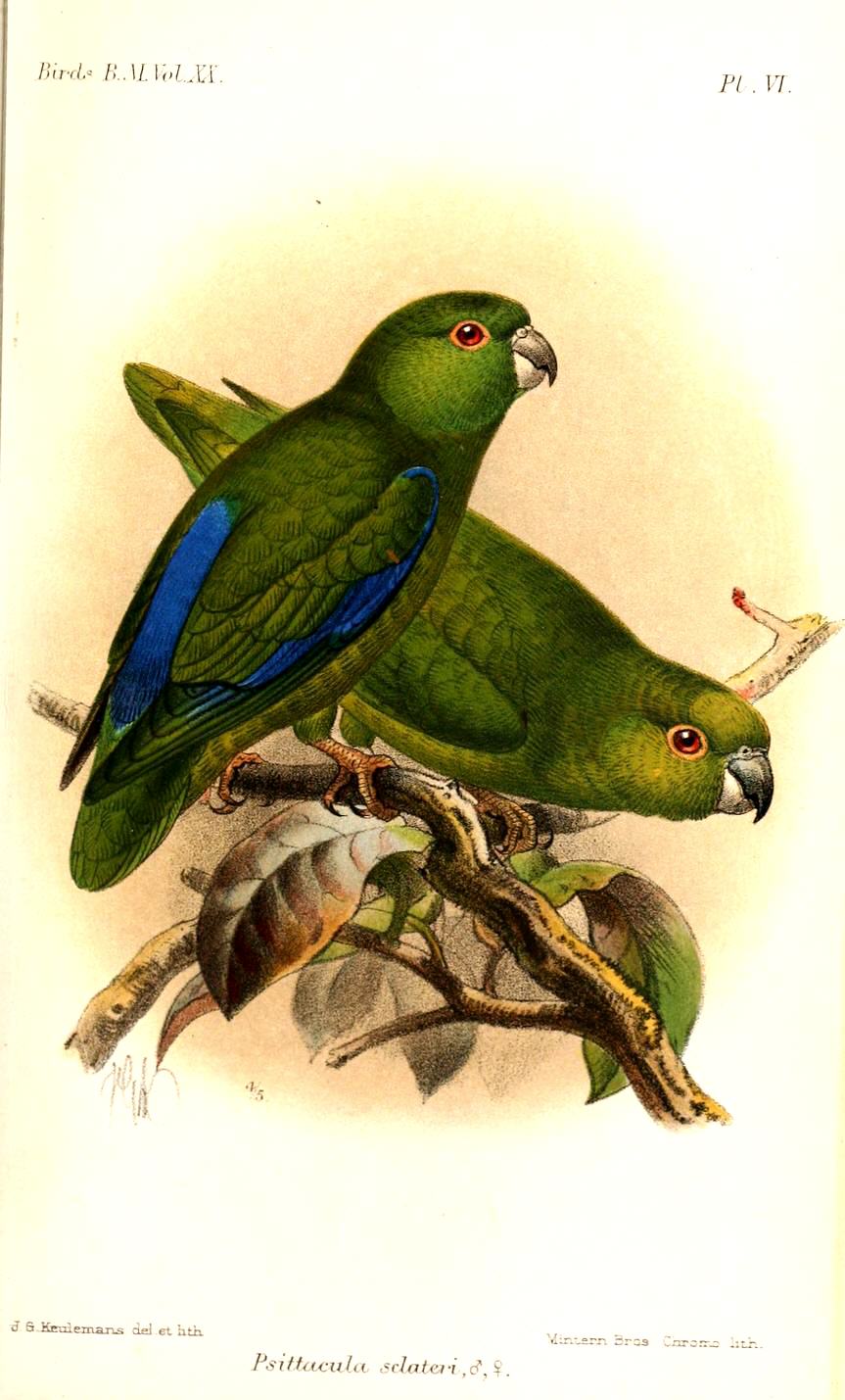
Dusky-billed Parrotlet

Dusky-billed Parrotlet

Forpus modestus

John Gerrard Keulemans, Public domain, via Wikimedia Commons

Pacific Parrotlet

Pacific Parrotlet

Forpus coelestis

peterdehaas2317, CC BY 2.0, via Wikimedia Commons

Side by side

Dusky-billed ParrotletPacific Parrotlet
Scientific nameForpus modestus (Cabanis, 1849)Forpus coelestis (R. Lesson, 1847)
English nameDusky-billed ParrotletPacific Parrotlet
GroupBirdsBirds
ClassAves BirdAves Bird
OrderPsittaciformes ParrotPsittaciformes Parrot
FamilyPsittacidae MacawsPsittacidae Macaws
GenusForpus Forpus ParrotletsForpus Forpus Parrotlets
Named in18491847
Red List categoryLeast ConcernLeast Concern
Countries on record9 countries3 countries
GBIF occurrence records4,460 records30,840 records

Rows where the two agree are shown in grey.

Where each is found

Both recorded in 3 countries

Only Dusky-billed Parrotlet (6)

From Catalogue of Life checklists and GBIF occurrence records. A country missing from a list means no record is held, which is not proof of absence.

Checked facts

Dusky-billed ParrotletPacific Parrotlet
Appearance
  • The species has darker green plumage and a dark upper bill. ebird.org
  • Wild individuals have green plumage with a dusty grey cast, a bright green facial mask and a pinkish beak. English Wikipedia
  • The legs and feet are pinkish-grey. English Wikipedia
  • Males have blue markings on their wings, whereas females lack blue wing coloration. English Wikipedia
  • Male individuals have blue streaks behind their eyes and blue rumps. English Wikipedia
  • Females may have blue streaks behind the eyes and a blue rump. English Wikipedia
SizeNo checked fact yet
Habitat
  • The species inhabits lowland tropical rainforest edges and clearings, riparian zones, secondary habitats, and savanna. English Wikipedia
  • The species appears to favor seasonally flooded forests. English Wikipedia
  • The species occurs at elevations no higher than 1,000 metres above sea level. English Wikipedia
  • The species commonly occupies dry habitats, including deserts and deciduous forests. English Wikipedia
  • The species has expanded into humid habitats in response to deforestation. English Wikipedia
  • Its habitats include subtropical or tropical dry forests. English Wikipedia
  • Its habitats include subtropical or tropical moist lowland forests. English Wikipedia
  • The species also inhabits subtropical or tropical dry shrublands. English Wikipedia
  • The species occurs in heavily degraded former forests. English Wikipedia
  • Individuals occupy woodlands, shrubby clearings, gardens, parks and agricultural crops. English Wikipedia
Diet
Behaviour
  • Outside the breeding season, the species usually gathers in flocks of up to 100 birds. English Wikipedia
  • During the breeding season, individuals are mostly observed in pairs. English Wikipedia
  • The species is highly social and conspicuous in its habitat. English Wikipedia
  • The species produces high-pitched notes and soft wheezing calls while perched or flying. English Wikipedia
  • The species is known for its assertive temperament despite its small body size. English Wikipedia
  • Wild individuals form flocks containing approximately 40–50 birds. English Wikipedia
  • Their vocalizations consist of rapid, high-pitched calls described as "tchit". English Wikipedia
  • Flock members produce continuous chattering. English Wikipedia
  • Captive individuals may display aggression towards other birds when confined. English Wikipedia
  • Individuals can learn to mimic human speech, although their vocalizations are less clear than those of larger parrots. English Wikipedia
Reproduction
LifespanNo checked fact yet
  • The average lifespan of wild individuals is 10.4 years. English Wikipedia
  • Captive individuals can live longer than the reported wild average when provided with good care, appropriate breeding and regular veterinary examinations. English Wikipedia
Distribution
  • The species occurs in the Amazon rainforest of South America. English Wikipedia
  • The species also occurs in the Andes, Amazonian foothills, the Amazon River outlet, and Marajo Island. English Wikipedia
  • The species is locally fairly common in the Amazon rainforest. English Wikipedia
  • The native range includes western Ecuador and northwestern Peru. English Wikipedia
  • The species has also been reported in the middle Marañón Valley. English Wikipedia
  • A small flock was reported near the Rio Mataje in southwestern Colombia in 2014. English Wikipedia
  • The species is non-migratory and remains in the same area throughout the year. English Wikipedia
Conservation
  • The species is classified as Least Concern on the IUCN Red List. English Wikipedia
  • The population size of the species is unknown but is believed to be stable. English Wikipedia
  • The species is relatively unaffected by deforestation. English Wikipedia
  • The species is not captured for the parrot trade, unlike many other members of its genus. English Wikipedia
  • Numerous protected areas occur throughout the species' range. English Wikipedia
  • The species is classified as Least Concern on the IUCN Red List. English Wikipedia
  • The wild population is considered stable. English Wikipedia
  • The species is abundant throughout its range and its populations are relatively undisturbed by human activity. English Wikipedia
OtherNo checked fact yet

In brief

Dusky-billed Parrotlet

The Dusky-billed Parrotlet (Forpus modestus) is a bird in the family Psittacidae, order Psittaciformes, and class Aves. It occurs in the Amazon rainforest of South America, as well as the Andes, Amazonian foothills, the Amazon River outlet, and Marajo Island. It has darker green plumage and a dark upper bill. Full profile

Pacific Parrotlet

The native range includes western Ecuador and northwestern Peru. It is distinguished by green plumage, a bright green facial mask and pinkish beak, with males showing blue wing markings. Full profile

Compare something else

Page built on 27 November 2026 from the data on the two species pages, where every source is listed.

Cite this page

ScientificNames.org. (2026). Dusky-billed Parrotlet vs Pacific Parrotlet. Retrieved November 27, 2026, from https://scientificnames.org/compare/dusky-billed-parrotlet-vs-pacific-parrotlet