Species · Birds
Pacific Parrotlet Forpus coelestis
The scientific name of the Pacific Parrotlet is Forpus coelestis. It is a species of bird in the family Psittacidae (macaws), order Psittaciformes. The name dates from 1847.
- Scientific name
- Forpus coelestis (R. Lesson, 1847)
- Common name
- Pacific Parrotlet
- Genus
- Forpus
- Family
- Psittacidae (Macaws)
- Order
- Psittaciformes
- Class
- Aves
- Red List category
- LC Least Concern
- Recorded in
- 3 countries
- Name status
- accepted in the Catalogue of Life

Overview
The native range includes western Ecuador and northwestern Peru. It is distinguished by green plumage, a bright green facial mask and pinkish beak, with males showing blue wing markings.
Written 26 November 2026 from the sources listed below. Each statement was checked against the passage it cites; statements that could not be supported were removed.
Appearance
Wild individuals have green plumage with a dusty grey cast, a bright green facial mask and a pinkish beak. Their legs and feet are pinkish-grey.[1][2]
Males have blue markings on their wings, blue streaks behind their eyes and blue rumps. Females lack blue wing coloration but may have blue streaks behind the eyes and a blue rump.[3][4][5]
Adults typically measure 11–14 centimetres in length. Typical individuals weigh 30 grams or more.[6][7]
Habitat
The Pacific Parrotlet commonly occupies dry habitats, including deserts and deciduous forests. Its habitats include subtropical or tropical dry forests, moist lowland forests and dry shrublands.[8][9][10][11]
The species has expanded into humid habitats in response to deforestation and also occurs in heavily degraded former forests. Individuals occupy woodlands, shrubby clearings, gardens, parks and agricultural crops.[12][13][14]
Its native range includes western Ecuador and northwestern Peru. It has also been reported in the middle Marañón Valley, and a small flock was reported near the Rio Mataje in southwestern Colombia in 2014.[15][16][17]
The species is non-migratory and remains in the same area throughout the year.[18]
Diet
Wild individuals commonly feed on berries and cactus fruits.[19]
Captive individuals consume fruits, seeds, vegetables and herbs.[20]
Behaviour
The Pacific Parrotlet is known for its assertive temperament despite its small body size. Wild individuals form flocks containing approximately 40–50 birds.[21][22]
Its vocalizations consist of rapid, high-pitched calls described as "tchit". Flock members produce continuous chattering.[23][24]
Captive individuals may display aggression towards other birds when confined. Individuals can learn to mimic human speech, although their vocalizations are less clear than those of larger parrots.[25][26]
Reproduction and life cycle
Wild individuals nest in tree cavities or on fence posts. The species has also been observed nesting in abandoned nests of necklaced spinetails and pale-legged horneros.[27][28]
Each clutch contains four to six white eggs. Egg incubation lasts an average of 18 days.[29][30]
Adults are highly protective of their eggs and chicks.[31]
Conservation
The Pacific Parrotlet is classified as Least Concern on the IUCN Red List. Its wild population is considered stable.[32][33]
The species is abundant throughout its range, and its populations are relatively undisturbed by human activity.[34]
Classification of the Pacific Parrotlet
| Kingdom | Animalia |
|---|---|
| Phylum | Chordata |
| Subphylum | Vertebrata |
| Infraphylum | Gnathostomata |
| Parvphylum | Osteichthyes |
| Megaclass | Tetrapoda |
| Class | Aves (Bird) |
| Order | Psittaciformes (Parrot) |
| Family | Psittacidae (Macaws) |
| Genus | Forpus (Forpus Parrotlets) |
| Species | Forpus coelestis (R. Lesson, 1847) |
Where the Pacific Parrotlet is found
Checklists and occurrence records place Forpus coelestis in 3 countries across South America. GBIF holds 30,840 georeferenced records of it.
Countries
Regions and cities with the most records
- Guayas, Ecuador 5,041
- Lambayeque, Peru 4,414
- Lima Province, Peru 4,011
- San Francisco De Borja, Peru 3,537
- Santa Anita - Los Ficus, Peru 3,521
- San Isidro, Peru 3,492
- Jesus Maria, Peru 3,467
- Manabí, Ecuador 3,439
- Breña, Peru 3,436
- Lima, Peru 3,411
- Carmen De La Legua Reynoso, Peru 3,330
- Villa Poeta José Gálvez Barrenechea, Peru 3,199
- Guayaquil, Ecuador 3,018
- Callao, Peru 2,712
- Pichincha, Ecuador 2,362
- Eloy Alfaro, Ecuador 2,321
- Piura, Peru 2,074
- Ferreñafe, Peru 1,576
- Chiclayo, Peru 1,559
- Lambayeque, Peru 1,516
- Monsefú, Peru 1,505
- Pimentel, Peru 1,497
- Picsi, Peru 1,476
- Loja, Ecuador 1,396
- Santa Elena, Ecuador 1,232
- Chongoyape, Peru 901
- Cajamarca Department, Peru 844
- Tumbes, Peru 830
- El Triunfo, Ecuador 823
- La Libertad, Peru 796
- Lima region, Peru 763
- Portoviejo, Ecuador 694
- Santa Elena, Ecuador 598
- La Libertad, Ecuador 516
- Catacaos, Peru 476
- El Oro, Ecuador 473
3 more countries have a few records outside this range
These countries hold a few records of Forpus coelestis but lie outside the range the checklists give for it. Such records are often zoo or garden specimens, museum material or vagrants, so the species is not counted as occurring there.
Range as the checklists state it
South America
A number beside a place is its count of GBIF occurrence records. A place without a number comes from a checklist alone. Records show where a species has been observed or collected, which can include escapes and vagrants.
Common names
English
- Pacific Parrotlet
Names in 28 other languages
- Catalan
- cotorreta celest
- Chinese
- 太平洋鸚哥, 太平洋鹦哥
- Croatian
- maslinastokrila papigica
- Czech
- papoušíček šedokřídlý
- Danish
- Spurvepapegøje
- Dutch
- Blauwe Muspapegaai, Grijsrugmuspapegaai
- Esperanto
- pacifika papageto
- Estonian
- võsa-värbpapagoi
- Finnish
- ecuadorinaranen
- French
- Forpus céleste, Toui céleste
- German
- Blaunacken-Sperlingspapagei, Himmelsperlingspapagei
- Hungarian
- szürkehátú verébpapagáj
- Italian
- Pappagallino del Pacifico
- Japanese
- マメルリハシインコ
- Lithuanian
- Ramiojo vandenyno žvirblinė papūgėlė
- Norwegian
- grønnmaskepapitt
- Norwegian Bokmål
- grønnmasket spurvepapegøye
- Polish
- wróbliczka zielonolica
- Portuguese
- periquito-celeste, periquito-do-pacífico, tuim-do-pacífico, tuim-peruano
- Russian
- Воробьиный попугайчик Лессона, Западный воробьиный попугайчик
- Serbian
- Plavovrati vrapčasti papagaj
- Slovak
- forpus modrokrký, papagájik modrokrký
- Spanish
- Cotorrita de Piura, Perico esmeralda
- Swedish
- stillahavssparvpapegoja
- Thai
- นกแก้วฟอร์พัสแปซิฟิก
- Turkish
- Pasifik Serçe Papağanı
- Ukrainian
- папуга-горобець еквадорський
- Welsh
- parotan y Môr Tawel
Synonyms
2 other scientific names have been used for this species and are now treated as synonyms of Forpus coelestis.
- Agapornis coelestis R. Lesson, 1847
- Forpus coelestis coelestis Lesson, RP, 1847
Related species
-
 Green-rumped ParrotletForpus passerinus
-
 Mexican ParrotletForpus cyanopygius
-
 Cobalt-rumped ParrotletForpus xanthopterygius
-
 Spectacled ParrotletForpus conspicillatus
-
 Yellow-faced ParrotletForpus xanthops
-
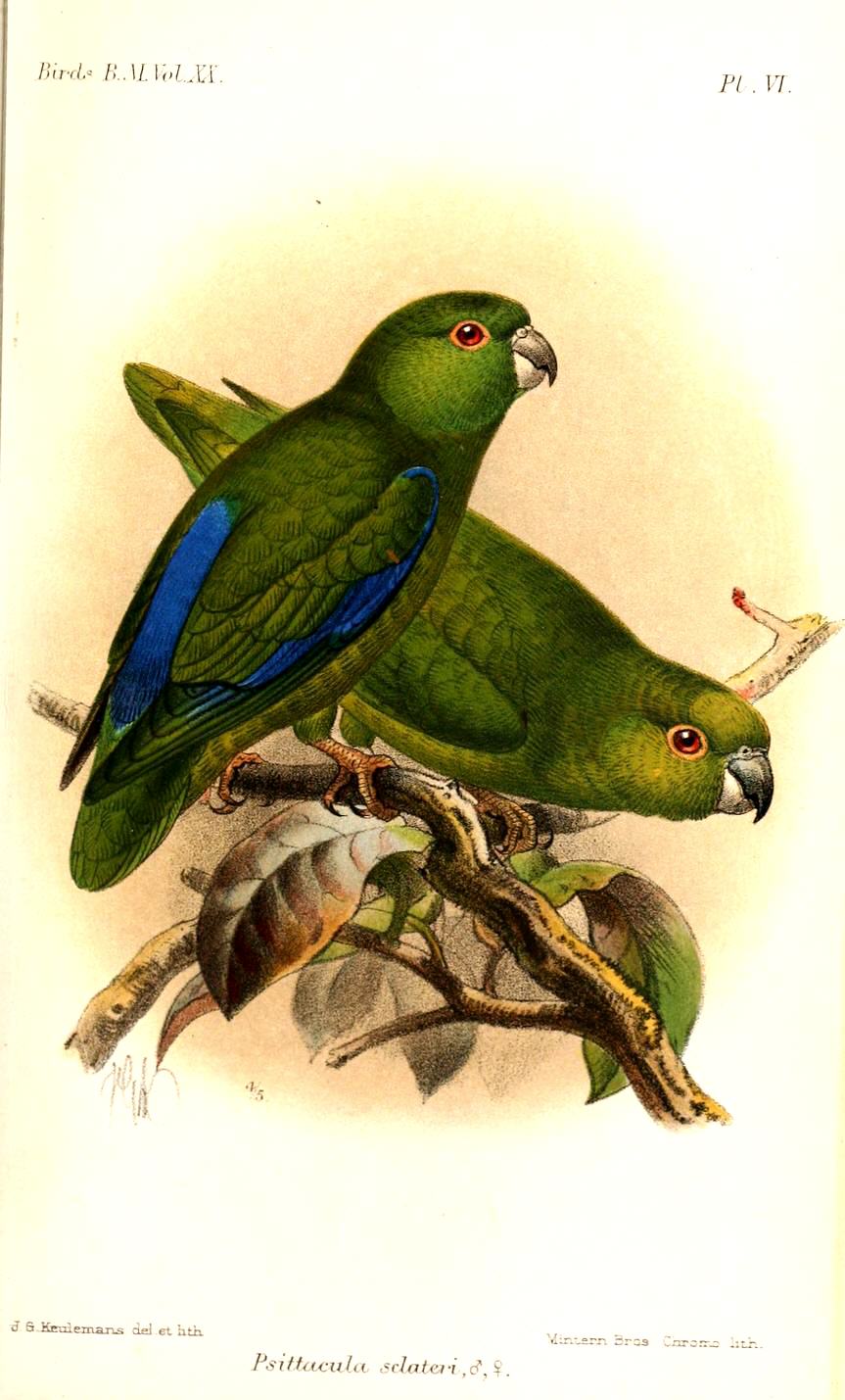 Dusky-billed ParrotletForpus modestus
-
 Turquoise-winged ParrotletForpus spengeli
-
 Riparian ParrotletForpus crassirostris
Compare
Questions and answers
What is the scientific name of the Pacific Parrotlet?
The scientific name of the Pacific Parrotlet is Forpus coelestis. Written with its author, the full name is Forpus coelestis (R. Lesson, 1847).
Which family does the Pacific Parrotlet belong to?
Forpus coelestis belongs to the family Psittacidae, in the order Psittaciformes and the class Aves.
Where is the Pacific Parrotlet found?
Checklists and occurrence records place Forpus coelestis in 3 countries: Ecuador, Peru and Colombia.
What is the conservation status of the Pacific Parrotlet?
The IUCN Red List category recorded for Forpus coelestis is Least Concern (LC).
How long does a Pacific Parrotlet live?
The average lifespan of wild individuals is 10.4 years. Captive individuals can live longer than the reported wild average when provided with good care, appropriate breeding and regular veterinary examinations.[35][36]
Sources
Passages the profile rests on
- Wild individuals have green plumage with a dusty grey cast, a bright green facial mask and a pinkish beak. Source passage: “Wild Pacific parrotlets are green with a dusty grey cast over the body, a bright green mask and a pinkish beak.” — English Wikipedia
- The legs and feet are pinkish-grey. Source passage: “Legs and feet are pinkish-grey.” — English Wikipedia
- Males have blue markings on their wings, whereas females lack blue wing coloration. Source passage: “males possess shades of blue on their wings.” — English Wikipedia
- Male individuals have blue streaks behind their eyes and blue rumps. Source passage: “Male parrotlets also have blue streaks behind the eyes which is often referred to as "eyeshadow;" as well as blue rumps.” — English Wikipedia
- Females may have blue streaks behind the eyes and a blue rump. Source passage: “Female parrotlets have no blue on the wings whatsoever but can have blue eye streaks as well as a blue rump.” — English Wikipedia
- Adults typically measure 11–14 centimetres in length. Source passage: “A typical specimen is 11–14 centimetres (4.3–5.5 in) long” — English Wikipedia
- Typical individuals weigh 30 grams or more. Source passage: “typically weighs 30 grams or more.” — English Wikipedia
- The species commonly occupies dry habitats, including deserts and deciduous forests. Source passage: “Most common in dry habitats such as the desert and deciduous forest” — English Wikipedia
- Its habitats include subtropical or tropical dry forests. Source passage: “subtropical or tropical dry forest” — English Wikipedia
- Its habitats include subtropical or tropical moist lowland forests. Source passage: “subtropical or tropical moist lowland forest” — English Wikipedia
- The species also inhabits subtropical or tropical dry shrublands. Source passage: “subtropical or tropical dry shrubland” — English Wikipedia
- The species has expanded into humid habitats in response to deforestation. Source passage: “but have spread into humid areas in response to deforestation.” — English Wikipedia
- The species occurs in heavily degraded former forests. Source passage: “heavily degraded former forest.” — English Wikipedia
- Individuals occupy woodlands, shrubby clearings, gardens, parks and agricultural crops. Source passage: “woodlands, shrubby clearings, gardens, parks, and crops” — English Wikipedia
- The native range includes western Ecuador and northwestern Peru. Source passage: “Wild Pacific parrotlets are native to western Ecuador and northwestern Peru.” — English Wikipedia
- The species has also been reported in the middle Marañón Valley. Source passage: “Pacific parrotlets have also been reported in the middle Marañón valley.” — English Wikipedia
- A small flock was reported near the Rio Mataje in southwestern Colombia in 2014. Source passage: “In 2014 a small flock of Pacific parrotlets was reported near the Rio Mataje in Nariño, southwestern Colombia.” — English Wikipedia
- The species is non-migratory and remains in the same area throughout the year. Source passage: “Pacific parrotlets are non-migratory, meaning they stay in the same area year-round.” — English Wikipedia
- Wild individuals commonly feed on berries and cactus fruits. Source passage: “Pacific parrotlets tend to feed on berries and cactus fruits” — English Wikipedia
- Captive individuals consume fruits, seeds, vegetables and herbs. Source passage: “In captivity, parrotlets eat many fruits, seeds, vegetables, and herbs.” — English Wikipedia
- The species is known for its assertive temperament despite its small body size. Source passage: “The species is well known among parrotlet breeders and owners as being feisty and curious despite their small size.” — English Wikipedia
- Wild individuals form flocks containing approximately 40–50 birds. Source passage: “Pacific parrotlets are found living in flocks from 40 to 50.” — English Wikipedia
- Their vocalizations consist of rapid, high-pitched calls described as "tchit". Source passage: “Calls are high-pitched and rapid "tchit"” — English Wikipedia
- Flock members produce continuous chattering. Source passage: “in flock situations this produces a constant chattering.” — English Wikipedia
- Captive individuals may display aggression towards other birds when confined. Source passage: “They are solitary birds in captivity due to their aggressive behavior towards other birds when confined” — English Wikipedia
- Individuals can learn to mimic human speech, although their vocalizations are less clear than those of larger parrots. Source passage: “Pacific parrotlets, like many larger parrot species, can learn to "speak", or mimic, though their "voices" are not as clear as larger birds.” — English Wikipedia
- Wild individuals nest in tree cavities or on fence posts. Source passage: “In the wild they nest in tree cavities or on fence posts.” — English Wikipedia
- The species has been observed nesting in abandoned nests of necklaced spinetails and pale-legged horneros. Source passage: “They have also been observed to nest in abandoned nests of necklaced spinetails and pale-legged horneros.” — English Wikipedia
- Each clutch contains four to six white eggs. Source passage: “Each clutch has 4–6 white eggs” — English Wikipedia
- Egg incubation lasts an average of 18 days. Source passage: “which are incubated for an average of 18 days.” — English Wikipedia
- Adults are highly protective of their eggs and chicks. Source passage: “Pacific parrotlets are very protective of their eggs and chicks.” — English Wikipedia
- The species is classified as Least Concern on the IUCN Red List. Source passage: “The Pacific parrotlet is currently listed as Least Concern by the IUCN Red List.” — English Wikipedia
- The wild population is considered stable. Source passage: “population size seems to be stable.” — English Wikipedia
- The species is abundant throughout its range and its populations are relatively undisturbed by human activity. Source passage: “They are abundant across their range; populations are relatively undisturbed by human activity.” — English Wikipedia
- The average lifespan of wild individuals is 10.4 years. Source passage: “In the wild, the average lifespan for Pacific parrotlets is 10.4 years.” — English Wikipedia
- Captive individuals can live longer than the reported wild average when provided with good care, appropriate breeding and regular veterinary examinations. Source passage: “Captive Pacific parrotlets can exceed this age with good care, proper breeding, and regular veterinary examinations” — English Wikipedia
Data
- Catalogue of Life, 2026-10-16 XR cc by
- Global Biodiversity Information Facility CC BY 4.0
- Wikidata CC0
- GeoNames CC BY 4.0
- Wikimedia Commons per image; credit shown with each image
- Within the Catalogue of Life, this name comes from The Integrated Taxonomic Information System cc0
References
- Dickinson, Edward C., ed. (2003). The Howard and Moore Complete Checklist of the Birds of the World, 3rd Edition.
- Gill, Frank, & and Minturn Wright. (2006). Birds of the World: Recommended English Names.
- Dickinson, E. C., and L. Christidis, eds. (2014). The Howard and Moore Complete Checklist of the Birds of the World, 4th Edition, Vol. 2 Passerines.
This species in other databases
Page built on 27 November 2026. See how the catalog is made and all sources and licences.
Cite this page
ScientificNames.org. (2026). Forpus coelestis (Pacific Parrotlet). Retrieved November 27, 2026, from https://scientificnames.org/species/forpus-coelestis
“Forpus coelestis (Pacific Parrotlet).” ScientificNames.org, 2026, scientificnames.org/species/forpus-coelestis. Accessed 27 Nov. 2026.
ScientificNames.org. “Forpus coelestis (Pacific Parrotlet).” Accessed November 27, 2026. https://scientificnames.org/species/forpus-coelestis.
@misc{scientificnames_forpus_coelestis_pacific_parrotlet,
  author = {{ScientificNames.org}},
  title = {Forpus coelestis (Pacific Parrotlet)},
  year = {2026},
  url = {https://scientificnames.org/species/forpus-coelestis},
  note = {Accessed 2026-11-27}
}