Comparison
Dusky-billed Parrotlet vs Cobalt-rumped Parrotlet
Dusky-billed Parrotlet (Forpus modestus) and Cobalt-rumped Parrotlet (Forpus xanthopterygius) both belong to the genus Forpus (forpus parrotlets) and part ways below it. Both are recorded in 5 countries.


Cobalt-rumped Parrotlet
Forpus xanthopterygius
Wagner Machado Carlos Lemes, CC BY 2.0, via Wikimedia Commons

Side by side
| Dusky-billed Parrotlet | Cobalt-rumped Parrotlet | |
|---|---|---|
| Scientific name | Forpus modestus (Cabanis, 1849) | Forpus xanthopterygius (von Spix, 1824) |
| English name | Dusky-billed Parrotlet | Cobalt-rumped Parrotlet |
| Group | Birds | Birds |
| Class | Aves Bird | Aves Bird |
| Order | Psittaciformes Parrot | Psittaciformes Parrot |
| Family | Psittacidae Macaws | Psittacidae Macaws |
| Genus | Forpus Forpus Parrotlets | Forpus Forpus Parrotlets |
| Named in | 1849 | 1824 |
| Red List category | Least Concern | Least Concern |
| Countries on record | 9 countries | 7 countries |
| GBIF occurrence records | 4,460 records | 84,619 records |
Rows where the two agree are shown in grey.
Where each is found
Both recorded in 5 countries
Only Dusky-billed Parrotlet (4)
Only Cobalt-rumped Parrotlet (2)
From Catalogue of Life checklists and GBIF occurrence records. A country missing from a list means no record is held, which is not proof of absence.
Checked facts
| Dusky-billed Parrotlet | Cobalt-rumped Parrotlet | |
|---|---|---|
| Appearance |
| |
| Habitat |
|
|
| Diet |
|
|
| Behaviour |
|
|
| Reproduction |
|
|
| Distribution |
|
|
| Conservation |
|
|
| Similar species | No checked fact yet |
|
| Other |
| No checked fact yet |
In brief
Dusky-billed Parrotlet
The Dusky-billed Parrotlet (Forpus modestus) is a bird in the family Psittacidae, order Psittaciformes, and class Aves. It occurs in the Amazon rainforest of South America, as well as the Andes, Amazonian foothills, the Amazon River outlet, and Marajo Island. It has darker green plumage and a dark upper bill. Full profile
Cobalt-rumped Parrotlet
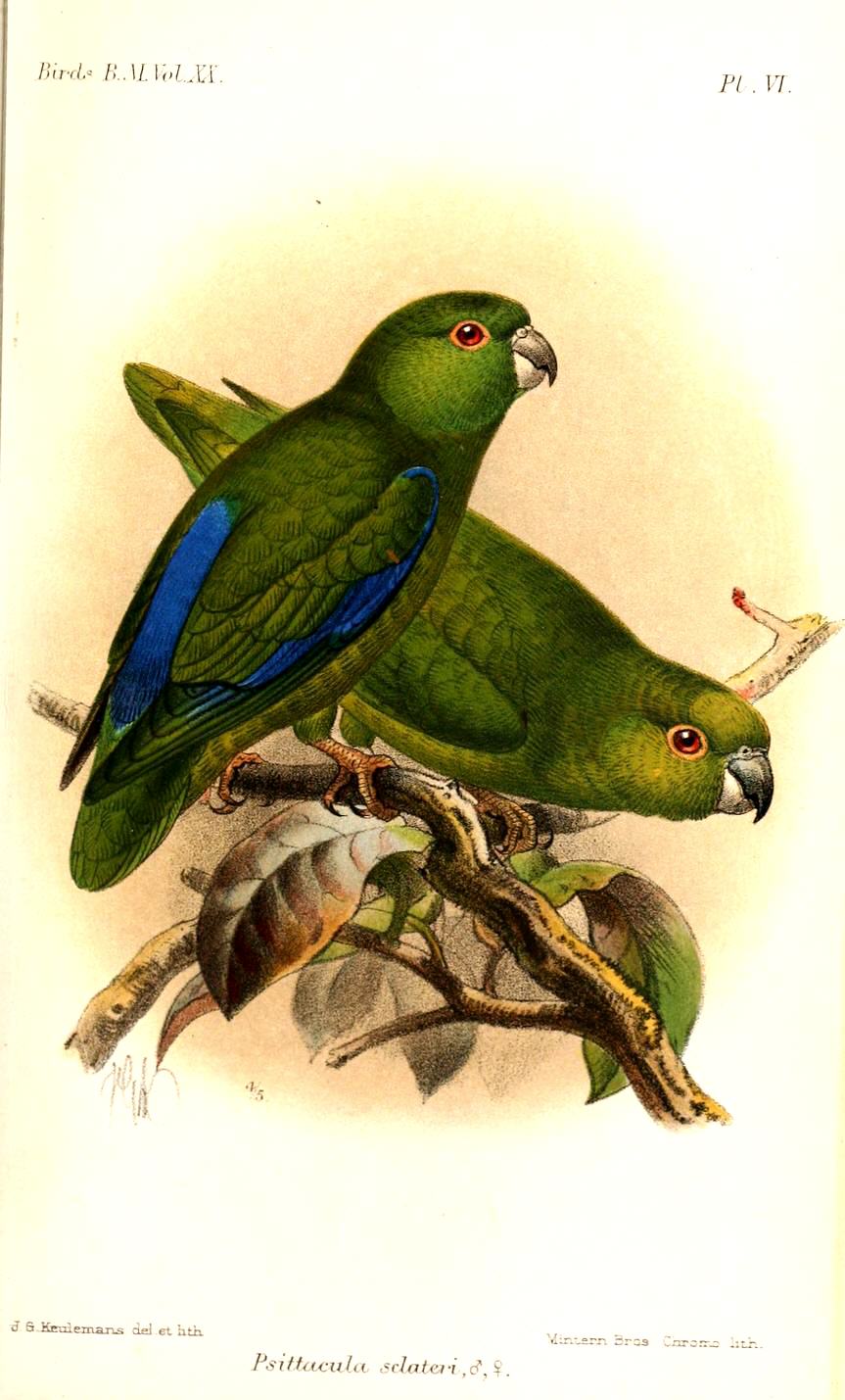
Forpus xanthopterygius occurs across much of central and northern South America, primarily inhabiting lowland environments. Adult males have cobalt-blue wings and a cobalt-blue rump, while females have entirely green plumage. Full profile
Compare something else
Page built on 27 November 2026 from the data on the two species pages, where every source is listed.
Cite this page
ScientificNames.org. (2026). Dusky-billed Parrotlet vs Cobalt-rumped Parrotlet. Retrieved November 27, 2026, from https://scientificnames.org/compare/dusky-billed-parrotlet-vs-cobalt-rumped-parrotlet
“Dusky-billed Parrotlet vs Cobalt-rumped Parrotlet.” ScientificNames.org, 2026, scientificnames.org/compare/dusky-billed-parrotlet-vs-cobalt-rumped-parrotlet. Accessed 27 Nov. 2026.
ScientificNames.org. “Dusky-billed Parrotlet vs Cobalt-rumped Parrotlet.” Accessed November 27, 2026. https://scientificnames.org/compare/dusky-billed-parrotlet-vs-cobalt-rumped-parrotlet.
@misc{scientificnames_dusky_billed_parrotlet_vs_cobalt_rumped_parrotlet,
  author = {{ScientificNames.org}},
  title = {Dusky-billed Parrotlet vs Cobalt-rumped Parrotlet},
  year = {2026},
  url = {https://scientificnames.org/compare/dusky-billed-parrotlet-vs-cobalt-rumped-parrotlet},
  note = {Accessed 2026-11-27}
}