Species · Birds
Cobalt-rumped Parrotlet Forpus xanthopterygius
The scientific name of the Cobalt-rumped Parrotlet is Forpus xanthopterygius. It is a species of bird in the family Psittacidae (macaws), order Psittaciformes. The name dates from 1824.
- Scientific name
- Forpus xanthopterygius (von Spix, 1824)
- Common name
- Cobalt-rumped Parrotlet
- Genus
- Forpus
- Family
- Psittacidae (Macaws)
- Order
- Psittaciformes
- Class
- Aves
- Red List category
- LC Least Concern
- Recorded in
- 7 countries
- Name status
- accepted in the Catalogue of Life

Overview
Forpus xanthopterygius occurs across much of central and northern South America, primarily inhabiting lowland environments. Adult males have cobalt-blue wings and a cobalt-blue rump, while females have entirely green plumage.
Written 26 November 2026 from the sources listed below. Each statement was checked against the passage it cites; statements that could not be supported were removed.
Appearance
The species has a green body, a short pointed tail, and a pale bill. Adult males have cobalt-blue wings and a cobalt-blue rump, while females have entirely green plumage.[1][2][3]
Habitat
The Cobalt-rumped Parrotlet primarily inhabits lowland environments. Its habitats include dry woodlands, riparian woodlands, palm groves, semi-arid scrubland, savannas, and pastures.[4][5][6][7]
The species tends to avoid densely forested environments and does not occur above 1,200 metres in elevation.[8][9]
Diet
Principal foods include fruits of Cecropia and Ficus species. The birds also consume seeds of Mikania species and Trema micrantha.[10][11]
The species feeds on flowers of Ambrosia, Handroanthus serratifolius, and Marcgravia species. It occasionally eats grasses.[12][13]
Behaviour
The species is highly social and gregarious and is generally non-migratory. Populations in Argentina undertake local movements in response to the flowering seasons of food plants, while populations in the Brazilian Atlantic Forest undertake altitudinal migrations.[14][15][16][17]
Flocks typically contain approximately 20 birds and can exceed 50 individuals near fruiting trees or seeding grasses. Individuals generally feed in groups of two to twelve birds.[18][19][20]
The birds vocalize while flying and while perched. Their calls include high-pitched screeches and twittering sounds, while large feeding and socializing groups produce twittering and chattering sounds.[21][22][23]
Local movements can correspond to the flowering and fruiting seasons of the species' principal food plants.[24]
Reproduction and life cycle
The usual breeding season extends from May through August. Occupied nests have also been recorded in January, March, and July in different parts of the range.[25][26]
Females lay clutches of three to seven eggs. The eggs are small, white, and approximately spherical.[27][28]
The species has been observed scraping clay nests made by rufous horneros with its beak. Rufous hornero nests have been used to raise its young.[29][30]
Conservation
The global population size is unknown, but the population is considered stable. The species is classified as Least Concern on the IUCN Red List.[31][32][33]
The species is not known to be affected by deforestation or the pet trade. Numerous areas within its distribution are protected.[34][35]
Similar species
The species was formerly considered conspecific with the green-rumped parrotlet. The turquoise-winged parrotlet and riparian parrotlet were also formerly classified as conspecific with it.[36][37]
Classification of the Cobalt-rumped Parrotlet
| Kingdom | Animalia |
|---|---|
| Phylum | Chordata |
| Subphylum | Vertebrata |
| Infraphylum | Gnathostomata |
| Parvphylum | Osteichthyes |
| Megaclass | Tetrapoda |
| Class | Aves (Bird) |
| Order | Psittaciformes (Parrot) |
| Family | Psittacidae (Macaws) |
| Genus | Forpus (Forpus Parrotlets) |
| Species | Forpus xanthopterygius (von Spix, 1824) |
Where the Cobalt-rumped Parrotlet is found
Checklists and occurrence records place Forpus xanthopterygius in 7 countries across South America. GBIF holds 84,619 georeferenced records of it.
Countries
Regions and cities with the most records
- São Paulo, Brazil 36,843
- Minas Gerais, Brazil 9,453
- São Paulo, Brazil 4,397
- São Caetano do Sul, Brazil 4,305
- Rio de Janeiro, Brazil 3,994
- Bahia, Brazil 3,823
- Diadema, Brazil 3,440
- Taboão da Serra, Brazil 3,351
- Santo André, Brazil 3,311
- Santa Catarina, Brazil 3,225
- Vila Galvão, Brazil 3,224
- Santa Gertrudes, Brazil 3,023
- Rio Claro, Brazil 3,003
- Ceará, Brazil 2,958
- Osasco, Brazil 2,924
- Embu das Artes, Brazil 2,889
- Cordeirópolis, Brazil 2,865
- Araras, Brazil 2,820
- San Lorenzo, Paraguay 2,736
- Fernando de la Mora, Paraguay 2,734
- Guarulhos, Brazil 2,725
- Capiatá, Paraguay 2,657
- Mariano Roque Alonso, Paraguay 2,627
- Itapecerica da Serra, Brazil 2,623
- Nemby, Paraguay 2,618
- Carapicuíba, Brazil 2,583
- Lambaré, Paraguay 2,567
- Villa Elisa, Paraguay 2,567
- Asunción, Paraguay 2,519
- San Antonio, Paraguay 2,496
- Limpio, Paraguay 2,482
- Jandira, Brazil 2,424
- São José dos Campos, Brazil 2,424
- Barueri, Brazil 2,392
- São Bernardo do Campo, Brazil 2,392
- Santa Cruz Department, Bolivia 2,387
Range as the checklists state it
South America
A number beside a place is its count of GBIF occurrence records. A place without a number comes from a checklist alone. Records show where a species has been observed or collected, which can include escapes and vagrants.
Common names
English
- Cobalt-rumped Parrotlet
- Blue-winged Parrotlet
Names in 27 other languages
- Catalan
- cotorreta alablava
- Chinese
- 蓝翅鹦哥, 藍翅鸚哥
- Croatian
- modroleđa papigica
- Czech
- papoušíček modrohřbetý, papoušíček modrohřbetý jižní, papoušíček modrokřídlý
- Danish
- Blårygget Spurvepapegøje
- Dutch
- Spix' Muspapegaai
- Esperanto
- bluflugila papageto
- Estonian
- brasiilia värbpapagoi
- Finnish
- viheraranen
- French
- Forpus de Spix, Toui de Spix
- German
- Blauflügel-Sperlingspapagei
- Hungarian
- kékfarú verébpapagáj
- Italian
- Pappagallino aliblu
- Japanese
- ハシブトルリハシインコ
- Lithuanian
- mėlynsparnė žvirblinė papūgėlė
- Norwegian
- koboltpapitt
- Norwegian Bokmål
- grønnbrillet spurvepapegøye
- Polish
- wróbliczka niebieskoskrzydła
- Portuguese
- Papacu, Tuiete, periquito-d'asa-azul, tuim, tuim-de-asa-azul
- Russian
- Синекрылый воробьиный попугайчик
- Serbian
- Plavokrili vrapčasti papagaj
- Slovak
- forpus modrokrídly, papagájik modrokrídly
- Spanish
- Catita enana, Cotorrita aliazul, Perico alas azules
- Swedish
- blåvingad sparvpapegoja
- Turkish
- Çivit Kanatlı Serçe Papağanı
- Ukrainian
- папуга-горобець синьокрилий
- Welsh
- parotan adain glaswyrdd
Synonyms
One other scientific name has been used for this species and is now treated as a synonym of Forpus xanthopterygius.
- Psittaculus xanthopterygius von Spix, 1824
Subspecies and varieties
- Forpus xanthopterygius flavescens subspecies
- Forpus xanthopterygius flavissimus subspecies
- Forpus xanthopterygius xanthopterygius subspecies
Related species
-
 Pacific ParrotletForpus coelestis
-
 Green-rumped ParrotletForpus passerinus
-
 Mexican ParrotletForpus cyanopygius
-
 Spectacled ParrotletForpus conspicillatus
-
 Yellow-faced ParrotletForpus xanthops
-
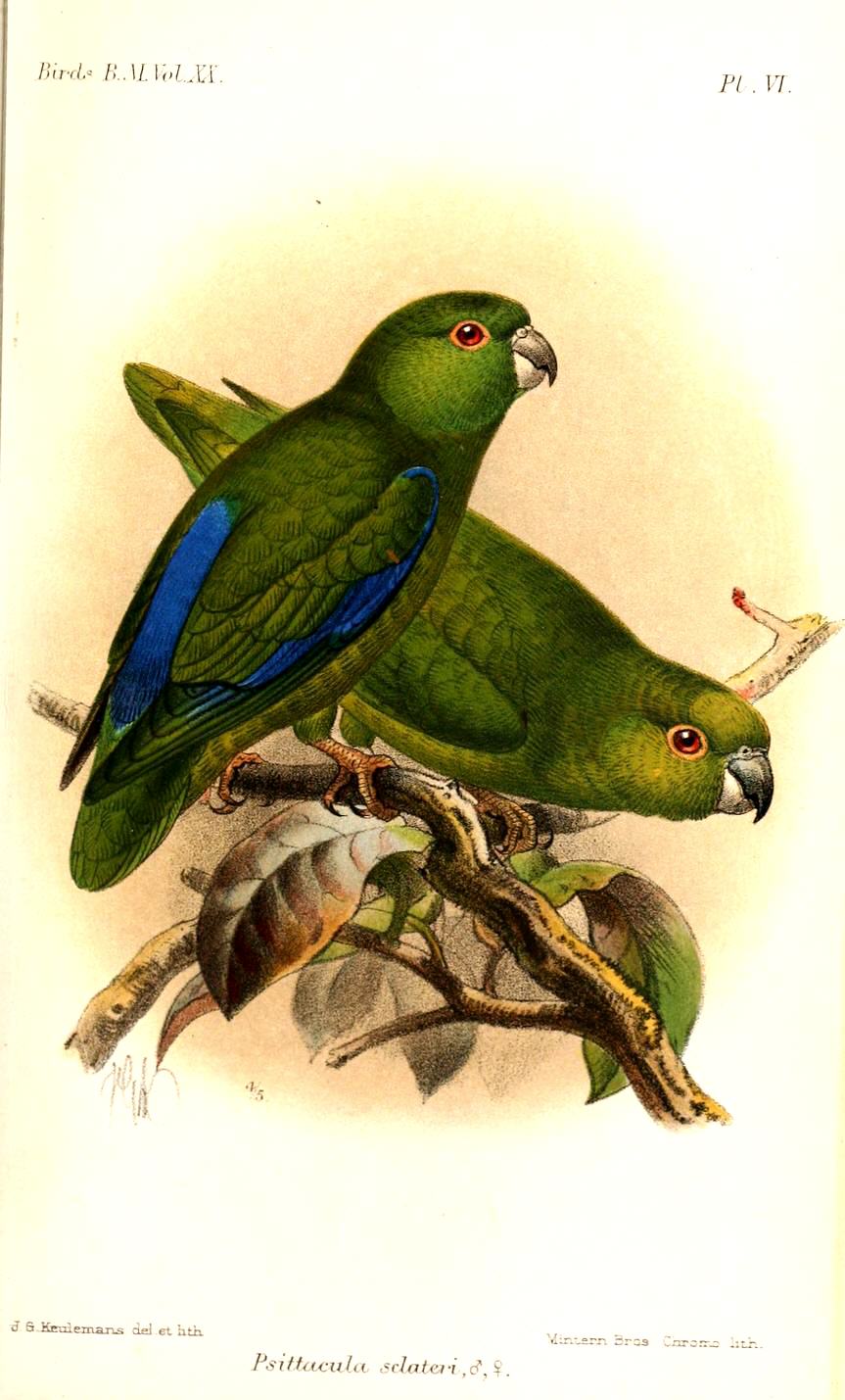 Dusky-billed ParrotletForpus modestus
-
 Turquoise-winged ParrotletForpus spengeli
-
 Riparian ParrotletForpus crassirostris
Compare
Questions and answers
What is the scientific name of the Cobalt-rumped Parrotlet?
The scientific name of the Cobalt-rumped Parrotlet is Forpus xanthopterygius. Written with its author, the full name is Forpus xanthopterygius (von Spix, 1824).
Which family does the Cobalt-rumped Parrotlet belong to?
Forpus xanthopterygius belongs to the family Psittacidae, in the order Psittaciformes and the class Aves.
Where is the Cobalt-rumped Parrotlet found?
Checklists and occurrence records place Forpus xanthopterygius in 7 countries, including Brazil, Paraguay, Bolivia, Argentina, Colombia and Peru.
What is the conservation status of the Cobalt-rumped Parrotlet?
The IUCN Red List category recorded for Forpus xanthopterygius is Least Concern (LC).
What other names does the Cobalt-rumped Parrotlet have?
Forpus xanthopterygius is also known in English as Blue-winged Parrotlet.
Sources
Passages the profile rests on
- The species has a green body, a short pointed tail, and a pale bill. Source passage: “Tiny parrot with green body, short pointed tail, and pale bill.” — ebird.org
- Adult males have cobalt-blue wings and a cobalt-blue rump. Source passage: “Males have cobalt-blue wings and rump” — ebird.org
- Females have entirely green plumage. Source passage: “females are all green.” — ebird.org
- The species primarily inhabits lowland environments. Source passage: “Cobalt-rumped parrotlets are mainly found in lowlands.” — English Wikipedia
- Its habitats include dry woodlands and riparian woodlands. Source passage: “They occur in dry and riparian woodlands” — English Wikipedia
- The species occurs in palm groves and semi-arid scrubland. Source passage: “palm groves, semi-arid scrubland” — English Wikipedia
- Savannas and pastures are also part of its habitat. Source passage: “savanna, and pastures.” — English Wikipedia
- The species tends to avoid densely forested environments. Source passage: “Cobalt-rumped parrotlets tend to avoid densely forested areas.” — English Wikipedia
- The species does not occur above 1,200 metres in elevation. Source passage: “They are not found at altitudes above 1,200 metres (3,900 ft).” — English Wikipedia
- Fruits of Cecropia and Ficus species are among the species' principal foods. Source passage: “Cobalt-rumped parrotlets mostly feed on Cecropia sp. and Ficus sp. fruits” — English Wikipedia
- The birds consume seeds of Mikania species and Trema micrantha. Source passage: “Mikania sp. and Trema micrantha seeds” — English Wikipedia
- The species feeds on flowers of Ambrosia, Handroanthus serratifolius, and Marcgravia species. Source passage: “Ambrosia sp., Handroanthus serratifolius, and Marcgravia sp. flowers.” — English Wikipedia
- The species occasionally eats grasses. Source passage: “However, they are known to occasionally feed on other plants such as grass.” — English Wikipedia
- The species is generally non-migratory. Source passage: “Cobalt-rumped parrotlets are generally non-migratory;” — English Wikipedia
- Populations in Argentina undertake local movements in response to the flowering seasons of food plants. Source passage: “populations in Argentina move locally according to the flowering seasons of various plant species in their diet.” — English Wikipedia
- Populations in the Brazilian Atlantic Forest undertake altitudinal migrations. Source passage: “Populations in the Brazilian Atlantic Forest are altitudinal migrants.” — English Wikipedia
- The species is highly social and gregarious. Source passage: “They are highly social and gregarious.” — English Wikipedia
- Flocks typically contain approximately 20 birds. Source passage: “Flocks are usually around 20 birds” — English Wikipedia
- Flocks can exceed 50 individuals near fruiting trees or seeding grasses. Source passage: “but can grow to over 50 around fruiting trees or seeding grasses.” — English Wikipedia
- Individuals generally feed in groups of two to twelve birds. Source passage: “Cobalt-rumped parrotlets tend to feed in groups, usually between 2 and 12 individuals.” — English Wikipedia
- The birds vocalize both while flying and while perched. Source passage: “Cobalt-rumped parrotlets call while in flight and perched.” — English Wikipedia
- Their calls include high-pitched screeches and twittering sounds. Source passage: “Their calls are high-pitched "sheet" or "zeet" screeches or twittering.” — English Wikipedia
- Large feeding and socializing groups produce twittering and chattering sounds. Source passage: “When feeding and socializing in large groups they make twittering and chattering noises.” — English Wikipedia
- Local movements by the species can correspond to the flowering and fruiting seasons of its principal food plants. Source passage: “Cobalt-rumped parrotlets have been known to migrate locally based on the flowering and fruiting seasons of some of the main plants of their diet.” — English Wikipedia
- The usual breeding season extends from May through August. Source passage: “Cobalt-rumped parrotlets' breeding season is May to August” — English Wikipedia
- Occupied nests have also been recorded in January, March, and July in different parts of the range. Source passage: “occupied nests have been observed in July, January, and March in different areas of the birds' range.” — English Wikipedia
- Females lay clutches of three to seven eggs. Source passage: “Females lay 3-7 small, white, roughly spherical eggs.” — English Wikipedia
- The eggs are small, white, and approximately spherical. Source passage: “3-7 small, white, roughly spherical eggs.” — English Wikipedia
- The species has been observed scraping clay nests made by rufous horneros with its beak. Source passage: “Some cobalt-rumped parrotlets have been observed to scrape rufous hornero nests (made of clay) with their beaks.” — English Wikipedia
- Rufous hornero nests have been used by the species to raise its young. Source passage: “nests created by rufous horneros have been used by cobalt-rumped parrotlets to raise their broods” — English Wikipedia
- The global population size of the species is unknown. Source passage: “The number of cobalt-rumped parrotlets is unknown” — English Wikipedia
- The population is considered stable. Source passage: “but the population is stable.” — English Wikipedia
- The species is classified as Least Concern on the IUCN Red List. Source passage: “It is listed as Least Concern by the IUCN Red List.” — English Wikipedia
- The species is not known to be affected by deforestation or the pet trade. Source passage: “The cobalt-rumped parrotlet is not known to be affected by deforestation or the pet trade” — English Wikipedia
- Numerous areas within the species' distribution are protected. Source passage: “There are many areas across its range that are already protected.” — English Wikipedia
- The species was formerly considered conspecific with the green-rumped parrotlet. Source passage: “For many years, the cobalt-rumped parrotlet was considered conspecific with the green-rumped parrotlet (Forpus passerinus)” — English Wikipedia
- The turquoise-winged parrotlet and riparian parrotlet were also formerly classified as conspecific with this species. Source passage: “The turquoise-winged parrotlet (F. spengeli) and the riparian parrotlet (F. crassirostris) were also considered conspecific with the cobalt-rumped parrotlet” — English Wikipedia
Data
- Catalogue of Life, 2026-10-16 XR cc by
- Global Biodiversity Information Facility CC BY 4.0
- Wikidata CC0
- GeoNames CC BY 4.0
- Wikimedia Commons per image; credit shown with each image
- Within the Catalogue of Life, this name comes from The Integrated Taxonomic Information System cc0
References
- Dickinson, Edward C., ed. (2003). The Howard and Moore Complete Checklist of the Birds of the World, 3rd Edition.
- Gill, Frank, & and Minturn Wright. (2006). Birds of the World: Recommended English Names.
- Dickinson, E. C., and L. Christidis, eds. (2014). The Howard and Moore Complete Checklist of the Birds of the World, 4th Edition, Vol. 2 Passerines.
This species in other databases
Page built on 28 November 2026. See how the catalog is made and all sources and licences.
Cite this page
ScientificNames.org. (2026). Forpus xanthopterygius (Cobalt-rumped Parrotlet). Retrieved November 28, 2026, from https://scientificnames.org/species/forpus-xanthopterygius
“Forpus xanthopterygius (Cobalt-rumped Parrotlet).” ScientificNames.org, 2026, scientificnames.org/species/forpus-xanthopterygius. Accessed 28 Nov. 2026.
ScientificNames.org. “Forpus xanthopterygius (Cobalt-rumped Parrotlet).” Accessed November 28, 2026. https://scientificnames.org/species/forpus-xanthopterygius.
@misc{scientificnames_forpus_xanthopterygius_cobalt_rumped_parrotlet,
  author = {{ScientificNames.org}},
  title = {Forpus xanthopterygius (Cobalt-rumped Parrotlet)},
  year = {2026},
  url = {https://scientificnames.org/species/forpus-xanthopterygius},
  note = {Accessed 2026-11-28}
}