Comparison
Fortune's Euonymus vs Japanese Spindle
Fortune's Euonymus (Euonymus fortunei) and Japanese Spindle (Euonymus japonicus) both belong to the genus Euonymus (spindle) and part ways below it. Both are recorded in 13 countries.

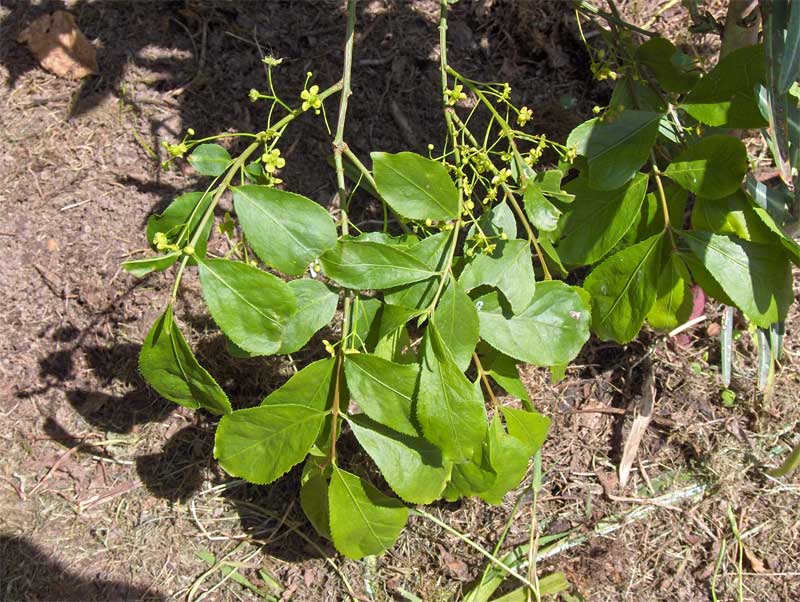
Fortune's Euonymus
Euonymus fortunei
James H. Miller, USDA Forest Service, Bugwood.org, CC BY 3.0, via Wikimedia Commons


Side by side
| Fortune's Euonymus | Japanese Spindle | |
|---|---|---|
| Scientific name | Euonymus fortunei (Turcz.) Hand.-Mazz. | Euonymus japonicus Thunb. |
| English name | Fortune's Euonymus | Japanese Spindle |
| Group | Flowering plants | Flowering plants |
| Class | Magnoliopsida | Magnoliopsida |
| Order | Celastrales | Celastrales |
| Family | Celastraceae Staff-tree Family | Celastraceae Staff-tree Family |
| Genus | Euonymus Spindle | Euonymus Spindle |
| Countries on record | 21 countries | 32 countries |
| GBIF occurrence records | 39,442 records | 12,074 records |
Rows where the two agree are shown in grey.
Where each is found
Both recorded in 13 countries
- China
- Georgia
- Germany
- Indonesia
- Japan
- Laos
- Myanmar
- Slovakia
- South Korea
- Taiwan
- Thailand
- United Kingdom
- United States
Only Fortune's Euonymus (8)
Only Japanese Spindle (19)
- Armenia
- Bolivia
- Cambodia
- Colombia
- Croatia
- Guernsey
- India
- Iran
- Ireland
- Jersey
- New Zealand
- North Korea
- Pakistan
- Philippines
- Tajikistan
- Turkey
- Turkmenistan
- Uzbekistan
- Vietnam
From Catalogue of Life checklists and GBIF occurrence records. A country missing from a list means no record is held, which is not proof of absence.
Checked facts
| Fortune's Euonymus | Japanese Spindle | |
|---|---|---|
| Appearance |
|
|
| Size |
|
|
| Habitat |
|
|
| Behaviour |
|
|
| Distribution |
|
|
| Conservation |
| No checked fact yet |
| Uses |
|
|
| Similar species |
|
|
| Other |
| No checked fact yet |
In brief
Fortune's Euonymus
Fortune's euonymus is an evergreen shrub in the family Celastraceae that can grow as a vine when provided with support. The species is native to East Asia and occurs in China, India, Indonesia, Japan, Korea, Laos, Myanmar, the Philippines, Thailand and Vietnam. It climbs using small rootlets along its stems and develops into a flowering adult phase without climbing rootlets. Full profile
Japanese Spindle
Japanese Spindle is an evergreen shrub or small tree. The species is native to Japan, Korea and China. Its leaves grow in opposite pairs and have an oval shape. Full profile
Compare something else
Page built on 29 November 2026 from the data on the two species pages, where every source is listed.
Cite this page
ScientificNames.org. (2026). Fortune's Euonymus vs Japanese Spindle. Retrieved November 29, 2026, from https://scientificnames.org/compare/fortunes-euonymus-vs-japanese-spindle
“Fortune's Euonymus vs Japanese Spindle.” ScientificNames.org, 2026, scientificnames.org/compare/fortunes-euonymus-vs-japanese-spindle. Accessed 29 Nov. 2026.
ScientificNames.org. “Fortune's Euonymus vs Japanese Spindle.” Accessed November 29, 2026. https://scientificnames.org/compare/fortunes-euonymus-vs-japanese-spindle.
@misc{scientificnames_fortunes_euonymus_vs_japanese_spindle,
  author = {{ScientificNames.org}},
  title = {Fortune's Euonymus vs Japanese Spindle},
  year = {2026},
  url = {https://scientificnames.org/compare/fortunes-euonymus-vs-japanese-spindle},
  note = {Accessed 2026-11-29}
}