Species · Flowering plants
Japanese Spindle Euonymus japonicus
The scientific name of the Japanese Spindle is Euonymus japonicus. It is a species of flowering plant in the family Celastraceae (staff-tree family), order Celastrales.
- Scientific name
- Euonymus japonicus Thunb.
- Common name
- Japanese Spindle
- Genus
- Euonymus
- Family
- Celastraceae (Staff-tree Family)
- Order
- Celastrales
- Class
- Magnoliopsida
- Recorded in
- 32 countries
- Name status
- accepted in the Catalogue of Life
Overview
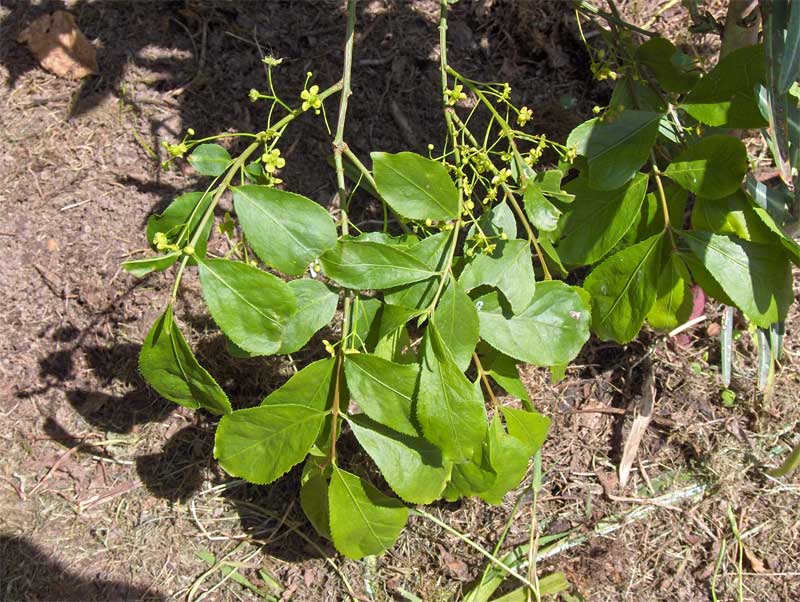
Japanese Spindle is an evergreen shrub or small tree. The species is native to Japan, Korea and China. Its leaves grow in opposite pairs and have an oval shape.
Written 26 November 2026 from the sources listed below. Each statement was checked against the passage it cites; statements that could not be supported were removed.
Appearance
Japanese Spindle can grow to 3 metres tall. Its leaves measure 3–12 cm in length, more usually 6–10 cm, and have finely serrated margins towards their ends.[1][2][3][4]
The flowers are inconspicuous and greenish-white, measuring approximately 5–6 mm across. The fruit is a capsule that can be brown, yellowish-brown, reddish-brown, pink, ivory or yellow, and the seeds have orange-red arils.[5][6][7][8][9]
Some cultivars have variegated or yellow leaves. 'Albomarginatus' has green leaves with narrow white margins, while 'Aureo-marginatus' has green and butter-yellow variegated leaves.[10][11][12]
'Bravo' has green and creamy-yellow variegated leaves, while 'Kathy' has broad green-and-white variegated leaves. 'Latifolius Albomarginatus' has green leaves with broad white margins.[13][14][15]
'President Gauthier' has dark green and creamy-white variegated leaves, while 'Susan' has dark green leaves with narrow creamy-white margins. 'Green Spire' is an evergreen shrub with a narrow, columnar form.[16][17][18]
Habitat
Japanese Spindle is native to Japan and Korea.[19]
Behaviour
Wild Japanese Spindle has an erect growth habit.[20]
Similar species
Euonymus fortunei is particularly similar to Japanese Spindle when cultivated. In the wild, Euonymus fortunei has a climbing or procumbent growth habit, unlike the erect growth habit of Japanese Spindle.[20][21][22]
Uses
Japanese Spindle is commonly cultivated as an ornamental plant in parks and gardens. It is cultivated ornamentally in Europe and North America as well as its native area.[23][24]
Its cultivars are grown in a wide range of soil types and in both sunny and shaded conditions. Compact, slow-growing cultivars with small leaves are suitable for low border edging.[25][26]
Some cultivars can serve as alternatives to box hedging where box blight or box tree caterpillars are problematic.[27]
Classification of the Japanese Spindle
| Kingdom | Plantae |
|---|---|
| Subkingdom | Pteridobiotina |
| Phylum | Tracheophyta |
| Class | Magnoliopsida |
| Order | Celastrales |
| Family | Celastraceae (Staff-tree Family) |
| Subfamily | Celastroideae |
| Tribe | Euonymae |
| Genus | Euonymus (Spindle) |
| Species | Euonymus japonicus Thunb. |
Where the Japanese Spindle is found
Checklists and occurrence records place Euonymus japonicus in 32 countries across Asia, Europe, North America, Oceania and South America. GBIF holds 12,074 georeferenced records of it.
Countries where it is native or its origin is not stated
- Armenia 4
- Cambodia
- China 664
- Georgia 16
- India 6
- Indonesia 38
- Iran 5
- Japan 1,419
- Laos 3
- Myanmar
- North Korea 5
- Philippines 24
- South Korea 2,151
- Taiwan 167
- Thailand 6
- Turkey 5
- Vietnam 9
Countries where it has been introduced
- Bolivia 2
- Colombia 11
- Croatia 8
- Germany 125
- Guernsey 5
- Ireland 15
- Jersey 4
- New Zealand 666
- Pakistan 14
- Slovakia 5
- Tajikistan 2
- Turkmenistan 5
- United Kingdom 5,902
- United States 772
- Uzbekistan 16
Regions and cities with the most records
- England, United Kingdom 4,994
- London, United Kingdom 575
- City of Westminster, United Kingdom 568
- Shadwell, United Kingdom 559
- Kirkby, United Kingdom 554
- Islington, United Kingdom 551
- Stepney, United Kingdom 550
- Brockley, United Kingdom 549
- Camden Town, United Kingdom 546
- Blackheath, United Kingdom 539
- Fazakerley, United Kingdom 539
- Chalk Farm, United Kingdom 538
- Shepherds Bush, United Kingdom 530
- Canning Town, United Kingdom 529
- Catford, United Kingdom 525
- Highbury, United Kingdom 525
- Maghull, United Kingdom 525
- Willesden, United Kingdom 524
- Fulham, United Kingdom 523
- Stratford, United Kingdom 523
- Streatham, United Kingdom 520
- Prescot, United Kingdom 519
- Huyton, United Kingdom 517
- Old Swan, United Kingdom 516
- Litherland, United Kingdom 514
- West Ham, United Kingdom 513
- Earlsfield, United Kingdom 509
- Harlesden, United Kingdom 509
- Archway, United Kingdom 507
- Bootle, United Kingdom 507
- Cricklewood, United Kingdom 500
- Liverpool, United Kingdom 495
- Allerton, United Kingdom 493
- Barnes, United Kingdom 493
- Halewood, United Kingdom 493
- Acton, United Kingdom 489
32 more countries have a few records outside this range
These countries hold a few records of Euonymus japonicus but lie outside the range the checklists give for it. Such records are often zoo or garden specimens, museum material or vagrants, so the species is not counted as occurring there.
- Algeria 4
- Argentina 4
- Australia 61
- Austria 13
- Belgium 247
- Brazil 11
- Bulgaria 7
- Canada 25
- Chile 7
- Cuba 3
- Denmark 31
- Egypt 5
- France 239
- Greece 6
- Hungary 5
- Isle of Man 38
- Italy 64
- Mexico 3
- Morocco 5
- Panama 6
- Poland 18
- Portugal 250
- Romania 4
- Russia 7
- Serbia 4
- South Africa 11
- Spain 200
- Sweden 54
- Switzerland 70
- The Netherlands 103
- Timor Leste 5
- Ukraine 26
Range as the checklists state it
England [I] (England [I], Wales [I], Isle of Man [I], Scotland [I], Isles of Scilly [I]); Ireland [I] (Ireland [I], Northern Ireland [I]); Germany [I]; Slovakia [I]; Channel Isl. [I] (Alderney [I], Guernsey [I], Jersey [I]); Croatia [I]; Turkmenistan [I]; Uzbekistan [I]; Tajikistan [I]; China (Anhui, Beijing, Fujian, Hebei, Gansu, Guangdong, Guangxi, Guizhou, Hainan, Henan, Hubei, Hunan, Jiangsu, Jiangxi, Liaoning, Qinghai, Shaanxi, Shanxi, Shandong, Sichuan, Xinjiang, Yunnan, Zhejiang); North Korea; South Korea; Japan (Hokkaido, Honshu, Shikoku, Kyushu); Ryukyu Isl.; Taiwan (Lan Yu Isl.); Pakistan [I]; Myanmar; Thailand; Cambodia; N-Vietnam; Philippines (Luzon); New Zealand [I]; USA [I] (Indiana [I], Louisiana [I], Mississippi [I], North Carolina [I], Virginia [I]); Colombia [I]; Bolivia [I]
A number beside a place is its count of GBIF occurrence records. A place without a number comes from a checklist alone. Records show where a species has been observed or collected, which can include escapes and vagrants.
Common names
English
- Japanese Spindle
- Evergreen Spindle
- Evergreen Euonymus
- Spindletree
Names in 6 other languages
- Dutch
- Kruipkardinaalsmuts
- German
- japanischer Spindelstrauch
- Japanese
- masaki
- Portuguese
- evônimo-do-Japão
- Swedish
- japansk benved
- Welsh
- Piswydden Fythwyrdd
Synonyms
48 other scientific names have been used for this species and are now treated as synonyms of Euonymus japonicus.
- Euonymus carrierei Dippel
- Euonymus carrierei var. vegetus (Rehder) Koidz.
- Euonymus fortunei f. vegetus (Rehder) Rehder
- Euonymus fortunei var. alticola Hand.-Mazz.
- Euonymus fortunei var. vegetus (Rehder) Rehder
- Euonymus japonicus f. albomarginatus (Rehder) Hegi
- Euonymus japonicus f. albomarginatus (T.Moore) Rehder
- Euonymus japonicus f. argenteovariegatus (Regel) Hegi
- Euonymus japonicus f. argenteovariegatus (Regel) Rehder
- Euonymus japonicus f. aureomarginatus (Rehder) Rehder
- Euonymus japonicus f. aureovariegatus (Regel) Hegi
- Euonymus japonicus f. aureovariegatus (Regel) Rehder
- Euonymus japonicus f. aureus (Rehder) Hegi
- Euonymus japonicus f. fastigiatus (Carrière) Rehder
- Euonymus japonicus f. macrophylla (Regel) Beissn.
- Euonymus japonicus f. mediopictus (Rehder) Hegi
- Euonymus japonicus f. microphyllus (H.Jaeger) Beissn.
- Euonymus japonicus f. pallens (Carrière) Hegi
- Euonymus japonicus f. pyramidatus (Carrière) Rehder
- Euonymus japonicus f. rugosus (Nakai) H.Hara
- Euonymus japonicus f. viridivariegatus (Rehder) Hegi
- Euonymus japonicus f. viridivariegatus (Rehder) Rehder
- Euonymus japonicus var. acutus Rehder
- Euonymus japonicus var. argenteovariegatus Regel
- Euonymus japonicus var. aureomarginatus Rehder
- Euonymus japonicus var. aureovariegatus Lowe
- Euonymus japonicus var. aureovariegatus Regel
- Euonymus japonicus var. fastigiatus Carrière
- Euonymus japonicus var. latifolia André
- Euonymus japonicus var. litoralis Konta & S.Matsumoto
- Euonymus japonicus var. longifolius Nakai
- Euonymus japonicus var. macrophylla Regel
- Euonymus japonicus var. microphyllus H.Jaeger
- Euonymus japonicus var. pyramidatus Carrière
- Euonymus japonicus var. radicifer Nakai
- Euonymus japonicus var. rugosus Nakai
- Euonymus japonicus var. subinteger Sugim.
- Euonymus japonicus var. viridivariegatus Rehder
- Euonymus pulchellus Jacob-Makoy
- Euonymus radicans var. acutus (Rehder) Rehder
Showing 40 of 48.
Related species
-
 BurningbushEuonymus alatus
-
 European Spindle-treeEuonymus europaeus
-
 Fortune's EuonymusEuonymus fortunei
-
 American Strawberry BushEuonymus americanus
-
 WahooEuonymus atropurpureus
-
 Hamilton's SpindleEuonymus hamiltonianus
-
 Broadleaf SpindleEuonymus latifolius
-
 CorktreeEuonymus phellomanus
Compare
Questions and answers
What is the scientific name of the Japanese Spindle?
The scientific name of the Japanese Spindle is Euonymus japonicus. Written with its author, the full name is Euonymus japonicus Thunb..
Which family does the Japanese Spindle belong to?
Euonymus japonicus belongs to the family Celastraceae, in the order Celastrales and the class Magnoliopsida.
Where is the Japanese Spindle found?
Checklists and occurrence records place Euonymus japonicus in 32 countries, including South Korea, Japan, China, Taiwan, Indonesia and Philippines.
What other names does the Japanese Spindle have?
Euonymus japonicus is also known in English as Evergreen Spindle, Evergreen Euonymus and Spindletree.
What conditions do Euonymus like?
Cultivars of Japanese Spindle are grown in a wide range of soil types and in both sunny and shaded conditions.[25]
Sources
Passages the profile rests on
- Euonymus japonicus can grow to 3 metres tall. Source passage: “growing to 3 m (10 ft) tall” — English Wikipedia
- The leaves measure 3–12 cm in length. Source passage: “3–12 cm (1.2–4.7 in) long” — English Wikipedia
- The leaves are more usually 6–10 cm long. Source passage: “more usually 6–10 cm (2.4–3.9 in) long” — English Wikipedia
- The leaf margins are finely serrated towards their ends. Source passage: “with finely serrated margins towards the end of the leaves.” — English Wikipedia
- The flowers are inconspicuous and greenish-white. Source passage: “The flowers are inconspicuous, greenish-white” — English Wikipedia
- The flowers measure approximately 5–6 mm across. Source passage: “5–6 mm (0.2 in) across.” — English Wikipedia
- The fruit is a capsule that is brown or yellowish-brown to reddish-brown. Source passage: “The fruit capsule is brown, or yellow- to red-brown.” — English Wikipedia
- The seeds have orange-red arils. Source passage: “The seeds have an orange-red aril.” — English Wikipedia
- The fruit of Euonymus japonicus can be reddish, pink, ivory or yellow capsules. Source passage: “Fruit Description: Fruit is a reddish, pink, ivory to yellow capsule ...” — plants.ces.ncsu.edu
- Some cultivars of Euonymus japonicus have variegated or yellow leaves. Source passage: “often with variegated or yellow leaves” — English Wikipedia
- The cultivar 'Albomarginatus' has green leaves with narrow white margins. Source passage: “'Albomarginatus' – leaves green, narrowly margined white” — English Wikipedia
- The cultivar 'Aureo-marginatus' has green and butter-yellow variegated leaves. Source passage: “'Aureo-marginatus' – also called "Golden Euonymus", variegated green and butter yellow leaves” — English Wikipedia
- The cultivar 'Bravo' has green and creamy-yellow variegated leaves. Source passage: “'Bravo' – green and creamy-yellow variegated leaves, upright habit” — English Wikipedia
- The cultivar 'Kathy' has broad green-and-white variegated leaves. Source passage: “'Kathy' – green and white variegated, broad leaves” — English Wikipedia
- The cultivar 'Latifolius Albomarginatus' has green leaves with broad white margins. Source passage: “'Latifolius Albomarginatus' – green leaves with broad white margin” — English Wikipedia
- The cultivar 'Green Spire' is an evergreen shrub with a narrow, columnar form. Source passage: “'Green Spire' – evergreen columnar narrow shrub” — English Wikipedia
- The cultivar 'President Gauthier' has dark green and creamy-white variegated leaves. Source passage: “'President Gauthier' – dark green and creamy-white variegated leaves” — English Wikipedia
- The cultivar 'Susan' has dark green leaves with narrow creamy-white margins. Source passage: “'Susan'agm – dark green leaves, narrowly marginated creamy-white” — English Wikipedia
- The species is native to Japan and Korea. Source passage: “native to Japan and Korea.” — English Wikipedia
- Wild Euonymus japonicus has an erect growth habit. Source passage: “In the wild, E. japonicus has an erect habit” — English Wikipedia
- Euonymus fortunei is particularly similar to Euonymus japonicus when cultivated. Source passage: “Euonymus japonicus is very similar to Euonymus fortunei, particularly in cultivation.” — English Wikipedia
- Euonymus fortunei differs from Euonymus japonicus in having a climbing or procumbent growth habit in the wild. Source passage: “whereas E. fortunei is climbing or procumbent.” — English Wikipedia
- Euonymus japonicus is commonly cultivated as an ornamental plant in parks and gardens. Source passage: “Euonymus japonicus is a popular ornamental plant for parks and gardens” — English Wikipedia
- The species is cultivated ornamentally in Europe and North America as well as its native area. Source passage: “both in its native area and also in Europe and North America.” — English Wikipedia
- Cultivars of Euonymus japonicus are grown in a wide range of soil types and in both sunny and shaded conditions. Source passage: “are widely grown in all soil types in sun or shade.” — English Wikipedia
- Compact, slow-growing cultivars of Euonymus japonicus with small leaves are suitable for low border edging. Source passage: “Compact, slow-growing evergreen euonymus with small leaves, including many cultivars of Euonymus japonicus , are ideal for low border edging.” — rhs.org.uk
- Some cultivars of Euonymus japonicus can serve as alternatives to box hedging where box blight or box tree caterpillars are problematic. Source passage: “They are a useful alternative to box (Buxus sempervirens) if box blight or box tree caterpillars make traditional box hedging no longer a viable option in your garden.” — rhs.org.uk
Data
- Catalogue of Life, 2026-10-16 XR cc by
- Global Biodiversity Information Facility CC BY 4.0
- Wikidata CC0
- GeoNames CC BY 4.0
- Wikimedia Commons per image; credit shown with each image
- Within the Catalogue of Life, this name comes from Synonymic Checklists of the Vascular Plants of the World cc by
References
- Thunb. (1780). Nova Acta Regiae Soc. Sci. Upsal. 3: 208 (1780), Thunb. Fl. Jap. 100 (1784). where the name was published
This species in other databases
Page built on 26 November 2026. See how the catalog is made and all sources and licences.
Cite this page
ScientificNames.org. (2026). Euonymus japonicus (Japanese Spindle). Retrieved November 26, 2026, from https://scientificnames.org/species/euonymus-japonicus
“Euonymus japonicus (Japanese Spindle).” ScientificNames.org, 2026, scientificnames.org/species/euonymus-japonicus. Accessed 26 Nov. 2026.
ScientificNames.org. “Euonymus japonicus (Japanese Spindle).” Accessed November 26, 2026. https://scientificnames.org/species/euonymus-japonicus.
@misc{scientificnames_euonymus_japonicus_japanese_spindle,
  author = {{ScientificNames.org}},
  title = {Euonymus japonicus (Japanese Spindle)},
  year = {2026},
  url = {https://scientificnames.org/species/euonymus-japonicus},
  note = {Accessed 2026-11-26}
}