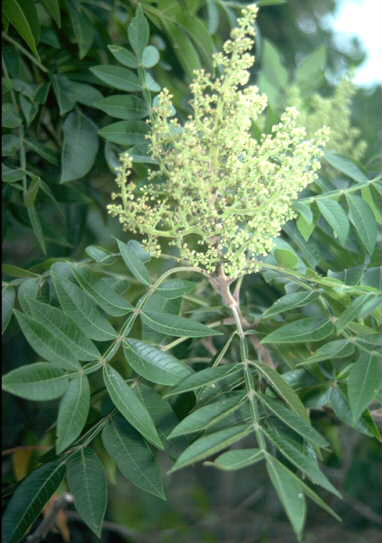
| Appearance | | - The plant has a rounded crown and grows as a deciduous tree. English Wikipedia
- The plant has alternate, pinnately compound leaves. English Wikipedia
- The leaflets grow along a winged central leaf axis. English Wikipedia
- The foliage is dark green during summer and changes to orange-red during autumn. English Wikipedia
- The flowers are small and greenish-yellow and grow in compact terminal panicles. English Wikipedia
- The flowers are yellow. English Wikipedia
- The flowers develop into conspicuous clusters of red berries. English Wikipedia
- The fruits remain on the plant into winter. English Wikipedia
- The plant typically develops multiple trunks but can be trained to grow with one trunk. English Wikipedia
- The species has brittle twigs that bleed white sticky sap when broken. mdc.mo.gov
- The leaves measure 5–12 inches long. mdc.mo.gov
- The upper leaf surfaces are shiny and dark green, while the lower surfaces are paler and hairy. mdc.mo.gov
- The leaves turn bright red during autumn. mdc.mo.gov
- The flowers have five greenish-white petals. mdc.mo.gov
- The fruits are flattened, round, red, hairy, and approximately one-eighth inch wide. mdc.mo.gov
|
|---|
| Size | - The shrub typically reaches 0.6–1.5 metres in height and 1.5–3 metres in width. English Wikipedia
- Plants recorded by Arches National Park range from approximately 0.5 to 2.5 metres tall. nps.gov
| |
|---|
| Habitat | - The species occurs in open rocky woodlands. English Wikipedia
- The species grows in valley bottoms and lower rocky slopes. English Wikipedia
- The species grows in conditions ranging from deep shade to full sun. English Wikipedia
- The species grows in well-drained soils with pH values of approximately 6.0–8.5. English Wikipedia
- The species is common along the forested eastern margins of the Great Plains. English Wikipedia
- The species also occurs in open or disturbed sites along the margins of Gulf Coast prairie. English Wikipedia
- In Arches National Park, the species grows in dry areas of desert shrub and pinyon-juniper communities. nps.gov
| - The species occurs in prairies, thickets, and open woods. mdc.mo.gov
- The species grows in rocky sandstone, chert, and igneous glades. mdc.mo.gov
- The species occurs along woodland borders, old fields, roadsides, and railroads. mdc.mo.gov
- The species grows best in full sunlight and well-drained soils. English Wikipedia
- The species can tolerate clay, loam, and sandy soils. English Wikipedia
|
|---|
| Diet | - The fruits provide an important winter food source for birds and small mammals. English Wikipedia
| |
|---|
| Behaviour | - Thickets formed by the species provide cover for small mammals and birds. English Wikipedia
- The species can sprout following fires through underground rhizomes and roots. English Wikipedia
| - The species spreads through underground runners that create dense shrubby cover. English Wikipedia
- The species forms thickets through root sprouting. mdc.mo.gov
- The species tolerates drought, pollution, compacted soil, and heavy pruning. English Wikipedia
- Established plants can be difficult to remove. English Wikipedia
|
|---|
| Reproduction | - The species is polygamodioecious, with plants primarily bearing flowers of one sex but sometimes also producing opposite-sex or bisexual flowers. English Wikipedia
- Pollinated flowers develop fruit between June and August. English Wikipedia
- Branches that trail along the ground can develop roots. English Wikipedia
- The species can produce colonies through ground suckering. English Wikipedia
| |
|---|
| Distribution | - The species is native to southern and eastern Canada, most of the contiguous United States, and Mexico. English Wikipedia
| - The species occurs from Florida's Coastal Plain northward to Ontario, Canada. English Wikipedia
- Its western distribution includes Texas, Nebraska, Oklahoma, and Kansas. English Wikipedia
- The species is most common south of the Missouri River in Missouri. mdc.mo.gov
|
|---|
| Conservation | - The species is globally classified as G5, indicating secure conservation status. English Wikipedia
- The species is listed as a special concern in Connecticut and is believed to be extirpated there. English Wikipedia
| - The species is classified as secure in New York, Pennsylvania, West Virginia, Delaware, Virginia, and North Carolina. English Wikipedia
- The species is considered apparently secure in Ontario, Canada. English Wikipedia
- The species is presumed possibly extirpated in Iowa. English Wikipedia
|
|---|
| Uses | - Native American tribes historically used the species to treat health problems and illnesses. English Wikipedia
- The ripe fruits were historically used to prepare a tart drink. English Wikipedia
- The leaves and bark were used in leather making because of their high tannin content. English Wikipedia
- The leaves were combined with tobacco to produce a smoking mixture. English Wikipedia
- The species can be planted to stabilize soil and prevent erosion on embankments. English Wikipedia
| - The species is cultivated as an ornamental shrub because of its glossy foliage and brilliant autumn color. mdc.mo.gov
- The species is recommended for highway median and parking lot plantings. English Wikipedia
- The species has been used for land reclamation. English Wikipedia
- The fruits can be eaten and are rich in vitamin A. English Wikipedia
- The fruits can be made into a lemonade-like beverage. English Wikipedia
- Crushed fruits have been used to flavor drinking water. mdc.mo.gov
- The bark has been used in the tanning industry because of its tannin content. mdc.mo.gov
- The bark has traditionally been used to treat diarrhea and menorrhagia. English Wikipedia
- Fruit and bark teas have been used externally for treating sores, burns, and blisters. English Wikipedia
|
|---|
| Similar species | - The trifoliate leaves resemble those of poison ivy and poison oak. English Wikipedia
- Fragrant sumac differs from poison ivy and poison oak because its central leaflet lacks a leaflet stem. English Wikipedia
| No checked fact yet |
|---|