Species · Flowering plants
Shining Sumac Rhus copallina
The scientific name of the Shining Sumac is Rhus copallina. It is a species of flowering plant in the family Anacardiaceae (sumac family), order Sapindales.
- Scientific name
- Rhus copallina L.
- Common name
- Shining Sumac
- Genus
- Rhus
- Family
- Anacardiaceae (Sumac Family)
- Order
- Sapindales
- Class
- Magnoliopsida
- Red List category
- LC Least Concern
- Recorded in
- 4 countries
- Name status
- accepted in the Catalogue of Life
Overview
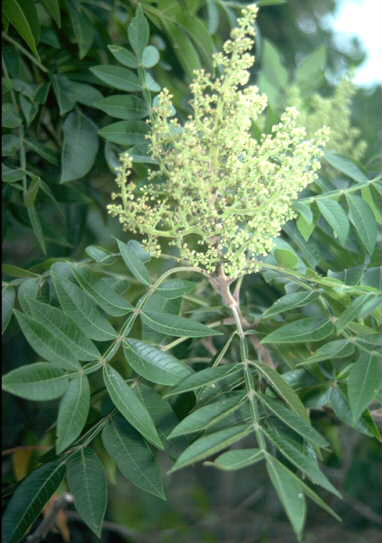
Shining sumac is a deciduous tree with a rounded crown. It occurs in prairies, thickets, open woods, woodland borders, old fields, roadsides, and railroads, from Florida's Coastal Plain northward to Ontario, Canada, with a western distribution that includes Texas, Nebraska, Oklahoma, and Kansas. Its shiny, dark green foliage turns bright red during autumn, and its red berries remain on the plant into winter.
Written 26 November 2026 from the sources listed below. Each statement was checked against the passage it cites; statements that could not be supported were removed.
Appearance
Shining sumac grows as a deciduous tree with a rounded crown. Mature plants typically reach 3.5–5.5 metres in height, while five-year-old saplings can reach approximately 2.5 metres.[1][2][3]
The leaves are alternate and pinnately compound, with leaflets growing along a winged central leaf axis. They measure 5–12 inches long and have shiny, dark green upper surfaces and paler, hairy lower surfaces.[4][5][6][7]
The foliage is dark green during summer and turns bright red or orange-red during autumn.[8][9]
The flowers are small and yellow or greenish-yellow, with five greenish-white petals, and grow in compact terminal panicles.[10][11][12]
The flowers develop into conspicuous clusters of flattened, round, red, hairy berries approximately one-eighth inch wide. The fruits remain on the plant into winter.[13][14][15]
The plant typically develops multiple trunks but can be trained to grow with one trunk. Its twigs are brittle and bleed white sticky sap when broken.[16][17]
Habitat
Shining sumac occurs in prairies, thickets, open woods, and rocky sandstone, chert, and igneous glades. It also grows along woodland borders, old fields, roadsides, and railroads.[18][19][20]
The species grows best in full sunlight and well-drained soils. It can tolerate clay, loam, and sandy soils.[21][22]
Its distribution extends from Florida's Coastal Plain northward to Ontario, Canada. Its western distribution includes Texas, Nebraska, Oklahoma, and Kansas, and it is most common south of the Missouri River in Missouri.[23][24][25]
Behaviour
Shining sumac spreads through underground runners that create dense shrubby cover. It also forms thickets through root sprouting.[26][27]
The species tolerates drought, pollution, compacted soil, and heavy pruning. Established plants can be difficult to remove.[28][29]
Reproduction and life cycle
Male and female flowers occur on separate plants. The species is pollinated by insects.[30][31]
Each fruit contains one seed. Seed germination increases following exposure to heat from fire, with optimal germination occurring at 90 °C.[32][33][34]
Seeds can achieve a germination rate of 75% after soaking in sulfuric acid at room temperature.[35]
Diet
The fruits are consumed by birds and other wildlife. Many types of birds eat the berries, while deer occasionally consume the berries, stems, and foliage.[36][37][38]
Deer browse the plant's twigs. Its leaves are also included in the diets of captive Coquerel's sifakas.[39][40]
Uses
Shining sumac is cultivated as an ornamental shrub because of its glossy foliage and brilliant autumn color. It is recommended for highway median and parking lot plantings and has been used for land reclamation.[41][42][43]
The fruits can be eaten and are rich in vitamin A. They can also be made into a lemonade-like beverage, and crushed fruits have been used to flavor drinking water.[44][45][46]
The bark has been used in the tanning industry because of its tannin content. It has traditionally been used to treat diarrhea and menorrhagia.[47][48]
Fruit and bark teas have been used externally for treating sores, burns, and blisters.[49]
Conservation
The species is classified as secure in New York, Pennsylvania, West Virginia, Delaware, Virginia, and North Carolina. It is considered apparently secure in Ontario, Canada.[50][51]
The species is presumed possibly extirpated in Iowa.[52]
Classification of the Shining Sumac
| Kingdom | Plantae |
|---|---|
| Subkingdom | Pteridobiotina |
| Phylum | Tracheophyta |
| Class | Magnoliopsida |
| Order | Sapindales |
| Family | Anacardiaceae (Sumac Family) |
| Tribe | Rhoeae |
| Genus | Rhus (Sumac) |
| Species | Rhus copallina L. |
Where the Shining Sumac is found
Checklists and occurrence records place Rhus copallina in 4 countries across North America. GBIF holds 41,859 georeferenced records of it.
Countries where it is native or its origin is not stated
Countries where it has been introduced
Regions and cities with the most records
- Florida, United States 6,126
- North Carolina, United States 3,214
- Virginia, United States 2,756
- New Jersey, United States 2,106
- Texas, United States 1,819
- Alabama, United States 1,753
- New York, United States 1,751
- Georgia, United States 1,693
- Maryland, United States 1,530
- Tennessee, United States 1,513
- Massachusetts, United States 1,372
- South Carolina, United States 1,120
- Brooklyn, United States 1,021
- New York City, United States 975
- Arkansas, United States 893
- Queens, United States 888
- Missouri, United States 861
- Pennsylvania, United States 780
- Oklahoma, United States 744
- Kentucky, United States 668
- Hoboken, United States 667
- Bayonne, United States 656
- Connecticut, United States 655
- Staten Island, United States 645
- Jersey City, United States 621
- Valley Stream, United States 619
- Ohio, United States 611
- Woodmere, United States 606
- Indiana, United States 603
- Gainesville, United States 589
- Mississippi, United States 578
- Manhattan, United States 540
- Elmont, United States 534
- North Valley Stream, United States 533
- Union City, United States 531
- West New York, United States 521
2 more countries have a few records outside this range
These countries hold a few records of Rhus copallina but lie outside the range the checklists give for it. Such records are often zoo or garden specimens, museum material or vagrants, so the species is not counted as occurring there.
Range as the checklists state it
USA (Alabama, District of Columbia, Delaware, Florida, Georgia, Maryland, North Carolina, New Jersey, New York, Pennsylvania, South Carolina, Virginia, West Virginia); Trinidad & Tobago [I]
A number beside a place is its count of GBIF occurrence records. A place without a number comes from a checklist alone. Records show where a species has been observed or collected, which can include escapes and vagrants.
Common names
English
- Shining Sumac
- Black Sumac
- Dwarf Sumac
- Eastern Winged Sumac
- Flameleaf Sumac
- Mountain Sumac
- Upland Sumac
Names in 8 other languages
- Chinese
- 亮叶漆树, 亮葉漆樹, 亮葉鹽膚木
- Estonian
- kopaalisumahh
- French
- sumac brillant
- German
- Geflügelter Sumach, Korall-Sumach
- Russian
- Сумах копаловый
- Slovak
- sumach lesklý
- Ukrainian
- Сумах копаловий
- mus
- tvwv-lvste
Synonyms
19 other scientific names have been used for this species and are now treated as synonyms of Rhus copallina.
- Rhus copallinum f. angustialata Engl.
- Rhus copallinum f. copallinum
- Rhus copallinum f. crispa Farw.
- Rhus copallinum f. frondosa Fernald
- Rhus copallinum f. integrifolia Engl.
- Rhus copallinum f. latialata Engl.
- Rhus copallinum f. serrata Engl.
- Rhus copallinum var. angustifolia Engl.
- Rhus copallinum var. arborescens Demcker
- Rhus copallinum var. copallinum
- Rhus copallinum var. extensa Sprenger
- Rhus copallinum var. nesophila House
- Rhus copallinum var. salicifolia Demcker
- Rhus lentiscifolia Stokes
- Rhus pistachiifolia Salisb.
- Schmaltzia copallina (L.) Small
- Sumacus copallina (L.) Raf.
- Sumacus montana Raf.
- Toxicodendron copallinum (L.) Kuntze
Subspecies and varieties
- Rhus copallina var. latifolia variety
- Rhus copallina var. leucantha (Southern Sumac) variety
Related species
-
 Staghorn SumacRhus typhina
-
 SumacRhus coriaria
-
 Smooth SumacRhus glabra
-
 Fragrant SumacRhus aromatica
-
 LemonadeberryRhus integrifolia
-
 Chinese SumacRhus chinensis
-
 Skunkbush SumacRhus trilobata
-
 Sugar BushRhus ovata
Compare
Questions and answers
What is the scientific name of the Shining Sumac?
The scientific name of the Shining Sumac is Rhus copallina. Written with its author, the full name is Rhus copallina L..
Which family does the Shining Sumac belong to?
Rhus copallina belongs to the family Anacardiaceae, in the order Sapindales and the class Magnoliopsida.
Where is the Shining Sumac found?
Checklists and occurrence records place Rhus copallina in 4 countries, including United States, Canada and Cuba.
What is the conservation status of the Shining Sumac?
The IUCN Red List category recorded for Rhus copallina is Least Concern (LC).
What other names does the Shining Sumac have?
Rhus copallina is also known in English as Black Sumac, Dwarf Sumac, Eastern Winged Sumac, Flameleaf Sumac, Mountain Sumac and Upland Sumac.
Can you eat shining sumac?
Yes. The fruits can be eaten and are rich in vitamin A. They can also be made into a lemonade-like beverage, and crushed fruits have been used to flavor drinking water.[44][45][46]
Where does sumac grow naturally?
Shining sumac occurs in prairies, thickets, open woods, rocky sandstone, chert, and igneous glades. It also grows along woodland borders, old fields, roadsides, and railroads. Its distribution extends from Florida's Coastal Plain northward to Ontario, Canada, with a western distribution that includes Texas, Nebraska, Oklahoma, and Kansas.[18][19][20][23][24]
Sources
Passages the profile rests on
- The plant has a rounded crown and grows as a deciduous tree. Source passage: “It is a deciduous tree growing to 3.5–5.5 metres (11–18 ft) tall and an equal spread with a rounded crown.” — English Wikipedia
- Mature plants typically reach 3.5–5.5 metres in height. Source passage: “growing to 3.5–5.5 metres (11–18 ft) tall” — English Wikipedia
- Five-year-old saplings can reach approximately 2.5 metres in height. Source passage: “A 5-year-old sapling will stand about 2.5 metres (8.2 ft).” — English Wikipedia
- The plant has alternate, pinnately compound leaves. Source passage: “Its leaves are alternate and pinnately compound.” — English Wikipedia
- The leaflets grow along a winged central leaf axis. Source passage: “The leaflets are borne on alate rachis that give the plant one of its common names: "winged sumac".” — English Wikipedia
- The leaves measure 5–12 inches long. Source passage: “Leaves are alternate, feather-compound, 5–12 inches long” — mdc.mo.gov
- The upper leaf surfaces are shiny and dark green, while the lower surfaces are paler and hairy. Source passage: “upper surface dark green, shiny; lower surface paler, hairy;” — mdc.mo.gov
- The foliage is dark green during summer and changes to orange-red during autumn. Source passage: “its lustrous dark green foliage which turns a brilliant orange-red in fall.” — English Wikipedia
- The leaves turn bright red during autumn. Source passage: “Leaves turn bright red in fall.” — mdc.mo.gov
- The flowers are small and greenish-yellow and grow in compact terminal panicles. Source passage: “The tiny, greenish-yellow flowers, borne in compact, terminal panicles” — English Wikipedia
- The flowers are yellow. Source passage: “The flowers are yellow, flowering in the summer.” — English Wikipedia
- The flowers have five greenish-white petals. Source passage: “flowers numerous, about ⅛ inch across; petals 5, greenish-white.” — mdc.mo.gov
- The flowers develop into conspicuous clusters of red berries. Source passage: “are followed by showy red clusters of berries” — English Wikipedia
- The fruits remain on the plant into winter. Source passage: “which persist into the winter” — English Wikipedia
- The fruits are flattened, round, red, hairy, and approximately one-eighth inch wide. Source passage: “fruit round, flattened, red, hairy, about ⅛ inch wide, 1-seeded.” — mdc.mo.gov
- The plant typically develops multiple trunks but can be trained to grow with one trunk. Source passage: “The tree wants to grow with several trunks, but can be trained to grow with a single trunk.” — English Wikipedia
- The species has brittle twigs that bleed white sticky sap when broken. Source passage: “Twigs are brittle, green to reddish-brown, hairy at first, smooth later, bleed a white sticky sap when broken;” — mdc.mo.gov
- The species occurs in prairies, thickets, and open woods. Source passage: “Occurs in prairies, thickets, open woods” — mdc.mo.gov
- The species grows in rocky sandstone, chert, and igneous glades. Source passage: “rocky sandstone, chert and igneous glades” — mdc.mo.gov
- The species occurs along woodland borders, old fields, roadsides, and railroads. Source passage: “borders of woodlands generally in acid soils, old fields, roadsides, and along railroads.” — mdc.mo.gov
- The species grows best in full sunlight and well-drained soils. Source passage: “This species grows best in full sunlight and well-drained soils” — English Wikipedia
- The species can tolerate clay, loam, and sandy soils. Source passage: “Soil tolerances include clay, loam, sand, slightly alkaline, acidic, and well-drained soil.” — English Wikipedia
- The species occurs from Florida's Coastal Plain northward to Ontario, Canada. Source passage: “Rhus copallinum extends from the Coastal Plain of Florida to Ontario, Canada.” — English Wikipedia
- Its western distribution includes Texas, Nebraska, Oklahoma, and Kansas. Source passage: “Rhus copallinum extends as far west as Texas, Nebraska, Oklahoma, and Kansas.” — English Wikipedia
- The species is most common south of the Missouri River in Missouri. Source passage: “This species is most common south of the Missouri River.” — mdc.mo.gov
- The species spreads through underground runners that create dense shrubby cover. Source passage: “it has underground runners which spread to provide dense, shrubby cover for birds and wildlife.” — English Wikipedia
- The species forms thickets through root sprouting. Source passage: “it forms thickets from root sprouting.” — mdc.mo.gov
- The species tolerates drought, pollution, compacted soil, and heavy pruning. Source passage: “but is resistant to the effects of pollution, drought, heavy pruning, compacted soil, and transplanting.” — English Wikipedia
- Established plants can be difficult to remove. Source passage: “Additionally, once established, it is difficult to remove from an area.” — English Wikipedia
- Male and female flowers occur on separate plants. Source passage: “both male and female flowers in dense clusters at the end of new growth, on separate plants;” — mdc.mo.gov
- The species is pollinated by insects. Source passage: “Rhus copallinum is insect pollinated” — English Wikipedia
- The fruits contain one seed each. Source passage: “fruit round, flattened, red, hairy, about ⅛ inch wide, 1-seeded.” — mdc.mo.gov
- Seed germination increases following exposure to heat from fire. Source passage: “Rhus copallinum is adapted to fire and seed germination increases with the heat from fire.” — English Wikipedia
- Optimal seed germination occurs at 90 °C. Source passage: “Optimal germination of Rhus copallinum occurs at 90 °C.” — English Wikipedia
- Seeds can achieve a germination rate of 75% after soaking in sulfuric acid at room temperature. Source passage: “The seeds have also been known to germinate at high rates (75%) when soaked in sulfuric acid at room temperature.” — English Wikipedia
- The fruits are consumed by birds and other wildlife. Source passage: “The fruit attracts birds with no significant litter problem” — English Wikipedia
- Many types of birds eat the berries. Source passage: “Many types of birds eat the berries” — mdc.mo.gov
- Deer occasionally consume the berries, stems, and foliage. Source passage: “deer occasionally browse the berries, stems, and foliage.” — mdc.mo.gov
- Deer browse the plant's twigs. Source passage: “Additionally, deer browse the twigs of the species.” — English Wikipedia
- The leaves are included in the diets of captive Coquerel's sifakas. Source passage: “The leaves make up part of the diets of captive Coquerel's sifakas (lemurs).” — English Wikipedia
- The species is cultivated as an ornamental shrub because of its glossy foliage and brilliant autumn color. Source passage: “Winged sumac makes a desirable ornamental shrub due to its glossy, dark green leaves and brilliant red fall color.” — mdc.mo.gov
- The species is recommended for highway median and parking lot plantings. Source passage: “It has been recommended for buffer strips around parking lots or for median strip plantings in the highway” — English Wikipedia
- The species has been used for land reclamation. Source passage: “as well as for land reclamation.” — English Wikipedia
- The fruits can be eaten and are rich in vitamin A. Source passage: “The somewhat sour berrylike fruits are edible and rich in vitamin A.” — English Wikipedia
- The fruits can be made into a lemonade-like beverage. Source passage: “can be made into a lemonade-like drink.” — English Wikipedia
- Crushed fruits have been used to flavor drinking water. Source passage: “The fruits have been crushed and used to flavor drinking water.” — mdc.mo.gov
- The bark has been used in the tanning industry because of its tannin content. Source passage: “The tannin-rich bark has been used in the tanning industry.” — mdc.mo.gov
- The bark has traditionally been used to treat diarrhea and menorrhagia. Source passage: “The bark can be used to treat diarrhea and menorrhagia” — English Wikipedia
- Fruit and bark teas have been used externally for treating sores, burns, and blisters. Source passage: “tea made from the fruit and bark can be used externally to treat oozing sores, burns, and blisters.” — English Wikipedia
- The species is classified as secure in New York, Pennsylvania, West Virginia, Delaware, Virginia, and North Carolina. Source passage: “The conservation status of Rhus copallinum is secure in New York, Pennsylvania, West Virginia, Delaware, Virginia, and North Carolina.” — English Wikipedia
- The species is considered apparently secure in Ontario, Canada. Source passage: “It is apparently secure in Ontario, Canada.” — English Wikipedia
- The species is presumed possibly extirpated in Iowa. Source passage: “it is presumed to be possibly extirpated in Iowa.” — English Wikipedia
Data
- Catalogue of Life, 2026-10-16 XR cc by
- Global Biodiversity Information Facility CC BY 4.0
- Wikidata CC0
- GeoNames CC BY 4.0
- Wikimedia Commons per image; credit shown with each image
- Within the Catalogue of Life, this name comes from Synonymic Checklists of the Vascular Plants of the World cc by
References
- L. (1753). Sp. Pl. [Linnaeus] 1: 266 (1753). where the name was published
This species in other databases
- Catalogue of Life 6X7Z5
- Wikidata Q7245720
- iNaturalist 126698
- World Flora Online wfo-0001049902
- GRIN 31681
Page built on 26 November 2026. See how the catalog is made and all sources and licences.
Cite this page
ScientificNames.org. (2026). Rhus copallina (Shining Sumac). Retrieved November 26, 2026, from https://scientificnames.org/species/rhus-copallina
“Rhus copallina (Shining Sumac).” ScientificNames.org, 2026, scientificnames.org/species/rhus-copallina. Accessed 26 Nov. 2026.
ScientificNames.org. “Rhus copallina (Shining Sumac).” Accessed November 26, 2026. https://scientificnames.org/species/rhus-copallina.
@misc{scientificnames_rhus_copallina_shining_sumac,
  author = {{ScientificNames.org}},
  title = {Rhus copallina (Shining Sumac)},
  year = {2026},
  url = {https://scientificnames.org/species/rhus-copallina},
  note = {Accessed 2026-11-26}
}