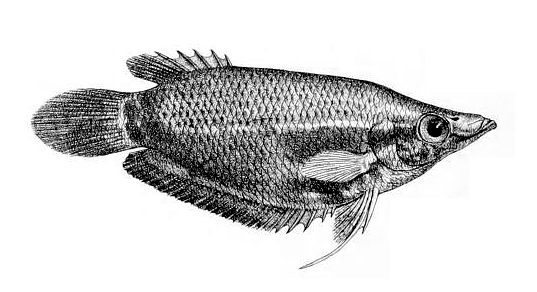
| Appearance | | - The species has long fins and a forked tail. English Wikipedia
- The species can change its coloration from lighter to darker in response to stimuli. English Wikipedia
- During fights, the fish may display dark blue lateral body stripes, extend its fins and spread its operculum. English Wikipedia
- An albino form of the species is available in the aquarium trade. English Wikipedia
|
|---|
| Size | | |
|---|
| Habitat | - The species inhabits clear, overgrown, slow-flowing waters. English Wikipedia
- The species has also been recorded in habitats with little foliage and vegetation. English Wikipedia
- The species occurs in lakes, ponds, rivers, and streams. inaturalist.org
- In Bangladesh, the species was observed in a shallow, slow-moving stream with clear water and a substrate of sand and organic detritus. English Wikipedia
- In the Suthimari River basin of West Bengal, specimens were collected from moderately flowing water with suspended sediment and no aquatic vegetation. English Wikipedia
- The species experiences seasonal monsoons in its native habitat during June and July. English Wikipedia
- Recorded habitat temperatures range from 15 to 32 degrees Celsius. English Wikipedia
- Habitats occupied by the species experience substantial seasonal changes in water conditions, volume, and flow. English Wikipedia
- The species has been collected in the Suthimari River basin of West Bengal in early September during the early afternoon. English Wikipedia
| - The species inhabits shallow freshwater environments with dense vegetation, including marshes and rice fields. English Wikipedia
- The species naturally inhabits small ponds, rice paddies and densely vegetated swamps. pmc.ncbi.nlm.nih.gov
- Floating plants are common in the species' spawning habitats and provide necessary support for nest building. pmc.ncbi.nlm.nih.gov
- The species can survive in both cool and warm freshwater environments. English Wikipedia
- The species is adapted to environments with extremely low dissolved oxygen and slightly acidic water. pmc.ncbi.nlm.nih.gov
- Despite adaptations to challenging environments, the species does not tolerate extreme environmental changes well. pmc.ncbi.nlm.nih.gov
|
|---|
| Diet | | - The species naturally preys on insects, invertebrates and fish fry. English Wikipedia
- In captivity, the species accepts almost any food but should receive a reasonably high-protein diet. English Wikipedia
- The species eats mosquito larvae, black worms, brine shrimp and small flies. English Wikipedia
|
|---|
| Behaviour | - Juveniles exhibit social behaviour while growing. English Wikipedia
- Mature individuals exhibit high aggression toward members of their own species and potentially other fish. English Wikipedia
- The male carries eggs in its mouth during parental care. English Wikipedia
- Males substantially reduce or stop feeding while carrying eggs. English Wikipedia
| - The species is comparatively aggressive among members of its family, being more aggressive than the three-spot gourami but less aggressive than the combtail. English Wikipedia
- Individuals may harass, attack and kill one another or small fish. English Wikipedia
- Aggressive behaviour is generally more pronounced toward members of the same species than toward other fish species. English Wikipedia
- Aggressive behaviour tends to increase with increasing distance from the species' native Asian habitat. English Wikipedia
- The species can learn through a restrictive learning process. English Wikipedia
- Air breathing influences territorial displays, social communication, courtship, breeding and parental care in labyrinth fish. pmc.ncbi.nlm.nih.gov
- The species is an obligatory air breather. pmc.ncbi.nlm.nih.gov
- The species possesses a labyrinth organ that enables it to use atmospheric air for gas exchange. pmc.ncbi.nlm.nih.gov
|
|---|
| Reproduction | - The species reproduces through mouth brooding. English Wikipedia
- The female collects the eggs after laying them and transfers them from her mouth for the male to carry. English Wikipedia
- The male holds the eggs with his anal fin before placing them in his mouth. English Wikipedia
- The egg-transfer process continues until all eggs have been laid. English Wikipedia
- The parents guard the breeding area during the egg-laying process. English Wikipedia
- Eggs remain in the male's mouth for approximately 7–20 days. English Wikipedia
- The male releases free-swimming fry after the mouth-brooding period. English Wikipedia
- The egg-holding ritual can continue for many hours. English Wikipedia
- Young or inexperienced individuals learn how to hold eggs without swallowing them. English Wikipedia
| - The species produces buoyant floating eggs and builds foam nests. pmc.ncbi.nlm.nih.gov
- The species' eggs measure approximately 0.8–0.9 mm in diameter. pmc.ncbi.nlm.nih.gov
- An oil droplet in the egg yolk makes the eggs buoyant, allowing them to rise to the water surface after fertilization. pmc.ncbi.nlm.nih.gov
- The oil droplet remains in the eggs for three to four days after fertilization, keeping the larvae buoyant in the foam nest during their first days after hatching. pmc.ncbi.nlm.nih.gov
- Male individuals build bubble nests using air and mucus secreted by the labyrinth organ. pmc.ncbi.nlm.nih.gov
- Males guard their nests until the larvae are old enough to feed independently. pmc.ncbi.nlm.nih.gov
- Spawning involves a male building a bubble nest and attracting a female to it. English Wikipedia
- During spawning, the female and male release eggs and sperm into the water while embracing. English Wikipedia
- After spawning, the male collects fertilized eggs and places them in the bubble nest. English Wikipedia
- Males may attack females and other fish approaching newly fertilized eggs or hatched fry. English Wikipedia
|
|---|
| Distribution | | No checked fact yet |
|---|
| Conservation | No checked fact yet | - Native populations of the species in Taiwan have declined to low levels because of river pollution. English Wikipedia
- The species is listed as threatened in Taiwan. English Wikipedia
|
|---|
| Uses | | - The species was the second Chinese ornamental fish introduced to Western countries after the goldfish. English Wikipedia
- The species was the first freshwater tropical fish successfully bred in captivity in Europe. English Wikipedia
- The species was imported to France in 1869 by aquarium fish importer Pierre Carbonnier. English Wikipedia
- The species has been used as a subject in behavioural and ethological research. pmc.ncbi.nlm.nih.gov
- The species has been used to study Iridoviridae-type viruses. English Wikipedia
- The species has been successfully raised and bred under laboratory conditions. pmc.ncbi.nlm.nih.gov
|
|---|
| Similar species | | No checked fact yet |
|---|
| Other | No checked fact yet | |
|---|