Comparison
French Physicnut vs Purgenut
French Physicnut (Jatropha multifida) and Purgenut (Jatropha curcas) both belong to the genus Jatropha (physic nuts) and part ways below it. Both are recorded in 59 countries.

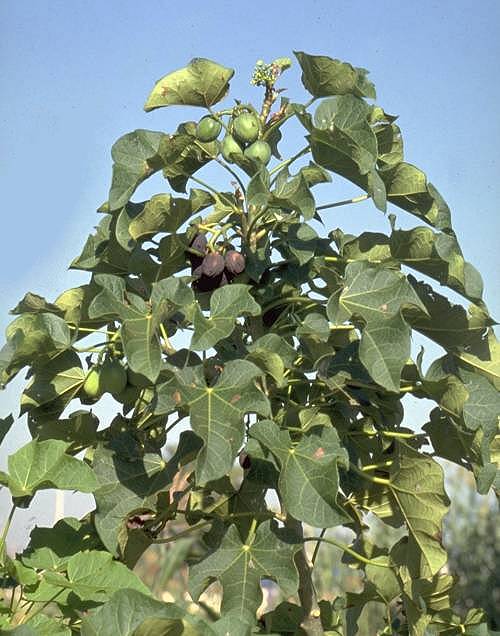


Side by side
| French Physicnut | Purgenut | |
|---|---|---|
| Scientific name | Jatropha multifida L. | Jatropha curcas L. |
| English name | French Physicnut | Purgenut |
| Group | Flowering plants | Flowering plants |
| Class | Magnoliopsida | Magnoliopsida |
| Order | Malpighiales | Malpighiales |
| Family | Euphorbiaceae Spurge Family | Euphorbiaceae Spurge Family |
| Genus | Jatropha Physic Nuts | Jatropha Physic Nuts |
| Red List category | Least Concern | Least Concern |
| Countries on record | 66 countries | 83 countries |
| GBIF occurrence records | 2,713 records | 9,125 records |
Rows where the two agree are shown in grey.
Where each is found
Both recorded in 59 countries
- Angola
- Antigua and Barbuda
- Australia
- Bahamas
- Bangladesh
- Barbados
- Belize
- Benin
- Bermuda
- Bolivia
- Bonaire, Saint Eustatius and Saba
- Brazil
- Cabo Verde
- Cambodia
- Cameroon
- Central African Republic
- China
- Colombia
- Costa Rica
- Cuba
- Democratic Republic of the Congo
- Dominica
- Dominican Republic
- Ecuador
- El Salvador
- French Guiana
- Gambia
- Grenada
- Guadeloupe
- Guam
- Guinea
- Haiti
- Honduras
- India
- Jamaica
- Martinique
- Mexico
- Montserrat
- Mozambique
- Nicaragua
- Palau
- Panama
- Paraguay
- Peru
- Philippines
- Puerto Rico
- Saint Barthelemy
- Saint Martin
- South Africa
- Thailand
- Togo
- Tonga
- Trinidad and Tobago
- U.S. Virgin Islands
- United States
- Vanuatu
- Venezuela
- Vietnam
- Zambia
Only French Physicnut (7)
Only Purgenut (24)
- Anguilla
- Argentina
- Burkina Faso
- Equatorial Guinea
- Eswatini
- Fiji
- Gabon
- Guatemala
- Guyana
- Laos
- Madagascar
- Mauritius
- Namibia
- Nepal
- New Caledonia
- Seychelles
- South Sudan
- Sudan
- Suriname
- Taiwan
- Timor Leste
- Tuvalu
- Yemen
- Zimbabwe
From Catalogue of Life checklists and GBIF occurrence records. A country missing from a list means no record is held, which is not proof of absence.
Checked facts
| French Physicnut | Purgenut | |
|---|---|---|
| Appearance |
|
|
| Size | No checked fact yet |
|
| Habitat |
|
|
| Diet | No checked fact yet |
|
| Reproduction | No checked fact yet |
|
| Lifespan | No checked fact yet |
|
| Distribution |
|
|
| Uses | No checked fact yet |
|
| Other |
|
|
In brief
French Physicnut
The species is native to Mexico and the Caribbean and has been introduced to Florida, South America, Africa, the Indian subcontinent, China, and Southeast Asia. Consumption causes gastrointestinal distress because the species is mildly toxic. Full profile
Purgenut
Purgenut (Jatropha curcas L.) is a semi-evergreen shrub or small tree in the family Euphorbiaceae, order Malpighiales and class Magnoliopsida. It is native to Mexico, the Caribbean, Central America and South America and grows in tropical and subtropical regions. Its seeds contain approximately 27–40% oil by weight and are particularly toxic. Full profile
Compare something else
Page built on 26 November 2026 from the data on the two species pages, where every source is listed.
Cite this page
ScientificNames.org. (2026). French Physicnut vs Purgenut. Retrieved November 26, 2026, from https://scientificnames.org/compare/french-physicnut-vs-purgenut
“French Physicnut vs Purgenut.” ScientificNames.org, 2026, scientificnames.org/compare/french-physicnut-vs-purgenut. Accessed 26 Nov. 2026.
ScientificNames.org. “French Physicnut vs Purgenut.” Accessed November 26, 2026. https://scientificnames.org/compare/french-physicnut-vs-purgenut.
@misc{scientificnames_french_physicnut_vs_purgenut,
  author = {{ScientificNames.org}},
  title = {French Physicnut vs Purgenut},
  year = {2026},
  url = {https://scientificnames.org/compare/french-physicnut-vs-purgenut},
  note = {Accessed 2026-11-26}
}