Species · Flowering plants
Purgenut Jatropha curcas
The scientific name of the Purgenut is Jatropha curcas. It is a species of flowering plant in the family Euphorbiaceae (spurge family), order Malpighiales.
- Scientific name
- Jatropha curcas L.
- Common name
- Purgenut
- Genus
- Jatropha
- Family
- Euphorbiaceae (Spurge Family)
- Order
- Malpighiales
- Class
- Magnoliopsida
- Red List category
- LC Least Concern
- Recorded in
- 83 countries
- Name status
- accepted in the Catalogue of Life
Overview
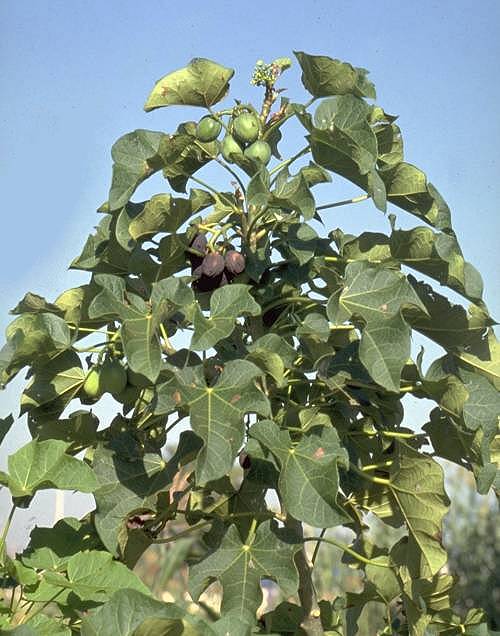
Purgenut (Jatropha curcas L.) is a semi-evergreen shrub or small tree in the family Euphorbiaceae, order Malpighiales and class Magnoliopsida. It is native to Mexico, the Caribbean, Central America and South America and grows in tropical and subtropical regions. Its seeds contain approximately 27–40% oil by weight and are particularly toxic.
Written 26 November 2026 from the sources listed below. Each statement was checked against the passage it cites; statements that could not be supported were removed.
Appearance
Purgenut is a semi-evergreen shrub or small tree that can reach a height of 6 metres or more. Its leaves are generally green to pale green and have three to five lobes.[1][2][3]
The plant generally bears separate male and female flowers on the same inflorescence, although some plants occasionally produce hermaphroditic flowers. Each inflorescence averages approximately 20 male flowers per female flower, although a ratio of 10 to one is also reported.[4][5][6]
The seeds have a black outer coat surrounding a shiny white kernel.[7]
Habitat
Purgenut grows in tropical and subtropical regions. It can grow in desert environments because of its high resistance to aridity.[8][9]
The plant can grow in gravelly, sandy and saline soils and can thrive in poor and stony soils.[10][11]
Uses
The seeds contain approximately 27–40% oil by weight. The seed oil can be processed into biodiesel suitable for standard diesel engines.[12][13]
The residue remaining after seed oil extraction can be used as biomass fuel or fertilizer. The plant has also been cultivated as an ornamental species.[14][15]
The plant has been used traditionally in Africa for its purgative effect.[16]
Diet
The seeds are toxic and are not suitable for human consumption in their ordinary form. All parts of the plant are described as toxic, with the seeds particularly toxic.[17][18]
The plant contains phorbol esters considered toxic, as well as trypsin inhibitors, phytate, saponins and the lectin curcin. It is commonly associated with gastrointestinal irritation and purgative effects.[19][20][21]
Reproduction and life cycle
Purgenut can be propagated through either seeds or cuttings. Propagation from seeds produces substantial genetic variability in growth, biomass, seed yield and oil content.[22][23]
The seeds are mature when their capsule changes from green to yellow. The plant can begin producing yields between nine and twelve months after establishment, with the highest yields generally obtained after two to three years.[24][25][26]
Fruit production generally occurs from midsummer through late fall. The plant can produce multiple fruit crops annually when soil moisture and temperatures are sufficiently high.[27][28]
The plant is self-compatible.[29]
Classification of the Purgenut
| Kingdom | Plantae |
|---|---|
| Subkingdom | Pteridobiotina |
| Phylum | Tracheophyta |
| Class | Magnoliopsida |
| Order | Malpighiales |
| Family | Euphorbiaceae (Spurge Family) |
| Subfamily | Crotonoideae |
| Tribe | Jatropheae |
| Genus | Jatropha (Physic Nuts) |
| Species | Jatropha curcas L. |
Where the Purgenut is found
Checklists and occurrence records place Jatropha curcas in 83 countries across Africa, Asia, North America, Oceania and South America. GBIF holds 9,125 georeferenced records of it.
Countries where it is native or its origin is not stated
- Anguilla
- Antigua and Barbuda
- Argentina 29
- Bahamas 7
- Barbados 3
- Belize 7
- Bolivia 88
- Bonaire, Saint Eustatius and Saba 10
- Brazil 661
- Colombia 3,036
- Costa Rica 119
- Cuba 42
- Dominica 22
- Dominican Republic 41
- El Salvador 120
- French Guiana 16
- Grenada 3
- Guadeloupe 20
- Guatemala 84
- Guyana 16
- Haiti 39
- Honduras 82
- Jamaica 21
- Martinique 25
- Mexico 1,161
- Montserrat 2
- Nicaragua 115
- Panama 123
- Paraguay 34
- Peru 135
- Puerto Rico 57
- Saint Barthelemy 5
- Saint Martin 4
- Suriname 25
- U.S. Virgin Islands 10
- Venezuela 57
Countries where it has been introduced
- Angola 17
- Australia 46
- Bangladesh 10
- Benin 249
- Bermuda 2
- Burkina Faso 27
- Cabo Verde 71
- Cambodia 7
- Cameroon 147
- Central African Republic 6
- China 471
- Democratic Republic of the Congo 78
- Ecuador 152
- Equatorial Guinea 25
- Eswatini 1
- Fiji 34
- Gabon 15
- Gambia 10
- Guam 20
- Guinea 31
- India 393
- Laos 24
- Madagascar 116
- Mauritius 3
- Mozambique 17
- Namibia 6
- Nepal 127
- New Caledonia 38
- Palau 2
- Philippines 312
- Seychelles 21
- South Africa 39
- South Sudan
- Sudan 7
- Taiwan 47
- Thailand 40
- Timor Leste 6
- Togo 8
- Tonga 37
- Trinidad and Tobago 8
- Tuvalu 1
- United States 128
- Vanuatu 27
- Vietnam 30
- Yemen 9
- Zambia 25
- Zimbabwe 16
Regions and cities with the most records
- Antioquia, Colombia 2,706
- Santa Fe de Antioquia, Colombia 2,260
- Ituango, Colombia 437
- Sinaloa, Mexico 200
- Veracruz, Mexico 171
- Chiapas, Mexico 158
- Yunnan, China 136
- Bolívar, Colombia 133
- María la Baja, Colombia 133
- Maharashtra, India 70
- Hainan, China 65
- Oaxaca, Mexico 56
- Guanacaste Province, Costa Rica 55
- Guangxi, China 55
- Sichuan, China 55
- Atakora, Benin 53
- Yucatán, Mexico 53
- Sergipe, Brazil 52
- San Pablo, Colombia 51
- Sucre Department, Colombia 49
- Aracaju, Brazil 47
- Barra dos Coqueiros, Brazil 47
- Laranjeiras, Brazil 47
- Nossa Senhora do Socorro, Brazil 47
- São Cristóvão, Brazil 47
- Guerrero, Mexico 46
- Itaporanga d'Ajuda, Brazil 45
- Culiacán, Mexico 44
- Tamil Nadu, India 44
- Karnataka, India 43
- São Paulo, Brazil 41
- Zacatecas, Mexico 41
- Catemaco, Mexico 39
- Mazatlán, Mexico 39
- Atlantique, Benin 37
- Borgou, Benin 36
41 more countries have a few records outside this range
These countries hold a few records of Jatropha curcas but lie outside the range the checklists give for it. Such records are often zoo or garden specimens, museum material or vagrants, so the species is not counted as occurring there.
- Bhutan 10
- Burundi 15
- Chad 4
- Christmas Island 6
- Comoros 7
- Cook Islands 8
- Egypt 4
- Ethiopia 87
- French Polynesia 20
- Ghana 33
- Guinea-Bissau 3
- Hong Kong 13
- Indonesia 196
- Ivory Coast 42
- Japan 8
- Kenya 38
- Liberia 6
- Malawi 27
- Malaysia 38
- Mali 12
- Mayotte 57
- Micronesia 16
- Myanmar 3
- Niger 4
- Nigeria 139
- Northern Mariana Islands 31
- Papua New Guinea 7
- Portugal 5
- Republic of the Congo 6
- Reunion 223
- Rwanda 3
- Samoa 13
- Sao Tome and Principe 5
- Saudi Arabia 6
- Senegal 34
- Sierra Leone 6
- Singapore 6
- Sri Lanka 32
- Tanzania 151
- Uganda 70
- Wallis and Futuna 10
Range as the checklists state it
Cape Verde Isl. [I] (Santo Antao Isl. [I], Sao Vicente Isl. [I], Santa Luzia Isl. [I], Ilha de Sao Nicolau [I], Sal Isl. [I], Ilha de Maio [I], Ilha de Sao Tiago [I], Fogo Isl. [I], Ilha Brava [I]); Gambia [I]; Guinea [I]; Burkina Faso [I]; Togo [I]; Benin [I]; Cameroon [I]; Bioko Isl. [Fernando Poo] [I]; São Tomé [I]; Annobon Isl. [I]; Gabon [I]; Central African Republic [I]; D. R. Congo [Zaire] [I]; Sudan [I]; South Sudan [I]; Angola [I]; Zambia [I]; Zimbabwe [I]; Mozambique [I]; Namibia [I]; South Africa [I]; Eswatini [Swaziland] [I]; Madagascar [I]; Mauritius [I]; La Réunion [I]; Seychelles [I]; Yemen [I] (Tihama [I], W-Yemen [I]); China [I] (Fujian [I], Guangdong [I], Guangxi [I], Hainan [I], Hongkong [I], Sichuan [I], Yunnan [I]); Taiwan [I]; Nepal [I]; India [I] (widespread); Lakshadweep Isl. [Laccadives] [I]; Bangladesh [I]; Andaman Isl. [I]; Nicobar Isl. [I]; Thailand [I]; Laos [I]; Cambodia [I]; Vietnam [I]; Sumatera [I]; South China Sea Isl. [I]; Sulawesi [I]; Philippines [I]; Jawa [I]; Lesser Sunda Isl. [I] (Bali [I], Timor [I], etc.); East Timor [I]; Moluccas [I]; New Guinea [I]; Australia [I] (Northern Territory [I], Queensland [I]); New Caledonia [I]; Vanuatu [I]; Rotuma Isl. [I]; Tonga [I] (Tongatapu [I], 'Eua [I], Lifuka [I], Vava'u [I]); Fiji [I]; Tuvalu [I] (Nui Atoll [I]); Cook Isl. [I] (Rarotonga [I], Atiu [I], Mauke [I], Manihiki [I], Rakahanga [I], ?Aitutaki [I]); Society Isl. [I] (Tahiti [I], Raiatea [I]); Austral Isl. [I]; Palau [I]; Northern Marianas [I] (Agrihan [I], Pagan [I], Saipan [I], Rota [I]); Guam [I]; Fed. States of Micronesia [I] (Yap [I], Truk [I], Pohnpei [I]); Hawaii [I] (East Maui [I]); USA [I] (Florida [I]); Bermuda [I]; Mexico (Campeche, Chiapas, Colima, Durango, Guerrero, Hidalgo, Jalisco, Mexico State, Michoacán, Morelos, Nayarit, Oaxaca, Puebla, Querétaro, Quintana Roo, San Luis Potosí, Sinaloa, Tabasco, Tamaulipas, Veracruz, Yucatán); Guatemala; Honduras; Nicaragua; Costa Rica; Bahamas; Cuba; Cayman Isl.; Jamaica; Hispaniola; Puerto Rico; Virgin Isl. (St. Croix, St. John, Tortola, Virgin Gorda); Anguilla; St. Martin/St. Maarten; St. Barthélémy; Saba; St. Eustatius; Barbuda; Montserrat; Guadeloupe; Dominica; Grenadines; St. Vincent; Grenada; Barbados; Trinidad & Tobago [I]; Colombia (Amazonas, Antioquia, Bolívar, Boyacá, Casanare, Cesar, Chocó, Córdoba, Cundinamarca, Guaviare, Huila, Nariño, Santander, Vichada); Isla Margarita; Venezuela (Apure, Aragua, Bolívar, Cojedes, Guárico, Lara, Monagas, Nueva Esparta, Táchira, Yaracuy); Guyana; Surinam; French Guiana; Ecuador [I]; Galápagos [I]; Bolivia (Beni, Chuquisaca, Cochabamba, La Paz, Pando, Santa Cruz); N-Brazil (Pará, Amazonas, Acre); NE-Brazil (Maranhão, Bahia); SE-Brazil (São Paulo, Minas Gerais); Paraguay (Cordillera); Argentina (Corrientes, Jujuy, Misiones, Salta)
A number beside a place is its count of GBIF occurrence records. A place without a number comes from a checklist alone. Records show where a species has been observed or collected, which can include escapes and vagrants.
Common names
English
- Purgenut
- Barbados-nut
- Bed Bug Plant
- Big-Purge Nut
- Big-Purge Nut Seed
- Black Vomit Nut
- Black Vomit Nut Seed
- Brazilian Stinging Nut
- Cuban Physic Nut
- Grave Physic Nut
- Hell Oil
- Physic Nut Tree
- Pinhoen Oil
- Purgeerboonjie
- Purging Nut Tree
- Bubblebush
- Purgingnut
Names in 40 other languages
- Afrikaans
- Purgeerboontjie
- Bengali
- সাদা ভেরেন্ডা
- Chinese
- 桐油樹,麻風樹,痲瘋樹,南洋油桐, 麻瘋樹
- Czech
- dávivec černý
- Danish
- ægte purgernød
- Dutch
- Purgeer Noot, Schijtnoot
- Finnish
- öljyjatropa
- French
- Pourguère, fève d'enfer, grand pignon d'Inde, gros ricin, médicinier, médicinier barrière, médicinier béni, médicinier purgatif
- German
- Purgiernuß, Termitenbaum
- Hindi
- ratanjyor, जट्रोफा
- Indonesian
- Jarak Pagar
- Irish
- aburokyiriaba, adadze, kaneadua, kitigbetso, kplukatso
- Japanese
- タイワンアブラギリ, ナンヨウアブラギリ
- Malagasy
- Valavelona kely
- Marathi
- मोगली एरंड
- Polish
- obrzydlec przeczyszczający
- Portuguese
- Pinhão-bravo, Pinhão-do-paraguai, galamaluco, grão-de-maluco, manduri-graça, pinhão-de-cerca, pinhão-de-purga, pinhão-manso
- Russian
- Ятрофа куркас
- Slovak
- jatrofa prečisťujúca
- Spanish
- Bonete, Piñón de tempate, Sangregado, frailejón, piñón, piñón blanco, tártago
- Swahili
- mbono, mbono-pwani, nicororwa
- Swedish
- oljejatrofa
- Thai
- สบู่ดำ
- Tswana
- mathlapametse
- Zulu
- inhlakuva
- bam
- Bàgànin
- bem
- mufurungwo
- cce
- lambo
- cha
- Tuba Tuba
- ewe
- Babatihé
- ful
- chidige, dialaduke, duladukad, kidi, kokolaji, kolakoladje, kolakolaje, kolkolwaahi
- hau
- bi ni zuguu, halallamai
- ibo
- botuje, botuje pupa, bula-olo, lapalapa, lapalapa-funfun, lobotuje, okwata, olobotuje
- kam
- muaegi
- nso
- aglowewe
- sna
- munjirimono
- srr
- litrog, niom, tabanani, tuba
- suk
- ikale, inhale
- ven
- mafuredonga, mupfire-wa-tshikhuwa, mupfure-donga, mupfure-wa-tshikhuwa
- yua
- ni-in
Synonyms
17 other scientific names have been used for this species and are now treated as synonyms of Jatropha curcas.
- Castiglionia lobata Ruiz & Pav.
- Curcas adansonii Endl.
- Curcas curcas (L.) Britton & Millsp.
- Curcas drastica Mart.
- Curcas indica A.Rich.
- Curcas lobata Splitg. ex Lanj.
- Curcas purgans Medik.
- Jatropha afrocurcas Pax
- Jatropha condor Wall.
- Jatropha condor Benth.
- Jatropha edulis Sessé
- Jatropha yucatanensis Briq.
- Manihot curcas (L.) Crantz
- Ricinoides americana Garsault
- Ricinus americanus Mill.
- Ricinus jarak Thunb.
- Jatropha acerifolia Salisb. ambiguous synonym
Related species
-
 PeregrinaJatropha integerrima
-
 Bellyache-bushJatropha gossypiifolia
-
 Guatemalan RhubarbJatropha podagrica
-
 French PhysicnutJatropha multifida
-
 LeatherwoodJatropha dioica
-
 Berlander's NettlespurgeJatropha cathartica
- Moran’s LomboyJatropha moranii
-
 SibruJatropha unicostata
Compare
Questions and answers
What is the scientific name of the Purgenut?
The scientific name of the Purgenut is Jatropha curcas. Written with its author, the full name is Jatropha curcas L..
Which family does the Purgenut belong to?
Jatropha curcas belongs to the family Euphorbiaceae, in the order Malpighiales and the class Magnoliopsida.
Where is the Purgenut found?
Checklists and occurrence records place Jatropha curcas in 83 countries, including Colombia, Mexico, Brazil, Peru, Panama and El Salvador.
What is the conservation status of the Purgenut?
The IUCN Red List category recorded for Jatropha curcas is Least Concern (LC).
What other names does the Purgenut have?
Jatropha curcas is also known in English as Barbados-nut, Bed Bug Plant, Big-Purge Nut, Big-Purge Nut Seed, Black Vomit Nut and Black Vomit Nut Seed.
What is jatropha used for?
Purgenut seed oil is processed into biodiesel suitable for standard diesel engines and is used as a biodiesel feedstock. The residue after oil extraction can be used as biomass fuel or fertilizer. The plant has also been cultivated as an ornamental species and used in traditional medicine.[13][30][14][31][15][32][33][16]
What is the Physic Nut tree?
The Physic Nut Tree is an English name on record for Jatropha curcas L., also called purgenut. It is a semi-evergreen shrub or small tree.[1]
Can I eat Jatropha leaf?
All parts of the plant are described as toxic. The plant contains phorbol esters considered toxic, as well as trypsin inhibitors, phytate, saponins and the lectin curcin.[19][20][18]
How long does Jatropha live?
The shrub has an approximate life expectancy of forty years.[34]
Which part of Jatropha is poisonous?
All parts of the plant are described as toxic, with the seeds particularly toxic.[18]
Sources
Passages the profile rests on
- Jatropha curcas is a semi-evergreen shrub or small tree. Source passage: “Jatropha curcas is a semi-evergreen shrub or small tree, reaching a height of 6 metres (20 feet) or more.” — English Wikipedia
- The plant can reach a height of 6 metres or more. Source passage: “reaching a height of 6 metres (20 feet) or more.” — English Wikipedia
- Its leaves are generally green to pale green and have three to five lobes. Source passage: “the leaves are green to pale green, alternate to subopposite, and three- to five-lobed” — English Wikipedia
- The plant generally bears separate male and female flowers on the same inflorescence. Source passage: “male and female flowers are produced on the same inflorescence” — English Wikipedia
- Some plants occasionally produce hermaphroditic flowers. Source passage: “Plants occasionally present hermaphroditic flowers.” — English Wikipedia
- Each inflorescence averages approximately 20 male flowers per female flower, although a ratio of 10 to one is also reported. Source passage: “averaging 20 male flowers to each female flower, or 10 male flowers to each female flower.” — English Wikipedia
- The seeds have a black outer coat surrounding a shiny white kernel. Source passage: “The seed has a black coat with a white shiny kernel inside” — pmc.ncbi.nlm.nih.gov
- The species can grow in desert environments because of its high resistance to aridity. Source passage: “It is resistant to a high degree of aridity, allowing it to grow in deserts.” — English Wikipedia
- The plant grows in tropical and subtropical regions. Source passage: “Jatropha curcas grows in tropical and subtropical regions.” — English Wikipedia
- The plant can grow in gravelly, sandy and saline soils. Source passage: “The plant can grow in wastelands and grows on almost any terrain, even on gravelly, sandy and saline soils.” — English Wikipedia
- The species can thrive in poor and stony soils. Source passage: “It can thrive in poor and stony soils” — English Wikipedia
- The seeds contain approximately 27–40% oil by weight. Source passage: “The seeds contain 27–40% oil (average: 34.4%)” — English Wikipedia
- The seed oil can be processed into biodiesel suitable for standard diesel engines. Source passage: “The seeds contain 27–40% oil (average: 34.4%) that can be processed to produce a high-quality biodiesel fuel, usable in a standard diesel engine.” — English Wikipedia
- The residue remaining after seed oil extraction can be used as biomass fuel or fertilizer. Source passage: “the residue (press cake) can also be used as biomass feedstock to power electricity plants, or used as fertilizer” — English Wikipedia
- The plant has been cultivated as an ornamental species. Source passage: “In other parts of world it is also grown as an ornamental plant.” — pmc.ncbi.nlm.nih.gov
- The plant has been used traditionally in Africa for its purgative effect. Source passage: “In Africa it has been specifically utilized for its purgative effect.” — pmc.ncbi.nlm.nih.gov
- The seeds are toxic and are not suitable for human consumption in their ordinary form. Source passage: “Jatropha oil is not suitable for human consumption, as it induces strong vomiting and diarrhea.” — English Wikipedia
- All parts of the plant are described as toxic, with the seeds particularly toxic. Source passage: “All parts of the plant are toxic particularly the seeds.” — pmc.ncbi.nlm.nih.gov
- The plant contains phorbol esters considered toxic. Source passage: “It contains phorbol esters, which are considered toxic.” — English Wikipedia
- The plant contains trypsin inhibitors, phytate, saponins and the lectin curcin. Source passage: “J. curcas also contains compounds such as trypsin inhibitors, phytate, saponins and a type of lectin known as curcin.” — English Wikipedia
- The plant is commonly associated with gastrointestinal irritation and purgative effects. Source passage: “The plant is commonly known to be a purgative and gastrointestinal irritant” — pmc.ncbi.nlm.nih.gov
- The species can be propagated through either seeds or cuttings. Source passage: “Jatropha curcas can easily be propagated by both seed or cuttings.” — English Wikipedia
- Propagation from seeds produces substantial genetic variability in growth, biomass, seed yield and oil content. Source passage: “Propagation through seed (sexual propagation) leads to a lot of genetic variability in terms of growth, biomass, seed yield and oil content.” — English Wikipedia
- The seeds are mature when their capsule changes from green to yellow. Source passage: “the seeds are mature when the capsule changes from green to yellow.” — English Wikipedia
- The plant can begin producing yields between nine and twelve months after establishment. Source passage: “Jatropha curcas starts yielding from 9–12 months time” — English Wikipedia
- The highest yields are generally obtained after two to three years. Source passage: “the best yields are obtained only after 2–3 years time.” — English Wikipedia
- Fruit production generally occurs from midsummer through late fall. Source passage: “Most fruit production is concentrated from midsummer to late fall” — English Wikipedia
- The plant can produce multiple fruit crops annually when soil moisture and temperatures are sufficiently high. Source passage: “fruits are produced in winter, or there may be several crops during the year if soil moisture is good and temperatures are sufficiently high.” — English Wikipedia
- The plant is self-compatible. Source passage: “The plants are self-compatible.” — English Wikipedia
- The seed oil is used to produce biodiesel in the Philippines, Pakistan and Brazil. Source passage: “Currently the oil from Jatropha curcas seeds is used for making biodiesel fuel in Philippines, Pakistan and in Brazil” — English Wikipedia
- The plant's oil is used as a biodiesel feedstock in India. Source passage: “it is presently being cultivated on a large scale for its seed oil, which is used as biodiesel.” — pmc.ncbi.nlm.nih.gov
- The seeds have been used in traditional Indian medicine as purgatives and antihelminthics. Source passage: “As purgative, antihelminthic, and abortifacient;” — pmc.ncbi.nlm.nih.gov
- The seed oil has been used traditionally to treat rheumatic conditions, itching and parasitic skin diseases. Source passage: “The seed oil of the plant has been used in treatment of rheumatic conditions, itch, parasitic skin diseases” — pmc.ncbi.nlm.nih.gov
- The shrub has an approximate life expectancy of forty years. Source passage: “this shrub has a life expectancy of approximately forty years.” — English Wikipedia
Data
- Catalogue of Life, 2026-10-16 XR cc by
- Global Biodiversity Information Facility CC BY 4.0
- Wikidata CC0
- GeoNames CC BY 4.0
- Wikimedia Commons per image; credit shown with each image
- Within the Catalogue of Life, this name comes from Synonymic Checklists of the Vascular Plants of the World cc by
References
- L. (1753). Sp. Pl. [Linnaeus] 2: 1006 (1753). where the name was published
This species in other databases
Page built on 27 November 2026. See how the catalog is made and all sources and licences.
Cite this page
ScientificNames.org. (2026). Jatropha curcas (Purgenut). Retrieved November 27, 2026, from https://scientificnames.org/species/jatropha-curcas
“Jatropha curcas (Purgenut).” ScientificNames.org, 2026, scientificnames.org/species/jatropha-curcas. Accessed 27 Nov. 2026.
ScientificNames.org. “Jatropha curcas (Purgenut).” Accessed November 27, 2026. https://scientificnames.org/species/jatropha-curcas.
@misc{scientificnames_jatropha_curcas_purgenut,
  author = {{ScientificNames.org}},
  title = {Jatropha curcas (Purgenut)},
  year = {2026},
  url = {https://scientificnames.org/species/jatropha-curcas},
  note = {Accessed 2026-11-27}
}