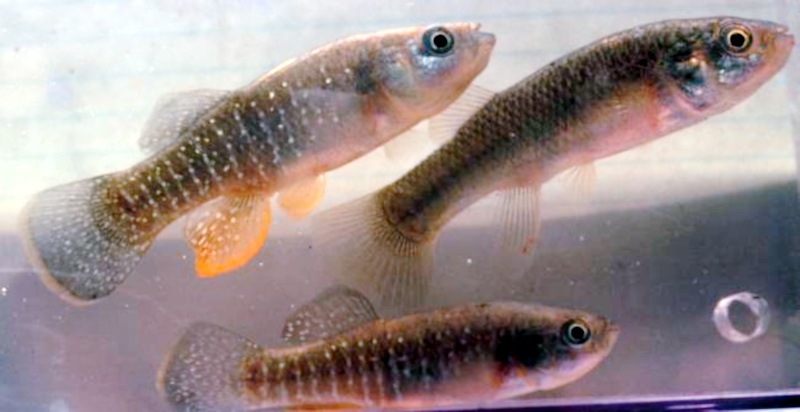
| Appearance | - Adult male spotfin killifish have 10–14 dark vertical bars and a distinctive ocellus on the posterior dorsal fin. English Wikipedia
- Adult females and juveniles are grayish-green to olive green and generally lack vertical bars and a dorsal ocellus. English Wikipedia
- The species has an elongated body, an upturned mouth, a flattened head and a rounded caudal fin. English Wikipedia
- The dorsal fin typically has eight rays, with a documented range of eight to nine. English Wikipedia
- The anal fin has ten rays. English Wikipedia
- The dorsal fin originates behind the origin of the anal fin. English Wikipedia
- The species has 34–36 longitudinal scale rows. English Wikipedia
- The gill opening is restricted at its upper end. English Wikipedia
- Breeding males develop vivid yellow-orange pigmentation across the belly, pelvic and anal fins, caudal peduncle and caudal fin. English Wikipedia
- Breeding males may develop small fleshy contact organs on the head, body sides and medial fins. English Wikipedia
| - The species has an elongated, thick body and a deep caudal peduncle. English Wikipedia
- Its mouth is upturned, and its lower jaw protrudes when the mouth is closed. English Wikipedia
- Its pectoral and tail fins are rounded. English Wikipedia
- Males have larger dorsal and anal fins than females. English Wikipedia
- Its coloration is generally olive-brown or olive-green and may vary with the surrounding background. English Wikipedia
- Males develop dark olive-green backs, steel-blue sides with approximately 15 silvery bars, and yellow or orange-yellow undersides during reproduction. English Wikipedia
- Females are generally paler than males and lack their characteristic body bars and intense yellow belly coloration. English Wikipedia
|
|---|
| Size | - Males reach sexual maturity at approximately 24–27 mm total length. English Wikipedia
- Females reach sexual maturity at approximately 28–30 mm total length. English Wikipedia
| |
|---|
| Habitat | - The species inhabits irregularly flooded salt marsh zones dominated largely by cordgrass and needlerush. English Wikipedia
- It shelters in puddles, shallow pools, small tidal rivulets, plant-base culms and crab burrows. English Wikipedia
- The species prefers muddy substrates, which retain water more effectively than sand during low tide. English Wikipedia
- The species prefers medium to high salinities. English Wikipedia
- Wild individuals have been collected in salinities ranging from 0 to 46 ppt. English Wikipedia
- The species has been recorded at water temperatures ranging from 0.6 to 36.1 °C. English Wikipedia
- Laboratory experiments demonstrated tolerance of salinities up to 106 ppt. English Wikipedia
| - The species inhabits brackish and coastal waters, including estuaries and salt marshes. English Wikipedia
- Its coastal habitats include muddy creeks, tidal channels, eelgrass or cordgrass beds, and sheltered shorelines. English Wikipedia
- The species occurs in coastal rivers but seldom beyond the tidal limit. English Wikipedia
- Tidal creeks are a preferred habitat, alongside saltwater marshes, estuaries, and sheltered shores with submerged eelgrass. animaldiversity.org
- Submerged vegetation is a common feature of the habitats used by this species for spawning and feeding. animaldiversity.org
|
|---|
| Diet | - The species consumes detritus, diatoms, foraminiferans and rotifers. English Wikipedia
- Its diet includes insects such as mosquitoes and larval chironomids. English Wikipedia
- The species consumes homopterans, coleopterans, hymenopterans, lepidopterans, odonates and hemipterans. English Wikipedia
- Its diet includes collembolans and arachnids, including spiders, pseudoscorpions and mites. English Wikipedia
- The species consumes crustaceans including copepods, tanaids, ostracods, cladocerans, isopods and amphipods. English Wikipedia
- Other recorded food items include annelid worms, gastropod mollusks and fish eggs. English Wikipedia
| - The species is an omnivore without a stomach. English Wikipedia
- Its recorded food includes diatoms, amphipods, other crustaceans, molluscs, fish eggs, small fish, insect larvae, and eelgrass. English Wikipedia
- Its diet includes phytoplankton, molluscs, crustaceans, insect larvae, eelgrass, and smaller fish. animaldiversity.org
|
|---|
| Behaviour | - The species is a permanent resident of emergent salt marshes and does not migrate. English Wikipedia
- Spotfin killifish remain in emergent marsh habitats during low tides. English Wikipedia
- The species spends its entire life in sporadically flooded salt marsh habitats. English Wikipedia
| - Individuals form dense shoals that can contain several hundred fish. English Wikipedia
- During northern winters, individuals move into upstream tidal pools and burrow into mud to depths of up to 20 cm. English Wikipedia
- Some individuals move into deeper waters during freezing winter conditions rather than burrowing into sediment. animaldiversity.org
- The species can survive several hours in moist air outside water by breathing air directly. English Wikipedia
- Adults can use aquatic surface respiration when dissolved oxygen falls to approximately 1 mg/L. English Wikipedia
|
|---|
| Reproduction | No checked fact yet | - The spawning season extends from spring through fall. English Wikipedia
- Southern populations can spawn up to eight times in a single season. English Wikipedia
- Spawning occurs most frequently during high tides associated with new or full moons. English Wikipedia
- Female fish attract males by turning onto their sides near the bottom and flicking their tails. English Wikipedia
- Mummichog eggs are pale yellow, strongly adhesive, and approximately 2 mm in diameter. English Wikipedia
- A female can deposit up to 740 eggs during a spawning event. English Wikipedia
- Eggs may be attached to vegetation, algal mats, empty mussel shells, sand, or mud. English Wikipedia
- Eggs develop while exposed to moist air and hatch when subsequent high spring tides submerge them. English Wikipedia
- Northern subspecies eggs possess adhesive chorionic fibrils that are absent from southern subspecies eggs. English Wikipedia
- Most individuals reach sexual maturity at approximately two years of age and 3.8 cm in length. English Wikipedia
- Newly hatched larvae are approximately 7 mm long. animaldiversity.org
- Larvae remain in the intertidal zone for six to eight weeks after hatching. animaldiversity.org
|
|---|
| Distribution | - The species occurs along the eastern coast of the United States from Massachusetts to Georgia. English Wikipedia
| No checked fact yet |
|---|
| Conservation | - The spotfin killifish is classified as Least Concern on the IUCN Red List. English Wikipedia
| - Introduced populations of the species are considered a significant ecological concern in the European Union. English Wikipedia
|
|---|
| Uses | No checked fact yet | - The species has been used in attempts to control mosquito populations by consuming mosquito larvae. English Wikipedia
- The species is commonly used in research on stress biology, thermal physiology, and toxicology. English Wikipedia
|
|---|
| Similar species | - The spotfin killifish closely resembles the mummichog in body shape and coloration. English Wikipedia
- The spotfin killifish can be distinguished from the mummichog by its eight to nine dorsal fin rays compared with eleven to twelve in the mummichog. English Wikipedia
- The spotfin killifish has a dorsal fin positioned farther back than that of the mummichog. English Wikipedia
| - The mummichog closely resembles the banded killifish (Fundulus diaphanus), and the two species have been reported to interbreed. English Wikipedia
|
|---|
| Other | - The species has been found to be locally abundant despite earlier assumptions that it was rare. English Wikipedia
| - Mummichogs are nonmigratory and typically occupy home ranges smaller than 1,000 m. pmc.ncbi.nlm.nih.gov
|
|---|