Comparison
Ua Huka Rail vs Weka
Ua Huka Rail (Gallirallus gracilitibia) and Weka (Gallirallus australis) both belong to the genus Gallirallus (pacific rails) and part ways below it.
Ua Huka Rail
Gallirallus gracilitibia
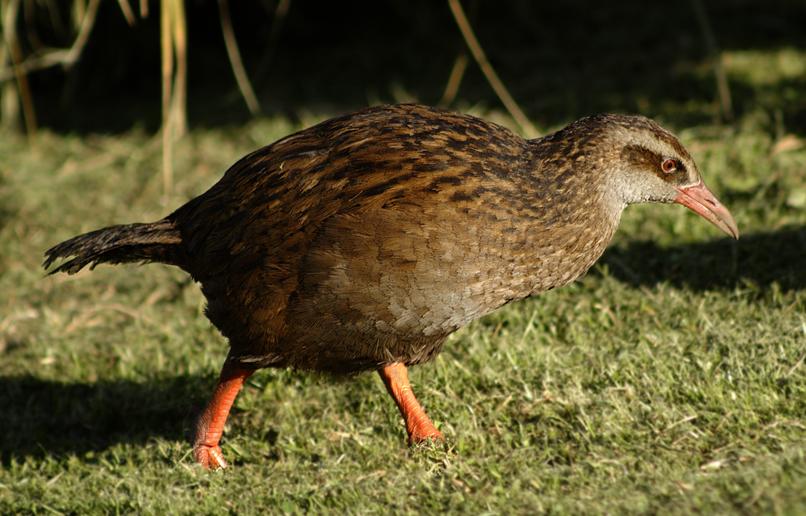
Weka
Gallirallus australis
Gallirallus_australis_1.jpg: Alan Vernon derivative work: Berichard (talk), CC BY 2.0, via Wikimedia Commons

Side by side
| Ua Huka Rail | Weka | |
|---|---|---|
| Scientific name | Gallirallus gracilitibia Kirchman & Steadman, 2007 | Gallirallus australis (Sparrman, 1786) |
| English name | Ua Huka Rail | Weka |
| Group | Birds | Birds |
| Class | Aves Bird | Aves Bird |
| Order | Gruiformes Rails | Gruiformes Rails |
| Family | Rallidae Rail | Rallidae Rail |
| Genus | Gallirallus Pacific Rails | Gallirallus Pacific Rails |
| Named in | 2007 | 1786 |
| Red List category | Not recorded | Vulnerable |
| Countries on record | Not recorded | 2 countries |
| GBIF occurrence records | Not recorded | 36,679 records |
Rows where the two agree are shown in grey.
Where each is found
Only Weka (2)
From Catalogue of Life checklists and GBIF occurrence records. A country missing from a list means no record is held, which is not proof of absence.
Checked facts
| Ua Huka Rail | Weka | |
|---|---|---|
| Appearance |
|
|
| Size |
|
|
| Habitat |
|
|
| Diet | No checked fact yet |
|
| Behaviour |
|
|
| Reproduction | No checked fact yet |
|
| Distribution |
|
|
| Conservation |
|
|
| Uses | No checked fact yet |
|
| Similar species |
| No checked fact yet |
| Name origin |
| No checked fact yet |
| Other |
|
|
In brief
Ua Huka Rail
The Ua Huka Rail (Gallirallus gracilitibia Kirchman & Steadman, 2007) was an extinct bird in the family Rallidae, order Gruiformes, class Aves. The species is known from subfossil remains found on Ua Huka in the Marquesas Islands of French Polynesia. The Ua Huka Rail was flightless and had reduced wings and an extremely thin tibiotarsus shaft. Full profile
Weka
The Weka (Gallirallus australis) is a flightless member of the rail family, Rallidae. The Weka is endemic to New Zealand and inhabits forests, sub-alpine grasslands, sand dunes, rocky shores and modified semi-urban environments. The Weka has predominantly rich brown plumage mottled with black and grey, sturdy legs, reduced wings and a stout reddish-brown beak. Full profile
Compare something else
Page built on 27 November 2026 from the data on the two species pages, where every source is listed.
Cite this page
ScientificNames.org. (2026). Ua Huka Rail vs Weka. Retrieved November 27, 2026, from https://scientificnames.org/compare/ua-huka-rail-vs-weka
“Ua Huka Rail vs Weka.” ScientificNames.org, 2026, scientificnames.org/compare/ua-huka-rail-vs-weka. Accessed 27 Nov. 2026.
ScientificNames.org. “Ua Huka Rail vs Weka.” Accessed November 27, 2026. https://scientificnames.org/compare/ua-huka-rail-vs-weka.
@misc{scientificnames_ua_huka_rail_vs_weka,
  author = {{ScientificNames.org}},
  title = {Ua Huka Rail vs Weka},
  year = {2026},
  url = {https://scientificnames.org/compare/ua-huka-rail-vs-weka},
  note = {Accessed 2026-11-27}
}