Comparison

Gammarid Shrimp vs Roeseli's Scud

Gammarid Shrimp (Gammarus salinus) and Roeseli's Scud (Gammarus roeselii) both belong to the genus Gammarus (scuds) and part ways below it. Both are recorded in 5 countries.

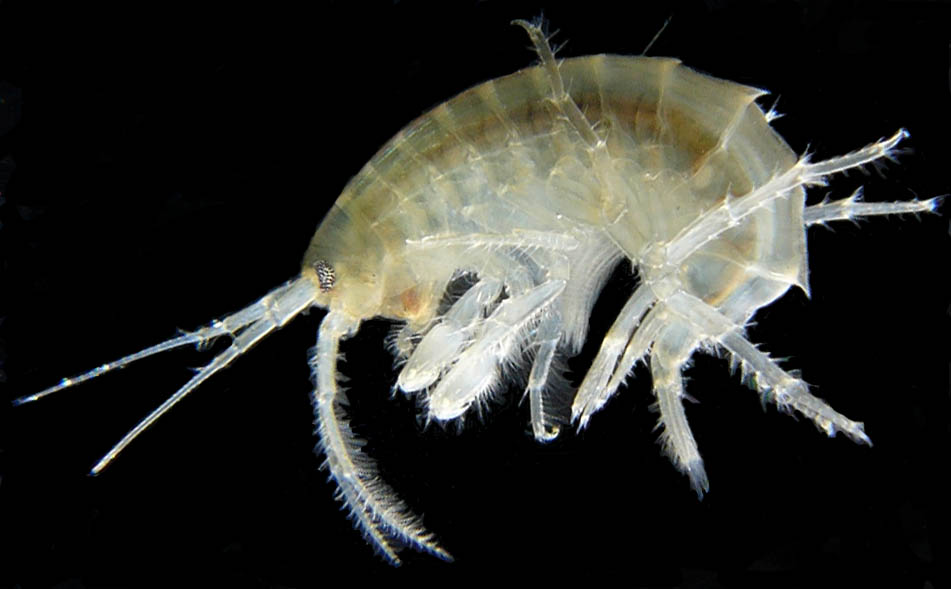
Gammarid Shrimp

Gammarid Shrimp

Gammarus salinus

Hans Hillewaert, CC BY-SA 4.0, via Wikimedia Commons

Roeseli's Scud

Roeseli's Scud

Gammarus roeselii

Michal Maňas, CC BY 2.5, via Wikimedia Commons

Side by side

Gammarid ShrimpRoeseli's Scud
Scientific nameGammarus salinus Spooner, 1947Gammarus roeselii Gervais, 1835
English nameGammarid ShrimpRoeseli's Scud
GroupCrustaceansCrustaceans
ClassMalacostracaMalacostraca
OrderAmphipodaAmphipoda
FamilyGammaridae ScudsGammaridae Scuds
GenusGammarus ScudsGammarus Scuds
Named in19471835
Environmentbrackish, marinefreshwater
Countries on record15 countries21 countries
GBIF occurrence records15,252 records6,807 records

Rows where the two agree are shown in grey.

Where each is found

Both recorded in 5 countries

Only Gammarid Shrimp (10)

Only Roeseli's Scud (16)

From Catalogue of Life checklists and GBIF occurrence records. A country missing from a list means no record is held, which is not proof of absence.

Checked facts

Gammarid ShrimpRoeseli's Scud
Appearance
  • The species has a laterally compressed, smooth and curved body. marlin.ac.uk
  • The body is divided into a head, pereon and pleon, although the abdomen is not distinctly separated from the thorax in size or shape. marlin.ac.uk
  • The head has no carapace and is fused with the first thoracic segment. marlin.ac.uk
  • The species has two well-developed, elongated pairs of antennae. marlin.ac.uk
  • The first antenna pair has a small accessory flagellum, while the second pair has numerous longer bristles. marlin.ac.uk
  • Its compound eyes are large, elongated and kidney-shaped. marlin.ac.uk
  • Each body segment bears a pair of limbs. marlin.ac.uk
  • The thoracic limbs include pereopods, while the abdominal limbs include pleopods and uropods. marlin.ac.uk
  • The first pair of thoracic limbs is modified into feeding structures called maxillipeds. marlin.ac.uk
  • The second and third pairs of thoracic limbs have a more robust structure and are called gnathopods. marlin.ac.uk
  • The telson is lobed and bears bristles and spines. marlin.ac.uk
  • The body is brownish or greenish brown with slight transverse banding. marlin.ac.uk
  • The lateral lobe of the head is angular and truncated and has a deep post-antennal sinus. marlin.ac.uk
  • The first antenna's peduncle articles bear approximately six, five to six, and two to three groups of ventral bristles, respectively. marlin.ac.uk
  • The accessory flagellum of the first antenna is approximately as long as the second article of its peduncle. marlin.ac.uk
  • The second antenna is more heavily bristled and males possess calceoli on it. marlin.ac.uk
  • Each telson lobe has three apical, one sub-apical and one or two lateral spines, with each group accompanied by several setae. marlin.ac.uk
  • Adults have spines on their fifth through seventh pereiopods, distinguishing this species from many other common amphipods. English Wikipedia
  • Individuals can be green, brown, gray, or yellow, sometimes with reddish markings on parts of their carapaces. English Wikipedia
Size
Habitat
  • The species occurs in lower and upper infralittoral habitats. marlin.ac.uk
  • Its recorded substrata include macroalgae, coarse clean sand and gravel or shingle. marlin.ac.uk
  • The species inhabits freshwater ponds, lakes, and streams. English Wikipedia
  • Populations tend to be most abundant in rivers with moderate water flow and plentiful plants that provide shelter. English Wikipedia
  • The species is more abundant at warmer temperatures than some amphipod species occurring alongside it. English Wikipedia
  • The study indicates that ancestral populations could have occupied either lake or river habitats. pmc.ncbi.nlm.nih.gov
  • Several present-day river populations descended from ancestors that occupied lake habitats during the Pleistocene. pmc.ncbi.nlm.nih.gov
Behaviour
  • The abdominal pleopods are used for swimming. marlin.ac.uk
  • The abdominal uropods are used for hopping or scudding across substrata. marlin.ac.uk
  • Males have longer intervals between moults than females. marlin.ac.uk
  • Females isolated without males progressively lengthen their moulting intervals from the third or fourth interval after isolation. marlin.ac.uk
  • Moulting intervals vary with temperature changes. marlin.ac.uk
  • No differences in moulting intervals were observed at salinities of 5, 10 and 30 psu. marlin.ac.uk
  • Individuals can attach their bodies to substrates using spines on their metasomes. English Wikipedia
  • Individuals can survive outside water for several days. English Wikipedia
Reproduction
  • Females kept with males in pairs maintained consistent intervals between moults. marlin.ac.uk
  • Males and females form precopulatory mating pairs. English Wikipedia
  • After mating, females carry eggs in a brood pouch before releasing juveniles. English Wikipedia
  • Some females produce clutches containing 80 or more eggs. English Wikipedia
  • Winter clutches are smaller but contain larger eggs than clutches produced during warmer months. English Wikipedia
  • Egg development in the brood pouch takes between 10 and more than 200 days depending on water temperature. English Wikipedia
  • Embryo survival is highest at water temperatures between 10 and 16 °C. English Wikipedia
  • Females can produce as many as eight broods during their lifetimes. English Wikipedia
  • Juveniles undergo nine or ten moults before reaching sexual maturity. English Wikipedia
ConservationNo checked fact yet
  • The species is considered an established non-native species in central, northern, and western Europe. English Wikipedia
  • The species can tolerate some anthropogenic environmental disturbance. English Wikipedia
  • Populations exposed to pesticide-contaminated river environments in Central Europe have developed increased tolerance to neonicotinoid insecticides over time. English Wikipedia
UsesNo checked fact yet
  • The species was formerly used as a food source in commercial fisheries. English Wikipedia
Similar species
  • The species can be distinguished from Gammarus zaddachi by having less pronounced bristle coverage on its body and appendages. marlin.ac.uk
No checked fact yet

In brief

Gammarid Shrimp

The species has a brownish or greenish brown body with slight transverse banding and less pronounced bristle coverage than Gammarus zaddachi. Full profile

Roeseli's Scud

Gammarus roeselii inhabits freshwater ponds, lakes, and streams. Adults have spines on their fifth through seventh pereiopods, distinguishing the species from many other common amphipods. Full profile

Compare something else

Page built on 29 November 2026 from the data on the two species pages, where every source is listed.

Cite this page

ScientificNames.org. (2026). Gammarid Shrimp vs Roeseli's Scud. Retrieved November 29, 2026, from https://scientificnames.org/compare/gammarid-shrimp-vs-roeselis-scud