Species · Crustaceans
Roeseli's Scud Gammarus roeselii
The scientific name of the Roeseli's Scud is Gammarus roeselii. It is a species of crustacean in the family Gammaridae (scuds), order Amphipoda. The name dates from 1835.
- Scientific name
- Gammarus roeselii Gervais, 1835
- Common name
- Roeseli's Scud
- Genus
- Gammarus
- Family
- Gammaridae (Scuds)
- Order
- Amphipoda
- Class
- Malacostraca
- Environment
- freshwater
- Recorded in
- 21 countries
- Name status
- accepted in the Catalogue of Life
Overview
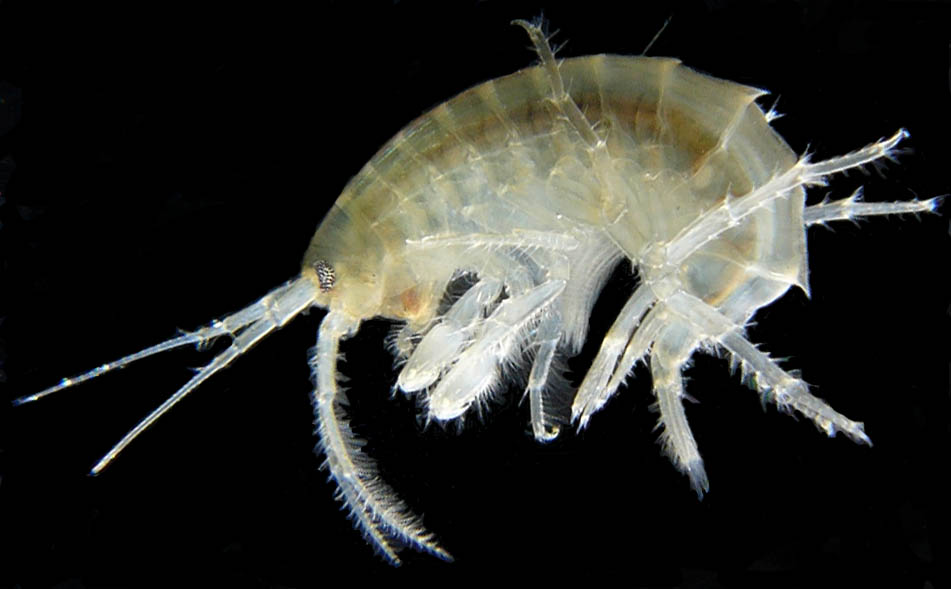
Gammarus roeselii inhabits freshwater ponds, lakes, and streams. Adults have spines on their fifth through seventh pereiopods, distinguishing the species from many other common amphipods.
Written 26 November 2026 from the sources listed below. Each statement was checked against the passage it cites; statements that could not be supported were removed.
Appearance
Adults have spines on their fifth through seventh pereiopods. Individuals can be green, brown, gray, or yellow, sometimes with reddish markings on parts of their carapaces.[1][2]
Adult males can reach 22 mm in length, while females are smaller.[3]
Habitat
Roeseli's Scud inhabits freshwater ponds, lakes, and streams. Populations tend to be most abundant in rivers with moderate water flow and plentiful plants that provide shelter.[4][5]
The species is more abundant at warmer temperatures than some amphipod species occurring alongside it.[6]
Ancestral populations could have occupied either lake or river habitats. Several present-day river populations descended from ancestors that occupied lake habitats during the Pleistocene.[7][8]
Behaviour
Individuals can attach their bodies to substrates using spines on their metasomes. They can also survive outside water for several days.[9][10]
Reproduction and life cycle
Males and females form precopulatory mating pairs. After mating, females carry eggs in a brood pouch before releasing juveniles.[11][12]
Some females produce clutches containing 80 or more eggs. Winter clutches are smaller but contain larger eggs than clutches produced during warmer months.[13][14]
Egg development in the brood pouch takes between 10 and more than 200 days depending on water temperature. Embryo survival is highest at water temperatures between 10 and 16 °C.[15][16]
Females can produce as many as eight broods during their lifetimes. Juveniles undergo nine or ten moults before reaching sexual maturity.[17][18]
Conservation
Roeseli's Scud is considered an established non-native species in central, northern, and western Europe. It can tolerate some anthropogenic environmental disturbance.[19][20]
Populations exposed to pesticide-contaminated river environments in Central Europe have developed increased tolerance to neonicotinoid insecticides over time.[21]
Uses
Roeseli's Scud was formerly used as a food source in commercial fisheries.[22]
Classification of the Roeseli's Scud
| Kingdom | Animalia |
|---|---|
| Phylum | Arthropoda |
| Subphylum | Crustacea |
| Class | Malacostraca |
| Order | Amphipoda |
| Suborder | Senticaudata |
| Infraorder | Gammarida |
| Parvorder | Gammaridira |
| Superfamily | Gammaroidea |
| Family | Gammaridae (Scuds) |
| Genus | Gammarus (Scuds) |
| Species | Gammarus roeselii Gervais, 1835 |
Where the Roeseli's Scud is found
Checklists and occurrence records place Gammarus roeselii in 21 countries. GBIF holds 6,807 georeferenced records of it.
Countries
- Albania 103
- Austria 1,007
- Belgium 144
- Bulgaria 11
- Croatia 76
- Czechia 28
- France 678
- Germany 3,327
- Greece 179
- Hungary 461
- Italy 88
- Luxembourg 25
- Montenegro 10
- North Macedonia 58
- Poland 197
- Romania 51
- Serbia 8
- Slovakia 59
- Slovenia 37
- Switzerland 6
- The Netherlands 254
Regions and cities with the most records
- North Rhine-Westphalia, Germany 977
- Hesse, Germany 799
- Bavaria, Germany 694
- Mecklenburg-Vorpommern, Germany 443
- Lower Austria, Austria 265
- Centre-Val de Loire, France 244
- Grand Est, France 203
- Upper Austria, Austria 198
- Büdingen, Germany 196
- Carinthia, Austria 196
- Bruchköbel, Germany 185
- Nidderau, Germany 185
- Burgenland, Austria 182
- Gelnhausen, Germany 171
- Karben, Germany 154
- Alzenau in Unterfranken, Germany 144
- Hanau am Main, Germany 144
- Maintal, Germany 142
- Mühlheim am Main, Germany 131
- Bad Vilbel, Germany 129
- Heusenstamm, Germany 126
- Montargis, France 123
- Obertshausen, Germany 119
- Zala County, Hungary 119
- Offenbach, Germany 118
- Schlüchtern, Germany 114
- Friedberg, Germany 112
- Seligenstadt, Germany 106
- Bad Nauheim, Germany 105
- Styria, Austria 105
- Butzbach, Germany 104
- Frankfurt am Main, Germany 103
- Neu-Isenburg, Germany 102
- Rheinland-Pfalz, Germany 102
- Nidda, Germany 101
- Friedrichsdorf, Germany 100
1 more country has a few records outside this range
These countries hold a few records of Gammarus roeselii but lie outside the range the checklists give for it. Such records are often zoo or garden specimens, museum material or vagrants, so the species is not counted as occurring there.
A number beside a place is its count of GBIF occurrence records. A place without a number comes from a checklist alone. Records show where a species has been observed or collected, which can include escapes and vagrants.
Common names
English
- Roeseli's Scud
- Lacustrine Amphipod
- Lacustrine Shrimp
Names in 5 other languages
- Czech
- blešivec hřebenatý
- Dutch
- Stekelrugvlokreeft
- German
- Flussflohkrebs
- Hungarian
- tüskés bolharák
- Slovenian
- rečna postranica
Synonyms
21 other scientific names have been used for this species and are now treated as synonyms of Gammarus roeselii.
- Carinogammarus meridionalis Karaman, 1929
- Carinogammarus roeselii (Gervais, 1835)
- Carinogammarus roeselii meridionalis Karaman, 1929
- Carinogammarus semiarmatus Karaman, 1929
- Carinogammarus triacanthus Schäferna, 1923
- Carinogammarus vardarensis Karaman, 1929
- Carinogammarus vardarensis semiarmatus Karaman, 1929
- Gammarus tetracanthus Garbini, 1902
- Gammarus triacanthus (Schäferna, 1923)
- Gammarus triacanthus prespensis (Karman S. & G., 1959)
- Gammarus triacanthus semiarmatus (Karaman, S., 1929)
- Gammarus triacanthus strumicae (Karaman, S. & G., 1959)
- Rivulogammarus graecus Karaman S. & G.S, 1959
- Rivulogammarus montenegrinus Karaman S. & G.S, 1959
- Rivulogammarus nisiae Karaman S. & G.S, 1959
- Rivulogammarus prespensis Karaman S. & G.S, 1959
- Rivulogammarus roeselii Gervais, 1835
- Rivulogammarus semiarmatus Karaman S. & G.S, 1959
- Rivulogammarus strumicae Karaman S. & G.S, 1959
- Rivulogammarus triacanthus Karaman S. & G.S, 1959
- Rivulogammarus vardarensis Karaman S. & G.S, 1959
Related species
-
 Common Freshwater AmphipodGammarus pulex
-
 Lacustrine ScudGammarus lacustris
-
 Trench ScudGammarus fossarum
- Illinois Cave AmphipodGammarus acherondytes
-
 Locust AmphipodGammarus locusta
-
 Noel's AmphipodGammarus desperatus
-
 Pecos AmphipodGammarus pecos
-
 Gammarus mucronatus
Compare
Questions and answers
What is the scientific name of the Roeseli's Scud?
The scientific name of the Roeseli's Scud is Gammarus roeselii. Written with its author, the full name is Gammarus roeselii Gervais, 1835.
Which family does the Roeseli's Scud belong to?
Gammarus roeselii belongs to the family Gammaridae, in the order Amphipoda and the class Malacostraca.
Where is the Roeseli's Scud found?
Checklists and occurrence records place Gammarus roeselii in 21 countries, including Germany, Austria, France, Hungary, The Netherlands and Poland.
What other names does the Roeseli's Scud have?
Gammarus roeselii is also known in English as Lacustrine Amphipod and Lacustrine Shrimp.
Sources
Passages the profile rests on
- Adults have spines on their fifth through seventh pereiopods, distinguishing this species from many other common amphipods. Source passage: “The species is distinct from many other common amphipods due to the spines on its fifth through seventh pereiopods.” — English Wikipedia
- Individuals can be green, brown, gray, or yellow, sometimes with reddish markings on parts of their carapaces. Source passage: “The color of G. roeselii individuals can vary from green to brown, gray, or yellow, and some have reddish markings on parts of their carapaces.” — English Wikipedia
- Adult males can reach 22 mm in length, while females are smaller. Source passage: “Gammarus roeselii adult males reach a length of up to 22 mm; females are smaller than males.” — English Wikipedia
- The species inhabits freshwater ponds, lakes, and streams. Source passage: “Gammarus roeselii are found in freshwater environments such as ponds, lakes and streams.” — English Wikipedia
- Populations tend to be most abundant in rivers with moderate water flow and plentiful plants that provide shelter. Source passage: “Populations tend to be highest in rivers with moderate water flow and ample plants to be used as shelter.” — English Wikipedia
- The species is more abundant at warmer temperatures than some amphipod species occurring alongside it. Source passage: “They are more abundant at warmer temperatures compared to some co-occurring amphipod species.” — English Wikipedia
- The study indicates that ancestral populations could have occupied either lake or river habitats. Source passage: “The Miocene ancestors could live in either lacustrine or riverine habitats” — pmc.ncbi.nlm.nih.gov
- Several present-day river populations descended from ancestors that occupied lake habitats during the Pleistocene. Source passage: “Several extant riverine populations had Pleistocene lacustrine ancestors.” — pmc.ncbi.nlm.nih.gov
- Individuals can attach their bodies to substrates using spines on their metasomes. Source passage: “G. roeselii have the ability to easily attach their bodies to substrates by using the spines on its metasomes.” — English Wikipedia
- Individuals can survive outside water for several days. Source passage: “These organisms are also able to survive out of water for several days at a time” — English Wikipedia
- Males and females form precopulatory mating pairs. Source passage: “Males and females form precopulatory mating pairs” — English Wikipedia
- After mating, females carry eggs in a brood pouch before releasing juveniles. Source passage: “after mating, females carry eggs in a brood pouch and then release juveniles.” — English Wikipedia
- Some females produce clutches containing 80 or more eggs. Source passage: “Clutch size is variable, reaching up to 80 or more eggs for some females” — English Wikipedia
- Winter clutches are smaller but contain larger eggs than clutches produced during warmer months. Source passage: “clutch sizes are smaller, but eggs are larger, in the winter than during warmer months.” — English Wikipedia
- Egg development in the brood pouch takes between 10 and more than 200 days depending on water temperature. Source passage: “Development in the brood pouch can take anywhere from 10 to over 200 days depending on water temperature” — English Wikipedia
- Embryo survival is highest at water temperatures between 10 and 16 °C. Source passage: “survival of embryos is highest between 10 and 16 °C.” — English Wikipedia
- Females can produce as many as eight broods during their lifetimes. Source passage: “Females can produce up to eight broods over their lifetimes.” — English Wikipedia
- Juveniles undergo nine or ten moults before reaching sexual maturity. Source passage: “Juveniles moult nine or ten times before reaching sexual maturity.” — English Wikipedia
- The species is considered an established non-native species in central, northern, and western Europe. Source passage: “it is considered to be a well-established non-native species in central, northern, and western Europe.” — English Wikipedia
- The species can tolerate some anthropogenic environmental disturbance. Source passage: “Gammarus roeselii is rather tolerant compared to other gammarids and also tolerates a certain degree of anthropogenic disturbance.” — English Wikipedia
- Populations exposed to pesticide-contaminated river environments in Central Europe have developed increased tolerance to neonicotinoid insecticides over time. Source passage: “Gammarus roeselii populations from pesticide-contaminated river systems in Central Europe have been shown to develop increased tolerance to neonicotinoid insecticides over time.” — English Wikipedia
- The species was formerly used as a food source in commercial fisheries. Source passage: “G. roeselii were once used as a food source in commercial fisheries” — English Wikipedia
Data
- Catalogue of Life, 2026-10-16 XR cc by
- Global Biodiversity Information Facility CC BY 4.0
- Wikidata CC0
- GeoNames CC BY 4.0
- Wikimedia Commons per image; credit shown with each image
- Within the Catalogue of Life, this name comes from World Register of Marine Species cc by
References
- Gervais, M. (1835). Note sur deux espèces de Crevettes qui vivent aux environs de Paris. Annls. Sei. Nat. (Zool.), 4 (2): 127–128. where the name was published
This species in other databases
- Catalogue of Life 3F8K3
- Wikidata Q377367
- iNaturalist 714591
- WoRMS urn:lsid:marinespecies.org:taxname:478923
Page built on 27 November 2026. See how the catalog is made and all sources and licences.
Cite this page
ScientificNames.org. (2026). Gammarus roeselii (Roeseli's Scud). Retrieved November 27, 2026, from https://scientificnames.org/species/gammarus-roeselii
“Gammarus roeselii (Roeseli's Scud).” ScientificNames.org, 2026, scientificnames.org/species/gammarus-roeselii. Accessed 27 Nov. 2026.
ScientificNames.org. “Gammarus roeselii (Roeseli's Scud).” Accessed November 27, 2026. https://scientificnames.org/species/gammarus-roeselii.
@misc{scientificnames_gammarus_roeselii_roeselis_scud,
  author = {{ScientificNames.org}},
  title = {Gammarus roeselii (Roeseli's Scud)},
  year = {2026},
  url = {https://scientificnames.org/species/gammarus-roeselii},
  note = {Accessed 2026-11-27}
}