Comparison
Blue Chub vs Thicktail Chub
Blue Chub (Gila coerulea) and Thicktail Chub (Gila crassicauda) both belong to the genus Gila (western chubs) and part ways below it. Both are recorded in 1 country.
Blue Chub
Gila coerulea
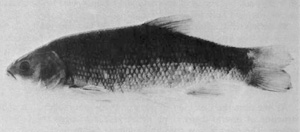
Thicktail Chub
Gila crassicauda
California Department of Fish and Game, Public domain, via Wikimedia Commons

Side by side
| Blue Chub | Thicktail Chub | |
|---|---|---|
| Scientific name | Gila coerulea (Girard, 1856) | Gila crassicauda (Baird & Girard, 1854) |
| English name | Blue Chub | Thicktail Chub |
| Group | Fishes | Fishes |
| Class | Teleostei Teleost | Teleostei Teleost |
| Order | Cypriniformes | Cypriniformes |
| Family | Cyprinidae Carps | Cyprinidae Carps |
| Genus | Gila Western Chubs | Gila Western Chubs |
| Named in | 1856 | 1854 |
| Red List category | Least Concern | Extinct |
| Environment | freshwater | freshwater |
| Countries on record | 1 country | 1 country |
| GBIF occurrence records | 181 records | 55 records |
Rows where the two agree are shown in grey.
Where each is found
Both recorded in 1 country
From Catalogue of Life checklists and GBIF occurrence records. A country missing from a list means no record is held, which is not proof of absence.
Checked facts
| Blue Chub | Thicktail Chub | |
|---|---|---|
| Appearance |
|
|
| Size | No checked fact yet |
|
| Habitat |
|
|
| Diet |
|
|
| Behaviour |
|
|
| Reproduction |
| No checked fact yet |
| Distribution | No checked fact yet |
|
| Conservation |
|
|
| Uses | No checked fact yet |
|
In brief
Blue Chub
Gila coerulea inhabits rocky pools in streams and rocky shorelines of reservoirs and lakes. It has silvery sides, a dark back, and breeding males develop a blue snout and orange fins and flanks. Full profile
Thicktail Chub
Gila crassicauda was native to the Central Valley of California, including the Sacramento and San Joaquin River systems. It had a heavy body, a thick tail, a small cone-shaped head, and yellow sides and belly. Full profile
Compare something else
Page built on 27 November 2026 from the data on the two species pages, where every source is listed.
Cite this page
ScientificNames.org. (2026). Blue Chub vs Thicktail Chub. Retrieved November 27, 2026, from https://scientificnames.org/compare/blue-chub-vs-thicktail-chub
“Blue Chub vs Thicktail Chub.” ScientificNames.org, 2026, scientificnames.org/compare/blue-chub-vs-thicktail-chub. Accessed 27 Nov. 2026.
ScientificNames.org. “Blue Chub vs Thicktail Chub.” Accessed November 27, 2026. https://scientificnames.org/compare/blue-chub-vs-thicktail-chub.
@misc{scientificnames_blue_chub_vs_thicktail_chub,
  author = {{ScientificNames.org}},
  title = {Blue Chub vs Thicktail Chub},
  year = {2026},
  url = {https://scientificnames.org/compare/blue-chub-vs-thicktail-chub},
  note = {Accessed 2026-11-27}
}