Species · Fishes
Blue Chub Gila coerulea
The scientific name of the Blue Chub is Gila coerulea. It is a species of fish in the family Cyprinidae (carps), order Cypriniformes. The name dates from 1856.
- Scientific name
- Gila coerulea (Girard, 1856)
- Common name
- Blue Chub
- Genus
- Gila
- Family
- Cyprinidae (Carps)
- Order
- Cypriniformes
- Class
- Teleostei
- Red List category
- LC Least Concern
- Environment
- freshwater
- Recorded in
- 1 country
- Name status
- accepted in the Catalogue of Life
Overview
Gila coerulea inhabits rocky pools in streams and rocky shorelines of reservoirs and lakes. It has silvery sides, a dark back, and breeding males develop a blue snout and orange fins and flanks.
Written 27 November 2026 from the sources listed below. Each statement was checked against the passage it cites; statements that could not be supported were removed.
Appearance
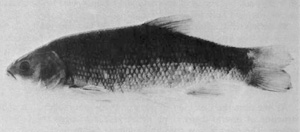
The Blue Chub has a slender, laterally compressed body with silvery sides and a dark back. It has a large eye, a pointed snout, and a terminal mouth extending to the front of the eye.[1][2]
The dorsal fin has 9 soft rays, while the anal fin has 8 or 9 soft rays. Breeding males develop a blue snout, orange fins, and orange flanks.[3][4]
Habitat
The Blue Chub inhabits rocky pools in streams ranging from small streams to large rivers. It also inhabits rocky shorelines of reservoirs and lakes.[5][6]
Diet
The Blue Chub feeds on aquatic insect larvae, water fleas, and filamentous algae.[7]
Behaviour
Blue Chubs can tolerate low concentrations of dissolved oxygen in water and water temperatures reaching 32 °C. They preyed on sucker larvae during laboratory feeding trials.[8][9][10]
Reproduction and life cycle
Blue Chubs spawn in Upper Klamath Lake during May and June, when water temperatures reach 15–18 °C. They deposit their eggs along shorelines consisting of rock, gravel, or rubble.[11][12][13]
Each spawning female is attended by a small number of males.[14]
Conservation
The Blue Chub is classified as Least Concern by the International Union for Conservation of Nature. Water abstraction and introduced non-native invasive species are identified as conservation concerns.[15][16][17]
Classification of the Blue Chub
| Kingdom | Animalia |
|---|---|
| Phylum | Chordata |
| Subphylum | Vertebrata |
| Infraphylum | Gnathostomata |
| Parvphylum | Osteichthyes |
| Gigaclass | Actinopterygii |
| Superclass | Actinopteri |
| Class | Teleostei (Teleost) |
| Order | Cypriniformes |
| Family | Cyprinidae (Carps) |
| Subfamily | Leuciscinae |
| Genus | Gila (Western Chubs) |
| Species | Gila coerulea (Girard, 1856) |
Where the Blue Chub is found
Checklists and occurrence records place Gila coerulea in 1 country. GBIF holds 181 georeferenced records of it.
Countries
Regions and cities with the most records
- Oregon, United States 135
- Klamath Falls, United States 66
- Altamont, United States 43
- California, United States 13
A number beside a place is its count of GBIF occurrence records. A place without a number comes from a checklist alone. Records show where a species has been observed or collected, which can include escapes and vagrants.
Common names
English
- Blue Chub
Names in 2 other languages
- Czech
- gila modravá
- Russian
- Голубая гила
Synonyms
3 other scientific names have been used for this species and are now treated as synonyms of Gila coerulea.
- Cheonda caerulea Girard, 1856
- Cheonda coerulea Girard, 1856
- Klamathella coerulea (Girard, 1856)
Related species
-
 Humpback ChubGila cypha
-
 Bonytail ChubGila elegans
-
 Thicktail ChubGila crassicauda
-
 Utah ChubGila atraria
-
 Roundtail ChubGila robusta
-
 Arroyo ChubGila orcuttii
-
 Rio Grande ChubGila pandora
- Virgin ChubGila seminuda
Compare
Questions and answers
What is the scientific name of the Blue Chub?
The scientific name of the Blue Chub is Gila coerulea. Written with its author, the full name is Gila coerulea (Girard, 1856).
Which family does the Blue Chub belong to?
Gila coerulea belongs to the family Cyprinidae, in the order Cypriniformes and the class Teleostei.
Where is the Blue Chub found?
Checklists and occurrence records place Gila coerulea in 1 country: United States.
What is the conservation status of the Blue Chub?
The IUCN Red List category recorded for Gila coerulea is Least Concern (LC).
Sources
Passages the profile rests on
- The blue chub has a slender, laterally compressed body with silvery sides and a dark back. Source passage: “It has a rather slender, laterally compressed body with a slender caudal peduncle. They have silvery sides with a dark back.” — English Wikipedia
- The species has a large eye, a pointed snout, and a terminal mouth extending to the front of the eye. Source passage: “It has a large eye, a pointed snout with a terminal mouth which extends as far as the front of the eye.” — English Wikipedia
- The dorsal fin has 9 soft rays, while the anal fin has 8 or 9 soft rays. Source passage: “The blue chub has its dorsal fin supported by 9 soft rays while the anal fin contains 8 or 9 soft rays.” — English Wikipedia
- Breeding males develop a blue snout, orange fins, and orange flanks. Source passage: “The males develop a blue snout, orange fins and orange flanks in the breeding season.” — English Wikipedia
- The blue chub inhabits rocky pools in streams ranging from small streams to large rivers. Source passage: “This species prefers rocky habitats in pools of small streams to large rivers” — English Wikipedia
- The species also inhabits rocky shorelines of reservoirs and lakes. Source passage: “and along the rocky shores of reservoirs and lakes.” — English Wikipedia
- The blue chub feeds on aquatic insect larvae, water fleas, and filamentous algae. Source passage: “The blue chub feeds on the aquatic larvae of insects, water fleas, and filamentous algae.” — English Wikipedia
- Blue chubs can tolerate low concentrations of dissolved oxygen in water. Source passage: “They can tolerate low levels of dissolved oxygen” — English Wikipedia
- The species can tolerate water temperatures reaching 32 °C. Source passage: “and water temperatures as high as 32 °C (90 °F).” — English Wikipedia
- Blue chubs preyed on sucker larvae during laboratory feeding trials. Source passage: “Concurrent feeding trials indicate that most predators—yellow perch (Perca flaverscens), fathead minnow (Pimephales promelas), blue chub (Gila coerulea), Klamath tui chub (Siphatales bicolor bicolor), Klamath Lake sculpin (Cottus princeps), slender sculpin (Cottus tenuis)—preyed on sucker larvae in the laboratory.” — pubs.usgs.gov
- Blue chubs spawn in Upper Klamath Lake during May and June. Source passage: “They spawn in Upper Klamath Lake in may and June” — English Wikipedia
- Spawning occurs when water temperatures reach 15–18 °C. Source passage: “when the water temperature reaches 15 to 18 °C (59 to 64 °F)” — English Wikipedia
- Blue chubs deposit their eggs along shorelines consisting of rock, gravel, or rubble. Source passage: “laying eggs along shorelines of rock, gravel or rubble.” — English Wikipedia
- Each spawning female is attended by a small number of males. Source passage: “each spawing female will be attended by a small number of males.” — English Wikipedia
- The species is classified as Least Concern by the International Union for Conservation of Nature. Source passage: “The blue chub is classed as Least-concern by the International Union for Conservation of Nature” — English Wikipedia
- Water abstraction is identified as a conservation concern for the blue chub. Source passage: “although they state that water abstraction” — English Wikipedia
- Introduced non-native invasive species are identified as a conservation concern for the blue chub. Source passage: “and introduced non native invasive species, especially the fathead minnow (Pimephales promelas).” — English Wikipedia
Data
- Catalogue of Life, 2026-10-16 XR cc by
- Global Biodiversity Information Facility CC BY 4.0
- Wikidata CC0
- GeoNames CC BY 4.0
- Within the Catalogue of Life, this name comes from World Register of Marine Species cc by
This species in other databases
- Catalogue of Life 3G2FZ
- Wikidata Q966314
- iNaturalist 101433
- WoRMS urn:lsid:marinespecies.org:taxname:1419418
- ITIS 163548
Page built on 27 November 2026. See how the catalog is made and all sources and licences.
Cite this page
ScientificNames.org. (2026). Gila coerulea (Blue Chub). Retrieved November 27, 2026, from https://scientificnames.org/species/gila-coerulea
“Gila coerulea (Blue Chub).” ScientificNames.org, 2026, scientificnames.org/species/gila-coerulea. Accessed 27 Nov. 2026.
ScientificNames.org. “Gila coerulea (Blue Chub).” Accessed November 27, 2026. https://scientificnames.org/species/gila-coerulea.
@misc{scientificnames_gila_coerulea_blue_chub,
  author = {{ScientificNames.org}},
  title = {Gila coerulea (Blue Chub)},
  year = {2026},
  url = {https://scientificnames.org/species/gila-coerulea},
  note = {Accessed 2026-11-27}
}