Comparison

Headwater Chub vs Thicktail Chub

Headwater Chub (Gila nigra) and Thicktail Chub (Gila crassicauda) both belong to the genus Gila (western chubs) and part ways below it. Both are recorded in 1 country.

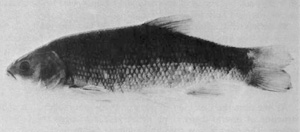
Headwater Chub

Headwater Chub

Gila nigra

U.S. Fish and Wildlife Service, Public domain, via Wikimedia Commons

Thicktail Chub

Thicktail Chub

Gila crassicauda

California Department of Fish and Game, Public domain, via Wikimedia Commons

Side by side

Headwater ChubThicktail Chub
Scientific nameGila nigra Cope, 1875Gila crassicauda (Baird & Girard, 1854)
English nameHeadwater ChubThicktail Chub
GroupFishesFishes
ClassTeleostei TeleostTeleostei Teleost
OrderCypriniformesCypriniformes
FamilyCyprinidae CarpsCyprinidae Carps
GenusGila Western ChubsGila Western Chubs
Named in18751854
Red List categoryNear ThreatenedExtinct
Environmentfreshwaterfreshwater
Countries on record1 country1 country
GBIF occurrence records155 records55 records

Rows where the two agree are shown in grey.

Where each is found

Both recorded in 1 country

From Catalogue of Life checklists and GBIF occurrence records. A country missing from a list means no record is held, which is not proof of absence.

Checked facts

Headwater ChubThicktail Chub
Appearance
  • The headwater chub has a thick, chunky to streamlined body that is not markedly attenuate. English Wikipedia
  • The upper body is dark olive-gray or brown, the sides are silver, and the underside is white. English Wikipedia
  • Its longitudinal stripes are often diffuse, and dark dorsal-lateral blotches are uncommon. English Wikipedia
  • The headwater chub lacks an adipose fin despite having a somewhat trout-like appearance. English Wikipedia
  • Its caudal peduncle is shorter than its head and is not pencil-like. English Wikipedia
  • Its scales cover the entire body and have variable basal radii. English Wikipedia
  • The species has 73–83 lateral scales. English Wikipedia
  • Its dorsal and anal fins usually have eight rays each, with seven or nine occurring rarely. English Wikipedia
  • The thicktail chub had a heavy body, a thick tail, and a small, cone-shaped head. English Wikipedia
  • The thicktail chub's back ranged in color from greenish brown to purplish black. English Wikipedia
  • The thicktail chub had yellow sides and a yellow belly. English Wikipedia
Size
  • Male headwater chubs reach a maximum reported length of approximately 50 cm. English Wikipedia
  • Female headwater chubs measure approximately 10–18 cm in total length. English Wikipedia
Habitat
  • Adult headwater chubs inhabit cool to warm water in middle and headwater sections of medium-sized streams. English Wikipedia
  • Adults are associated with deep nearshore pools adjacent to swift riffles and runs. English Wikipedia
  • Adult habitat cover includes root wads, boulders, undercut banks, submerged organic debris, and deep water. English Wikipedia
  • In Fossil Creek, headwater chubs were recorded in water deeper than 1.8 m with current velocities below 0.10 m/s. English Wikipedia
  • The species is associated with gravel, small boulders, and large in-stream objects as substrates. English Wikipedia
  • The preferred water temperature range is approximately 20–27 °C. English Wikipedia
  • The reported minimum water temperature associated with the species is approximately 7 °C. English Wikipedia
  • Juveniles occupy shallow, low-velocity habitats with overhead cover. English Wikipedia
  • In Fossil Creek, juveniles were reported at depths of approximately 0.9–1.5 m, velocities of 0.15 m/s, and sandy substrates. English Wikipedia
  • The thicktail chub inhabited lowlands and weedy backwaters of the Sacramento and San Joaquin Rivers in California's Central Valley. English Wikipedia
  • The thicktail chub inhabited lowland lakes, marshes, ponds, and slow-moving river stretches. English Wikipedia
  • During years of heavy runoff, the thicktail chub also inhabited surface waters of San Francisco Bay. English Wikipedia
DietNo checked fact yet
  • The thicktail chub was probably carnivorous and fed on small fish and invertebrates. English Wikipedia
Behaviour
  • The species grows rapidly, although its growth depends on water temperature. English Wikipedia
Lifespan
  • The reported lifespan of the headwater chub is approximately 8–10 years. English Wikipedia
No checked fact yet
Distribution
  • The headwater chub is endemic to the Gila River basin in Arizona and New Mexico. English Wikipedia
  • The species occupies middle and headwater reaches of medium-sized streams within its native basin. English Wikipedia
  • The thicktail chub was native to the Central Valley of California, including the Sacramento and San Joaquin River systems. English Wikipedia
Conservation
  • Reductions in the species' range and population numbers are considered likely consequences of habitat loss. English Wikipedia
  • Competition with and predation by non-native fish are identified as likely contributors to population declines. English Wikipedia
  • Aquifer pumping is identified as a threat to the headwater chub. English Wikipedia
  • Stream diversion and reductions in stream flows are identified as threats to the species. English Wikipedia
  • Predation by and competition with non-native fishes are listed as threats. English Wikipedia
  • Recommended management needs include protecting watersheds and stream flows. English Wikipedia
  • Research into the mechanisms responsible for population disappearance is identified as a management need. English Wikipedia
  • Management recommendations include reducing the effects of harmful non-native fishes. English Wikipedia
  • The thicktail chub became extinct, with its last known specimen caught on April 16, 1957. English Wikipedia
  • Agricultural conversion of the Central Valley was identified as the primary cause of the thicktail chub's extinction. English Wikipedia
  • Drainage of sloughs and marshes, dam construction, and irrigation-related water diversion destroyed much of the thicktail chub's habitat. English Wikipedia
  • Competition from exotic species contributed to the extinction of the thicktail chub. English Wikipedia
UsesNo checked fact yet
  • The thicktail chub was a favored food of Indigenous peoples living around Clear Lake and in the Central Valley. English Wikipedia
  • The thicktail chub was commercially exploited by fishermen supplying the San Francisco market. English Wikipedia
  • The thicktail chub represented 40% of fish remains in Native American middens. English Wikipedia
Similar species
  • The humpback chub and bonytail chub are identified as similar species. English Wikipedia
  • The headwater chub is described as morphologically intermediate between the roundtail chub and Gila chub. English Wikipedia
No checked fact yet

In brief

Headwater Chub

Gila nigra is endemic to the Gila River basin in Arizona and New Mexico, where it occupies middle and headwater reaches of medium-sized streams. It has a thick, chunky to streamlined body, dark olive-gray or brown upper body, silver sides, and white underside, and lacks an adipose fin. Full profile

Thicktail Chub

Gila crassicauda was native to the Central Valley of California, including the Sacramento and San Joaquin River systems. It had a heavy body, a thick tail, a small cone-shaped head, and yellow sides and belly. Full profile

Compare something else

Page built on 28 November 2026 from the data on the two species pages, where every source is listed.

Cite this page

ScientificNames.org. (2026). Headwater Chub vs Thicktail Chub. Retrieved November 28, 2026, from https://scientificnames.org/compare/headwater-chub-vs-thicktail-chub