Species · Fishes
Headwater Chub Gila nigra
The scientific name of the Headwater Chub is Gila nigra. It is a species of fish in the family Cyprinidae (carps), order Cypriniformes. The name dates from 1875.
- Scientific name
- Gila nigra Cope, 1875
- Common name
- Headwater Chub
- Genus
- Gila
- Family
- Cyprinidae (Carps)
- Order
- Cypriniformes
- Class
- Teleostei
- Red List category
- NT Near Threatened
- Environment
- freshwater
- Recorded in
- 1 country
- Name status
- accepted in the Catalogue of Life

Overview
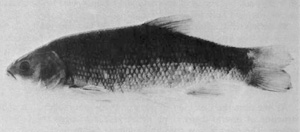
Gila nigra is endemic to the Gila River basin in Arizona and New Mexico, where it occupies middle and headwater reaches of medium-sized streams. It has a thick, chunky to streamlined body, dark olive-gray or brown upper body, silver sides, and white underside, and lacks an adipose fin.
Written 27 November 2026 from the sources listed below. Each statement was checked against the passage it cites; statements that could not be supported were removed.
Appearance
The Headwater Chub has a thick, chunky to streamlined body that is not markedly attenuate. Its upper body is dark olive-gray or brown, its sides are silver, and its underside is white. Longitudinal stripes are often diffuse, and dark dorsal-lateral blotches are uncommon.[1][2][3]
Despite its somewhat trout-like appearance, the species lacks an adipose fin. Its caudal peduncle is shorter than its head and is not pencil-like.[4][5]
Scales cover the entire body and have variable basal radii. The species has 73–83 lateral scales, and its dorsal and anal fins usually have eight rays each, with seven or nine occurring rarely.[6][7][8]
Male Headwater Chubs reach a maximum reported length of approximately 50 cm. Females measure approximately 10–18 cm in total length.[9][10]
Habitat
Adult Headwater Chubs inhabit cool to warm water in middle and headwater sections of medium-sized streams. They are associated with deep nearshore pools adjacent to swift riffles and runs.[11][12]
Adult habitat cover includes root wads, boulders, undercut banks, submerged organic debris, and deep water. The species is associated with gravel, small boulders, and large in-stream objects as substrates.[13][14]
The preferred water temperature range is approximately 20–27 °C. The reported minimum water temperature associated with the species is approximately 7 °C.[15][16]
In Fossil Creek, Headwater Chubs were recorded in water deeper than 1.8 m with current velocities below 0.10 m/s.[17]
Juveniles occupy shallow, low-velocity habitats with overhead cover. In Fossil Creek, juveniles were reported at depths of approximately 0.9–1.5 m, velocities of 0.15 m/s, and sandy substrates.[18][19]
Behaviour
The species grows rapidly, although its growth depends on water temperature. Its reported lifespan is approximately 8–10 years.[20][21]
Similar species
The humpback chub and bonytail chub are identified as similar species. The Headwater Chub is morphologically intermediate between the roundtail chub and Gila chub.[22][23]
Conservation
Habitat loss is considered a likely cause of reductions in the species' range and population numbers. Competition with and predation by non-native fish are identified as likely contributors to population declines.[24][25]
Aquifer pumping, stream diversion, and reductions in stream flows are identified as threats to the Headwater Chub. Predation by and competition with non-native fishes are also listed as threats.[26][27][28]
Recommended management needs include protecting watersheds and stream flows, researching the mechanisms responsible for population disappearance, and reducing the effects of harmful non-native fishes.[29][30][31]
Classification of the Headwater Chub
| Kingdom | Animalia |
|---|---|
| Phylum | Chordata |
| Subphylum | Vertebrata |
| Infraphylum | Gnathostomata |
| Parvphylum | Osteichthyes |
| Gigaclass | Actinopterygii |
| Superclass | Actinopteri |
| Class | Teleostei (Teleost) |
| Order | Cypriniformes |
| Family | Cyprinidae (Carps) |
| Subfamily | Leuciscinae |
| Genus | Gila (Western Chubs) |
| Species | Gila nigra Cope, 1875 |
Where the Headwater Chub is found
Checklists and occurrence records place Gila nigra in 1 country. GBIF holds 155 georeferenced records of it.
Countries
Regions and cities with the most records
A number beside a place is its count of GBIF occurrence records. A place without a number comes from a checklist alone. Records show where a species has been observed or collected, which can include escapes and vagrants.
Common names
English
- Headwater Chub
Related species
-
 Humpback ChubGila cypha
-
 Bonytail ChubGila elegans
-
 Thicktail ChubGila crassicauda
-
 Utah ChubGila atraria
-
 Roundtail ChubGila robusta
-
 Arroyo ChubGila orcuttii
-
 Rio Grande ChubGila pandora
- Virgin ChubGila seminuda
Compare
Questions and answers
What is the scientific name of the Headwater Chub?
The scientific name of the Headwater Chub is Gila nigra. Written with its author, the full name is Gila nigra Cope, 1875.
Which family does the Headwater Chub belong to?
Gila nigra belongs to the family Cyprinidae, in the order Cypriniformes and the class Teleostei.
Where is the Headwater Chub found?
Checklists and occurrence records place Gila nigra in 1 country: United States.
What is the conservation status of the Headwater Chub?
The IUCN Red List category recorded for Gila nigra is Near Threatened (NT).
Sources
Passages the profile rests on
- The headwater chub has a thick, chunky to streamlined body that is not markedly attenuate. Source passage: “The body of the headwater chub is thick and chunky to streamlined but not markedly attenuate.” — English Wikipedia
- The upper body is dark olive-gray or brown, the sides are silver, and the underside is white. Source passage: “The coloration of the fish is dark olive-gray or brown above, with a silver side, and white below.” — English Wikipedia
- Its longitudinal stripes are often diffuse, and dark dorsal-lateral blotches are uncommon. Source passage: “The longitudinal stripes are often diffuse, and are rarely with dark dorsal-lateral blotches.” — English Wikipedia
- The headwater chub lacks an adipose fin despite having a somewhat trout-like appearance. Source passage: “Gila nigra are somewhat trout-like in appearance, except they lack an adipose fin.” — English Wikipedia
- Its caudal peduncle is shorter than its head and is not pencil-like. Source passage: “The caudal peduncle is not pencil-like, its length is less than its head length;” — English Wikipedia
- Its scales cover the entire body and have variable basal radii. Source passage: “Scales are developed and cover the entire body, with the basal radii variable.” — English Wikipedia
- The species has 73–83 lateral scales. Source passage: “There are 73-83 lateral scales,” — English Wikipedia
- Its dorsal and anal fins usually have eight rays each, with seven or nine occurring rarely. Source passage: “with usually 8 dorsal and anal fin rays, and rarely 7 or 9 fin rays.” — English Wikipedia
- Male headwater chubs reach a maximum reported length of approximately 50 cm. Source passage: “The maximum size of the male fish is about 50 cm” — English Wikipedia
- Female headwater chubs measure approximately 10–18 cm in total length. Source passage: “females are about 10–18 cm total length.” — English Wikipedia
- Adult headwater chubs inhabit cool to warm water in middle and headwater sections of medium-sized streams. Source passage: “Adult headwater chub occupy cool to warm water in mid- to headwater stretches of mid-sized streams of the Gila River basin.” — English Wikipedia
- Adults are associated with deep nearshore pools adjacent to swift riffles and runs. Source passage: “They are associated with deep, near shore pools adjacent to swift riffles and runs, and near obstructions.” — English Wikipedia
- Adult habitat cover includes root wads, boulders, undercut banks, submerged organic debris, and deep water. Source passage: “Cover consists of root wads, boulders, undercut banks, submerged organic debris, or deep water.” — English Wikipedia
- The species is associated with gravel, small boulders, and large in-stream objects as substrates. Source passage: “Substrates they are associated with include gravel, small boulders, and large in-stream objects.” — English Wikipedia
- The preferred water temperature range is approximately 20–27 °C. Source passage: “Preferred water temperature ranges of 20-27 °C” — English Wikipedia
- The reported minimum water temperature associated with the species is approximately 7 °C. Source passage: “with a minimum temperature around 7 °C.” — English Wikipedia
- In Fossil Creek, headwater chubs were recorded in water deeper than 1.8 m with current velocities below 0.10 m/s. Source passage: “In Fossil Creek, they were found in water more than 1.8 m deep with velocities under 0.10 meters per second.” — English Wikipedia
- Juveniles occupy shallow, low-velocity habitats with overhead cover. Source passage: “Juveniles are associated with shallow, low velocity habitat with overhead cover.” — English Wikipedia
- In Fossil Creek, juveniles were reported at depths of approximately 0.9–1.5 m, velocities of 0.15 m/s, and sandy substrates. Source passage: “In Fossil Creek, headwater chub seem to select depths between 0.9 and 1.5 m and velocities of 0.15 meters per second and are found over sand substrate.” — English Wikipedia
- The reported lifespan of the headwater chub is approximately 8–10 years. Source passage: “The headwater chub life span is 8–10 years.” — English Wikipedia
- The species grows rapidly, although its growth depends on water temperature. Source passage: “They grow rapidly but growth is dependent on water temperature.” — English Wikipedia
- The humpback chub and bonytail chub are identified as similar species. Source passage: “Similar species include the humpback chub (Gila cypha) and bonytail chub (G. elegans),” — English Wikipedia
- The headwater chub is described as morphologically intermediate between the roundtail chub and Gila chub. Source passage: “they are morphologically intermediate between the roundtail chub (Gila robusta) and the Gila chub (Gila intermedia).” — English Wikipedia
- Reductions in the species' range and population numbers are considered likely consequences of habitat loss. Source passage: “reductions in range and numbers are likely the result of habitat loss,” — English Wikipedia
- Competition with and predation by non-native fish are identified as likely contributors to population declines. Source passage: “as well as competition with, and predation by, non-native fish species.” — English Wikipedia
- Aquifer pumping is identified as a threat to the headwater chub. Source passage: “Threats: aquifer pumping;” — English Wikipedia
- Stream diversion and reductions in stream flows are identified as threats to the species. Source passage: “stream diversion; reduction in stream flows;” — English Wikipedia
- Predation by and competition with non-native fishes are listed as threats. Source passage: “predation by and competition with nonnative fishes.” — English Wikipedia
- Recommended management needs include protecting watersheds and stream flows. Source passage: “Management needs: watershed and stream flow protection;” — English Wikipedia
- Research into the mechanisms responsible for population disappearance is identified as a management need. Source passage: “research to determine mechanisms of disappearance;” — English Wikipedia
- Management recommendations include reducing the effects of harmful non-native fishes. Source passage: “ameliorate effects of deleterious nonnative fishes.” — English Wikipedia
Data
- Catalogue of Life, 2026-10-16 XR cc by
- Global Biodiversity Information Facility CC BY 4.0
- Wikidata CC0
- GeoNames CC BY 4.0
- Wikimedia Commons per image; credit shown with each image
- Within the Catalogue of Life, this name comes from World Register of Marine Species cc by
References
- Cope, E. D., & Yarrow, H. C. (1875). Report upon the collections of fishes made in portions of Nevada, Utah, California, Colorado, New Mexico, and Arizona, during the years 1871, 1872, 1873, and 1874. Engineer Department, United States Army, Report upon the Geographical and Geological Explorations and Surveys West of the One Hundredth Meridian, v. 5 (Zoology) Chapter 6: 635–703, Pls. 26–32. https://doi.org/10.5962/bhl.title.13592 Link where the name was published
This species in other databases
- Catalogue of Life 3G2GR
- Wikidata Q3767742
- WoRMS urn:lsid:marinespecies.org:taxname:1020328
- ITIS 163558-689138
Page built on 28 November 2026. See how the catalog is made and all sources and licences.
Cite this page
ScientificNames.org. (2026). Gila nigra (Headwater Chub). Retrieved November 28, 2026, from https://scientificnames.org/species/gila-nigra
“Gila nigra (Headwater Chub).” ScientificNames.org, 2026, scientificnames.org/species/gila-nigra. Accessed 28 Nov. 2026.
ScientificNames.org. “Gila nigra (Headwater Chub).” Accessed November 28, 2026. https://scientificnames.org/species/gila-nigra.
@misc{scientificnames_gila_nigra_headwater_chub,
  author = {{ScientificNames.org}},
  title = {Gila nigra (Headwater Chub)},
  year = {2026},
  url = {https://scientificnames.org/species/gila-nigra},
  note = {Accessed 2026-11-28}
}