Comparison

Rio Grande Chub vs Thicktail Chub

Rio Grande Chub (Gila pandora) and Thicktail Chub (Gila crassicauda) both belong to the genus Gila (western chubs) and part ways below it. Both are recorded in 1 country.

Rio Grande Chub

Rio Grande Chub

Gila pandora

USFWS Mountain-Prairie, Public domain, via Wikimedia Commons

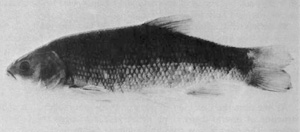
Thicktail Chub

Thicktail Chub

Gila crassicauda

California Department of Fish and Game, Public domain, via Wikimedia Commons

Side by side

Rio Grande ChubThicktail Chub
Scientific nameGila pandora (Cope, 1872)Gila crassicauda (Baird & Girard, 1854)
English nameRio Grande ChubThicktail Chub
GroupFishesFishes
ClassTeleostei TeleostTeleostei Teleost
OrderCypriniformesCypriniformes
FamilyCyprinidae CarpsCyprinidae Carps
GenusGila Western ChubsGila Western Chubs
Named in18721854
Red List categoryLeast ConcernExtinct
Environmentfreshwaterfreshwater
Countries on record2 countries1 country
GBIF occurrence records1,715 records55 records

Rows where the two agree are shown in grey.

Where each is found

Both recorded in 1 country

Only Rio Grande Chub (1)

From Catalogue of Life checklists and GBIF occurrence records. A country missing from a list means no record is held, which is not proof of absence.

Checked facts

Rio Grande ChubThicktail Chub
Appearance
  • The Rio Grande chub has large eyes, an elongated head, and a forked tail. English Wikipedia
  • Its dorsal surface is dark, while its underside is light, with coloration gradually becoming lighter toward the ventral side. English Wikipedia
  • The species has two faint black longitudinal lines, one above and one below its lateral line. English Wikipedia
  • The lateral line contains between 51 and 67 scales. English Wikipedia
  • Both the dorsal and anal fins have eight rays. English Wikipedia
  • The thicktail chub had a heavy body, a thick tail, and a small, cone-shaped head. English Wikipedia
  • The thicktail chub's back ranged in color from greenish brown to purplish black. English Wikipedia
  • The thicktail chub had yellow sides and a yellow belly. English Wikipedia
Size
  • Adults can reach 30 cm in length, although they are typically smaller. English Wikipedia
  • Rio Grande chubs in Colorado are usually approximately 13 cm long. English Wikipedia
Habitat
  • The species inhabits small streams, rivers, headwaters, and flowing pools. English Wikipedia
  • The species has also been recorded in small lakes and ponds. English Wikipedia
  • The Rio Grande chub occasionally inhabits irrigation ditches, canals, and stock ponds. English Wikipedia
  • The species prefers cool, flowing water. English Wikipedia
  • Suitable habitat includes cover provided by undercut banks, overhanging vegetation, woody material, and aquatic vegetation. English Wikipedia
  • The species shows a preference for habitats with sand, gravel, cobble, or combinations of these substrate types. English Wikipedia
  • Rio Grande chubs occur at elevations between 7,580 and 8,400 feet. English Wikipedia
  • The species occupies depths between 12 and 69 inches in the water column. English Wikipedia
  • The thicktail chub inhabited lowlands and weedy backwaters of the Sacramento and San Joaquin Rivers in California's Central Valley. English Wikipedia
  • The thicktail chub inhabited lowland lakes, marshes, ponds, and slow-moving river stretches. English Wikipedia
  • During years of heavy runoff, the thicktail chub also inhabited surface waters of San Francisco Bay. English Wikipedia
Diet
  • The Rio Grande chub feeds on zooplankton, insects, crustaceans, and juvenile fish. English Wikipedia
  • The species also consumes limited amounts of vegetation and detritus. English Wikipedia
  • Rio Grande chubs have greater predation success against larvae with smaller cases. English Wikipedia
  • The thicktail chub was probably carnivorous and fed on small fish and invertebrates. English Wikipedia
Behaviour
  • The species has both carnivorous and omnivorous feeding characteristics. English Wikipedia
Reproduction
  • Gravel and cobble substrates are required by the species for spawning. English Wikipedia
No checked fact yet
Distribution
  • The Rio Grande chub is endemic to the United States. English Wikipedia
  • Its native range includes the upper Rio Grande and Pecos River systems in Colorado, New Mexico, and Texas. English Wikipedia
  • Genetic diversity research examined 15 populations across the Rio Grande, Pecos, and Canadian drainage basins in New Mexico. usgs.gov
  • The Rio Ojo Caliente population had the highest recorded allelic richness, at 15.09. usgs.gov
  • The Upper Rio Bonito population had the lowest recorded allelic richness, at 6.75. usgs.gov
  • Genetic differentiation was detected among all populations examined. usgs.gov
  • Seven genetic clusters were identified among the studied populations. usgs.gov
  • The thicktail chub was native to the Central Valley of California, including the Sacramento and San Joaquin River systems. English Wikipedia
Conservation
  • The species is listed as sensitive by the US Forest Service. English Wikipedia
  • The Bureau of Land Management also lists the Rio Grande chub as a sensitive species. English Wikipedia
  • The species is designated a Colorado species of concern and a tier 1 species of greatest conservation need. English Wikipedia
  • The Rio Grande chub has experienced an estimated 75 percent decline in overall population numbers. English Wikipedia
  • Introduced brook trout and brown trout compete with the Rio Grande chub and prey upon it. English Wikipedia
  • Effective breeder numbers ranged from 6.1 in Upper Rio Bonito to 109.7 in Rio Peñasco. usgs.gov
  • Genetic diversity conservation planning should consider which populations are selected for translocation. usgs.gov
  • The thicktail chub became extinct, with its last known specimen caught on April 16, 1957. English Wikipedia
  • Agricultural conversion of the Central Valley was identified as the primary cause of the thicktail chub's extinction. English Wikipedia
  • Drainage of sloughs and marshes, dam construction, and irrigation-related water diversion destroyed much of the thicktail chub's habitat. English Wikipedia
  • Competition from exotic species contributed to the extinction of the thicktail chub. English Wikipedia
UsesNo checked fact yet
  • The thicktail chub was a favored food of Indigenous peoples living around Clear Lake and in the Central Valley. English Wikipedia
  • The thicktail chub was commercially exploited by fishermen supplying the San Francisco market. English Wikipedia
  • The thicktail chub represented 40% of fish remains in Native American middens. English Wikipedia
Similar species
  • The Rio Grande chub can naturally hybridize with the longnose dace (Rhinichthys cataractae). English Wikipedia
No checked fact yet

In brief

Rio Grande Chub

The native range includes the upper Rio Grande and Pecos River systems in Colorado, New Mexico, and Texas. The Rio Grande Chub has large eyes, an elongated head, a forked tail, and two faint black longitudinal lines. Full profile

Thicktail Chub

Gila crassicauda was native to the Central Valley of California, including the Sacramento and San Joaquin River systems. It had a heavy body, a thick tail, a small cone-shaped head, and yellow sides and belly. Full profile

Compare something else

Page built on 28 November 2026 from the data on the two species pages, where every source is listed.

Cite this page

ScientificNames.org. (2026). Rio Grande Chub vs Thicktail Chub. Retrieved November 28, 2026, from https://scientificnames.org/compare/rio-grande-chub-vs-thicktail-chub